

demonstrates tremendous potential for direct contact membrane distillation desalination application (Tijing et al. 2016). Carbon nanotubes are used as nanofillers in
nanofiber membrane to exhibit additional mechanical and hydrophobic properties
(Tijing et al. 2016). Different strategies have been developed for the synthesis of
nanofibers, ranging from current methods including self-assembly, polymerization,
electrospinning, and template-based synthesis to emerging techniques like electrohydrodynamic writing, solution blow spinning, and centrifugal jet spinning (Lim
2017). Of all current strategies, electrospinning is widely employed for synthesizing
one-dimensional nanofiber (Huang et al. 2004). Several variations in conventional
electrospinning technique have been employed in order to enhance the productivity.
Such variations resulted in needleless, multineedle, and coaxial electrospinning
techniques. The needleless and multineedle electrospinning techniques are generally
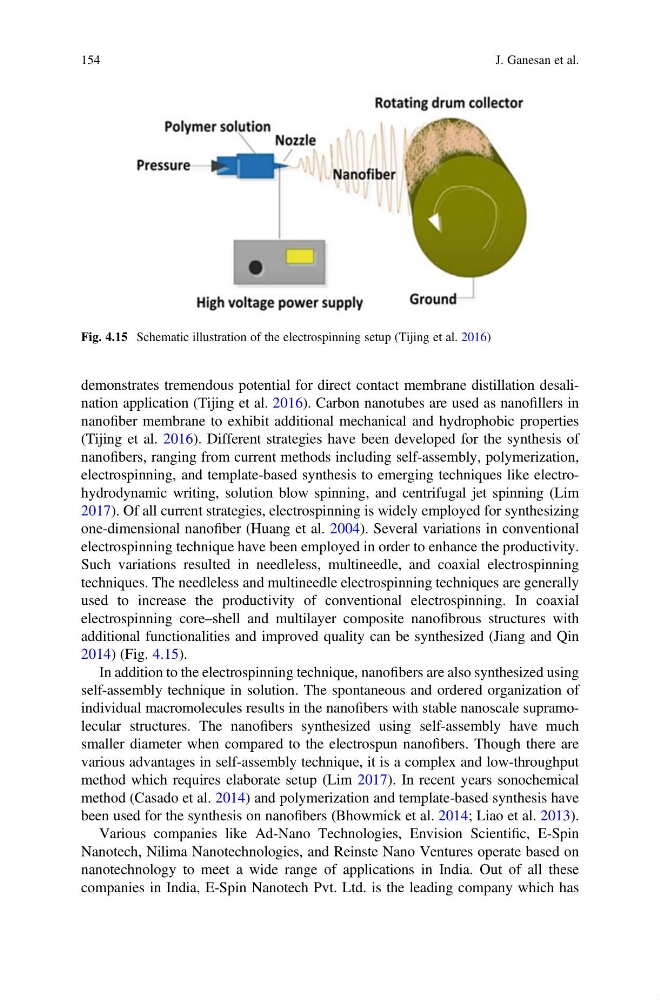
used to increase the productivity of conventional electrospinning. In coaxial
electrospinning core–shell and multilayer composite nanofibrous structures with
additional functionalities and improved quality can be synthesized (Jiang and Qin
2014) (Fig. 4.15).
In addition to the electrospinning technique, nanofibers are also synthesized using
self-assembly technique in solution. The spontaneous and ordered organization of
individual macromolecules results in the nanofibers with stable nanoscale supramolecular structures. The nanofibers synthesized using self-assembly have much
smaller diameter when compared to the electrospun nanofibers. Though there are
various advantages in self-assembly technique, it is a complex and low-throughput
method which requires elaborate setup (Lim 2017). In recent years sonochemical
method (Casado et al. 2014) and polymerization and template-based synthesis have
been used for the synthesis on nanofibers (Bhowmick et al. 2014; Liao et al. 2013).
Various companies like Ad-Nano Technologies, Envision Scientific, E-Spin
Nanotech, Nilima Nanotechnologies, and Reinste Nano Ventures operate based on
nanotechnology to meet a wide range of applications in India. Out of all these
companies in India, E-Spin Nanotech Pvt. Ltd. is the leading company which has
Fig. 4.15 Schematic illustration of the electrospinning setup (Tijing et al. 2016)
154
J. Ganesan et al.
nanofiber membrane to exhibit additional mechanical and hydrophobic properties
(Tijing et al. 2016). Different strategies have been developed for the synthesis of
nanofibers, ranging from current methods including self-assembly, polymerization,
electrospinning, and template-based synthesis to emerging techniques like electrohydrodynamic writing, solution blow spinning, and centrifugal jet spinning (Lim
2017). Of all current strategies, electrospinning is widely employed for synthesizing
one-dimensional nanofiber (Huang et al. 2004). Several variations in conventional
electrospinning technique have been employed in order to enhance the productivity.
Such variations resulted in needleless, multineedle, and coaxial electrospinning
techniques. The needleless and multineedle electrospinning techniques are generally
used to increase the productivity of conventional electrospinning. In coaxial
electrospinning core–shell and multilayer composite nanofibrous structures with
additional functionalities and improved quality can be synthesized (Jiang and Qin
2014) (Fig. 4.15).
In addition to the electrospinning technique, nanofibers are also synthesized using
self-assembly technique in solution. The spontaneous and ordered organization of
individual macromolecules results in the nanofibers with stable nanoscale supramolecular structures. The nanofibers synthesized using self-assembly have much
smaller diameter when compared to the electrospun nanofibers. Though there are
various advantages in self-assembly technique, it is a complex and low-throughput
method which requires elaborate setup (Lim 2017). In recent years sonochemical
method (Casado et al. 2014) and polymerization and template-based synthesis have
been used for the synthesis on nanofibers (Bhowmick et al. 2014; Liao et al. 2013).
Various companies like Ad-Nano Technologies, Envision Scientific, E-Spin
Nanotech, Nilima Nanotechnologies, and Reinste Nano Ventures operate based on
nanotechnology to meet a wide range of applications in India. Out of all these
companies in India, E-Spin Nanotech Pvt. Ltd. is the leading company which has
Fig. 4.15 Schematic illustration of the electrospinning setup (Tijing et al. 2016)
154
J. Ganesan et al.