

automated analysis, low cost, and no requirement of skilled personnel. On the other
side, enhanced sensitivity and their improved stability allow long-term use. Because
of the ease of use of these devices, many commercial systems continue to develop
not only for aflatoxins but also for all mycotoxins (Eldin et al. 2014).
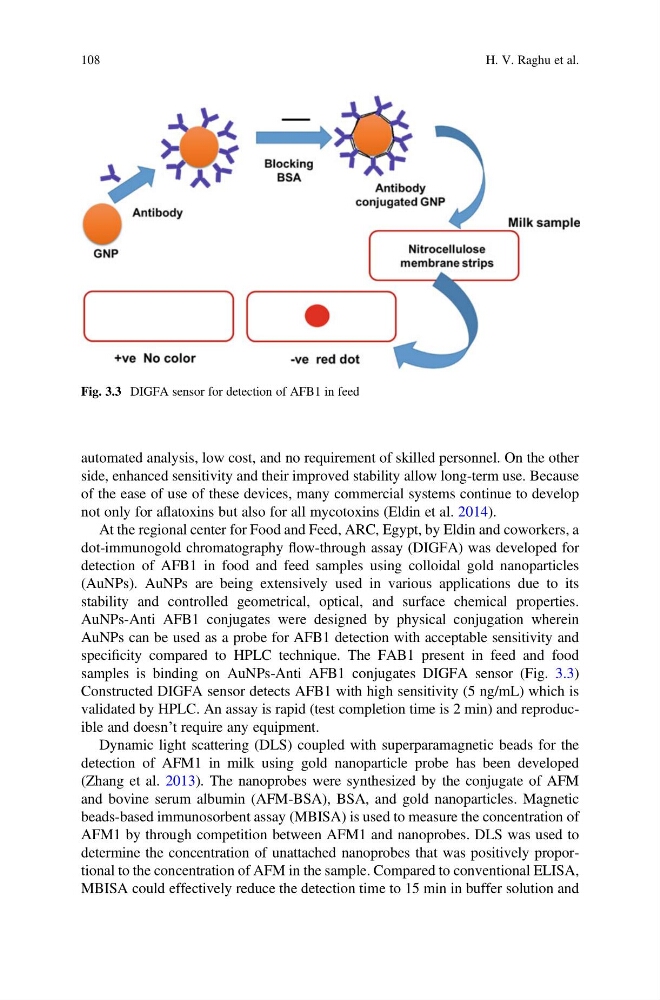
At the regional center for Food and Feed, ARC, Egypt, by Eldin and coworkers, a
dot-immunogold chromatography flow-through assay (DIGFA) was developed for
detection of AFB1 in food and feed samples using colloidal gold nanoparticles
(AuNPs). AuNPs are being extensively used in various applications due to its
stability and controlled geometrical, optical, and surface chemical properties.
AuNPs-Anti AFB1 conjugates were designed by physical conjugation wherein
AuNPs can be used as a probe for AFB1 detection with acceptable sensitivity and
specificity compared to HPLC technique. The FAB1 present in feed and food
samples is binding on AuNPs-Anti AFB1 conjugates DIGFA sensor (Fig. 3.3)
Constructed DIGFA sensor detects AFB1 with high sensitivity (5 ng/mL) which is
validated by HPLC. An assay is rapid (test completion time is 2 min) and reproducible and doesn’t require any equipment.
Dynamic light scattering (DLS) coupled with superparamagnetic beads for the
detection of AFM1 in milk using gold nanoparticle probe has been developed
(Zhang et al. 2013). The nanoprobes were synthesized by the conjugate of AFM
and bovine serum albumin (AFM-BSA), BSA, and gold nanoparticles. Magnetic
beads-based immunosorbent assay (MBISA) is used to measure the concentration of
AFM1 by through competition between AFM1 and nanoprobes. DLS was used to
determine the concentration of unattached nanoprobes that was positively proportional to the concentration of AFM in the sample. Compared to conventional ELISA,
MBISA could effectively reduce the detection time to 15 min in buffer solution and
Fig. 3.3 DIGFA sensor for detection of AFB1 in feed
108
H. V. Raghu et al.
side, enhanced sensitivity and their improved stability allow long-term use. Because
of the ease of use of these devices, many commercial systems continue to develop
not only for aflatoxins but also for all mycotoxins (Eldin et al. 2014).
At the regional center for Food and Feed, ARC, Egypt, by Eldin and coworkers, a
dot-immunogold chromatography flow-through assay (DIGFA) was developed for
detection of AFB1 in food and feed samples using colloidal gold nanoparticles
(AuNPs). AuNPs are being extensively used in various applications due to its
stability and controlled geometrical, optical, and surface chemical properties.
AuNPs-Anti AFB1 conjugates were designed by physical conjugation wherein
AuNPs can be used as a probe for AFB1 detection with acceptable sensitivity and
specificity compared to HPLC technique. The FAB1 present in feed and food
samples is binding on AuNPs-Anti AFB1 conjugates DIGFA sensor (Fig. 3.3)
Constructed DIGFA sensor detects AFB1 with high sensitivity (5 ng/mL) which is
validated by HPLC. An assay is rapid (test completion time is 2 min) and reproducible and doesn’t require any equipment.
Dynamic light scattering (DLS) coupled with superparamagnetic beads for the
detection of AFM1 in milk using gold nanoparticle probe has been developed
(Zhang et al. 2013). The nanoprobes were synthesized by the conjugate of AFM
and bovine serum albumin (AFM-BSA), BSA, and gold nanoparticles. Magnetic
beads-based immunosorbent assay (MBISA) is used to measure the concentration of
AFM1 by through competition between AFM1 and nanoprobes. DLS was used to
determine the concentration of unattached nanoprobes that was positively proportional to the concentration of AFM in the sample. Compared to conventional ELISA,
MBISA could effectively reduce the detection time to 15 min in buffer solution and
Fig. 3.3 DIGFA sensor for detection of AFB1 in feed
108
H. V. Raghu et al.