

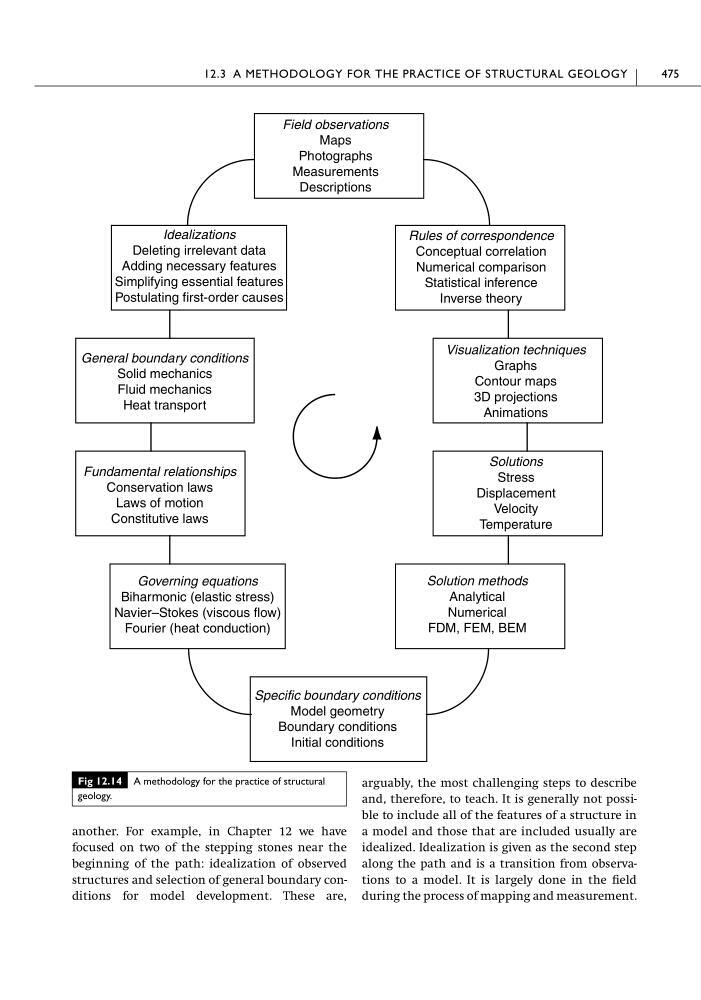
another. For example, in Chapter 12 we have
focused on two of the stepping stones near the
beginning of the path: idealization of observed
structures and selection of general boundary conditions for model development. These are,
arguably, the most challenging steps to describe
and, therefore, to teach. It is generally not possible to include all of the features of a structure in
a model and those that are included usually are
idealized. Idealization is given as the second step
along the path and is a transition from observations to a model. It is largely done in the field
during the process of mapping and measurement.
12.3 A METHODOLOGY FOR THE PRACTICE OF STRUCTURAL GEOLOGY
475
Fig 12.14 A methodology for the practice of structural
geology.
Field observations
Maps
Photographs
Measurements
Descriptions
General boundary conditions
Solid mechanics
Fluid mechanics
Heat transport
Governing equations
Biharmonic (elastic stress)
Navier–Stokes (viscous flow)
Fourier (heat conduction)
Fundamental relationships
Conservation laws
Laws of motion
Constitutive laws
Specific boundary conditions
Model geometry
Boundary conditions
Initial conditions
Solutions
Stress
Displacement
Velocity
Temperature
Idealizations
Deleting irrelevant data
Adding necessary features
Simplifying essential features
Postulating first-order causes
Solution methods
Analytical
Numerical
FDM, FEM, BEM
Visualization techniques
Graphs
Contour maps
3D projections
Animations
Rules of correspondence
Conceptual correlation
Numerical comparison
Statistical inference
Inverse theory
focused on two of the stepping stones near the
beginning of the path: idealization of observed
structures and selection of general boundary conditions for model development. These are,
arguably, the most challenging steps to describe
and, therefore, to teach. It is generally not possible to include all of the features of a structure in
a model and those that are included usually are
idealized. Idealization is given as the second step
along the path and is a transition from observations to a model. It is largely done in the field
during the process of mapping and measurement.
12.3 A METHODOLOGY FOR THE PRACTICE OF STRUCTURAL GEOLOGY
475
Fig 12.14 A methodology for the practice of structural
geology.
Field observations
Maps
Photographs
Measurements
Descriptions
General boundary conditions
Solid mechanics
Fluid mechanics
Heat transport
Governing equations
Biharmonic (elastic stress)
Navier–Stokes (viscous flow)
Fourier (heat conduction)
Fundamental relationships
Conservation laws
Laws of motion
Constitutive laws
Specific boundary conditions
Model geometry
Boundary conditions
Initial conditions
Solutions
Stress
Displacement
Velocity
Temperature
Idealizations
Deleting irrelevant data
Adding necessary features
Simplifying essential features
Postulating first-order causes
Solution methods
Analytical
Numerical
FDM, FEM, BEM
Visualization techniques
Graphs
Contour maps
3D projections
Animations
Rules of correspondence
Conceptual correlation
Numerical comparison
Statistical inference
Inverse theory