

existing fractures have not opened due to the fluid
pressure in the wellbore, consider cases where:
(6.119)
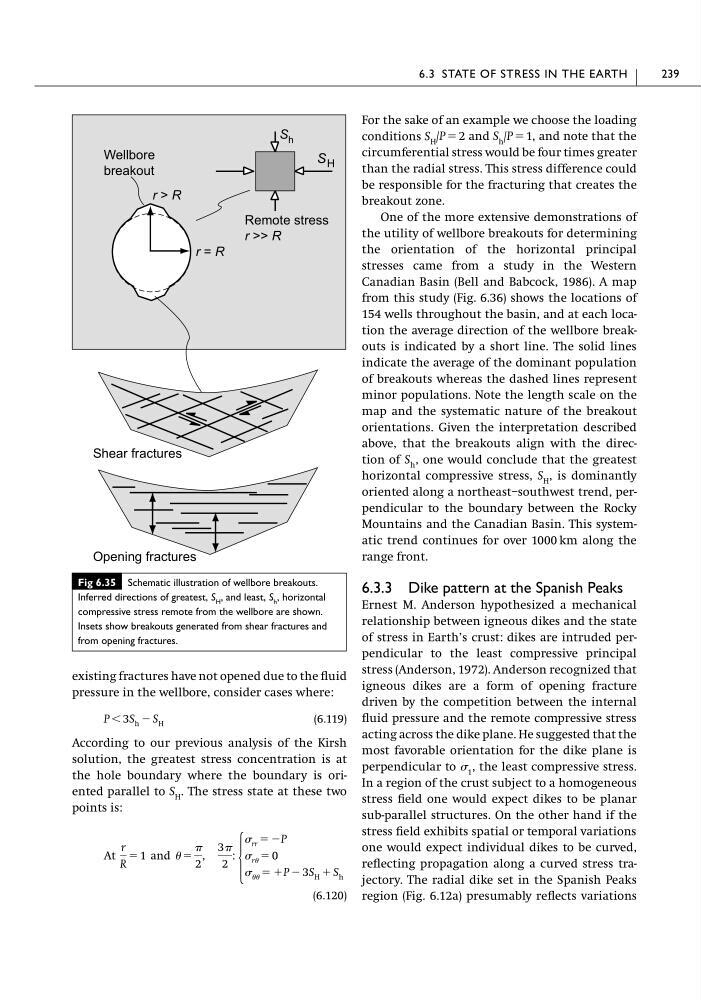
According to our previous analysis of the Kirsh
solution, the greatest stress concentration is at
the hole boundary where the boundary is oriented parallel to S H . The stress state at these two
points is:
(6.120)
At
r
R
ϭ 1 and ϭ
2
,
3
2
:
Ά
rr ϭ ϪP
r ϭ 0
ϭ ϩP Ϫ 3S H ϩ S h
P Ͻ 3S h Ϫ S H
For the sake of an example we choose the loading
conditions S H /P ϭ 2 and S h /P ϭ 1, and note that the
circumferential stress would be four times greater
than the radial stress. This stress difference could
be responsible for the fracturing that creates the
breakout zone.
One of the more extensive demonstrations of
the utility of wellbore breakouts for determining
the orientation of the horizontal principal
stresses came from a study in the Western
Canadian Basin (Bell and Babcock, 1986). A map
from this study (Fig. 6.36) shows the locations of
154 wells throughout the basin, and at each location the average direction of the wellbore breakouts is indicated by a short line. The solid lines
indicate the average of the dominant population
of breakouts whereas the dashed lines represent
minor populations. Note the length scale on the
map and the systematic nature of the breakout
orientations. Given the interpretation described
above, that the breakouts align with the direction of S h , one would conclude that the greatest
horizontal compressive stress, S H , is dominantly
oriented along a northeast–southwest trend, perpendicular to the boundary between the Rocky
Mountains and the Canadian Basin. This systematic trend continues for over 1000 km along the
range front.
6.3.3 Dike pattern at the Spanish Peaks
Ernest M. Anderson hypothesized a mechanical
relationship between igneous dikes and the state
of stress in Earth’s crust: dikes are intruded perpendicular to the least compressive principal
stress (Anderson, 1972). Anderson recognized that
igneous dikes are a form of opening fracture
driven by the competition between the internal
fluid pressure and the remote compressive stress
acting across the dike plane. He suggested that the
most favorable orientation for the dike plane is
perpendicular to 1 , the least compressive stress.
In a region of the crust subject to a homogeneous
stress field one would expect dikes to be planar
sub-parallel structures. On the other hand if the
stress field exhibits spatial or temporal variations
one would expect individual dikes to be curved,
reflecting propagation along a curved stress trajectory. The radial dike set in the Spanish Peaks
region (Fig. 6.12a) presumably reflects variations
6.3 STATE OF STRESS IN THE EARTH
239
Fig 6.35 Schematic illustration of wellbore breakouts.
Inferred directions of greatest, S H , and least, S h , horizontal
compressive stress remote from the wellbore are shown.
Insets show breakouts generated from shear fractures and
from opening fractures.
S h
r = R
r > R
Wellbore
breakout
Opening fractures
Shear fractures
Remote stress
r >> R
S H
pressure in the wellbore, consider cases where:
(6.119)
According to our previous analysis of the Kirsh
solution, the greatest stress concentration is at
the hole boundary where the boundary is oriented parallel to S H . The stress state at these two
points is:
(6.120)
At
r
R
ϭ 1 and ϭ
2
,
3
2
:
Ά
rr ϭ ϪP
r ϭ 0
ϭ ϩP Ϫ 3S H ϩ S h
P Ͻ 3S h Ϫ S H
For the sake of an example we choose the loading
conditions S H /P ϭ 2 and S h /P ϭ 1, and note that the
circumferential stress would be four times greater
than the radial stress. This stress difference could
be responsible for the fracturing that creates the
breakout zone.
One of the more extensive demonstrations of
the utility of wellbore breakouts for determining
the orientation of the horizontal principal
stresses came from a study in the Western
Canadian Basin (Bell and Babcock, 1986). A map
from this study (Fig. 6.36) shows the locations of
154 wells throughout the basin, and at each location the average direction of the wellbore breakouts is indicated by a short line. The solid lines
indicate the average of the dominant population
of breakouts whereas the dashed lines represent
minor populations. Note the length scale on the
map and the systematic nature of the breakout
orientations. Given the interpretation described
above, that the breakouts align with the direction of S h , one would conclude that the greatest
horizontal compressive stress, S H , is dominantly
oriented along a northeast–southwest trend, perpendicular to the boundary between the Rocky
Mountains and the Canadian Basin. This systematic trend continues for over 1000 km along the
range front.
6.3.3 Dike pattern at the Spanish Peaks
Ernest M. Anderson hypothesized a mechanical
relationship between igneous dikes and the state
of stress in Earth’s crust: dikes are intruded perpendicular to the least compressive principal
stress (Anderson, 1972). Anderson recognized that
igneous dikes are a form of opening fracture
driven by the competition between the internal
fluid pressure and the remote compressive stress
acting across the dike plane. He suggested that the
most favorable orientation for the dike plane is
perpendicular to 1 , the least compressive stress.
In a region of the crust subject to a homogeneous
stress field one would expect dikes to be planar
sub-parallel structures. On the other hand if the
stress field exhibits spatial or temporal variations
one would expect individual dikes to be curved,
reflecting propagation along a curved stress trajectory. The radial dike set in the Spanish Peaks
region (Fig. 6.12a) presumably reflects variations
6.3 STATE OF STRESS IN THE EARTH
239
Fig 6.35 Schematic illustration of wellbore breakouts.
Inferred directions of greatest, S H , and least, S h , horizontal
compressive stress remote from the wellbore are shown.
Insets show breakouts generated from shear fractures and
from opening fractures.
S h
r = R
r > R
Wellbore
breakout
Opening fractures
Shear fractures
Remote stress
r >> R
S H