

M
ost structural geologists think about
deformation and flow in an inverse
problem mode: from the final state back
toward the initial state of the deformed body of
rock. For example, the lower right photograph in
the frontispiece for this chapter shows deformed
oöids with elliptical shapes: ratios of long to short
axes are about 1.56 (Cloos, 1947, 1971). The upper
left photograph shows nearly undeformed oöids
with approximately circular shapes: ratios of long
to short axes are about 1.16. One can think of the
deformed oöids being transformed back toward
an initial state much like that of the nearly undeformed oöids. In other words the ellipsoidal particles become nearly spherical. This viewpoint is
natural since the primary observational data of
structural geologists are field observations of
deformed rock.
The above admonition by the Austrian geologist Bruno Sander, written in 1948 (Sander, 1970),
suggests that we set aside much of the physics in
our initial study of rock deformation and focus exclusively on kinematics. Becker and Sander are
prominent participants in the early history of
structural geology. Their advice is followed to this
date by an influential “school” of structural geologists, to which the present authors do not subscribe (Fletcher and Pollard, 1999; Pollard, 2000).
Instead, we take kinematics as an integral part
of a complete mechanical analysis, including
enough physics to formulate a well-posed problem.
Therefore we devote this chapter to the subject of
kinematics and succeeding chapters to the other
elements of a complete mechanics.
Other types of observations enter a synthesis
leading to understanding of a process of deformation and its products. For example, controlled
laboratory experiments produce detailed information on the behavior of rock materials under
load, ranging from brittle failure at modest temperature and pressure to slow creeping flow at
high temperature and pressure. Moreover, theoretical study of deformation and failure of a wide
range of materials and human-made structures
over the last two centuries has provided a refined
picture of the processes involved and the laws governing them. The considerable insight and information provided by these additional sources tend
to favor the formulation of a forward problem for
such processes as faulting, folding, or mountain
building at plate margins. Field observations of
many sorts, including the deformed shapes of
objects such as oöids may be selected to constrain
a forward model built upon a synthesis of much
previous information (Nur et al., 1986; Pachell,
et al., 2003).
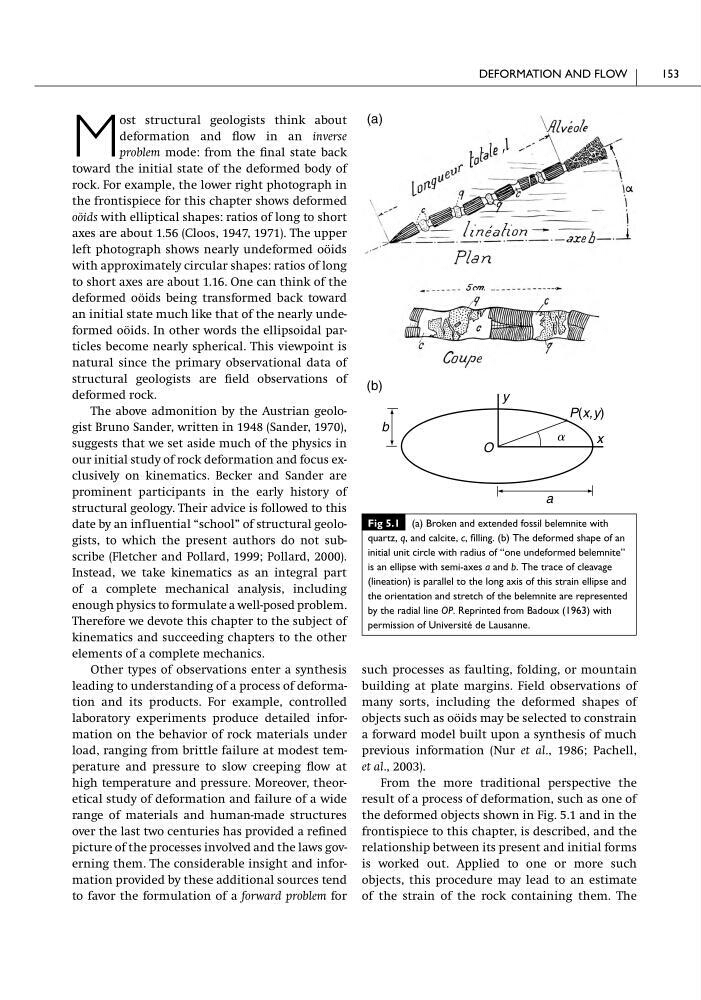
From the more traditional perspective the
result of a process of deformation, such as one of
the deformed objects shown in Fig. 5.1 and in the
frontispiece to this chapter, is described, and the
relationship between its present and initial forms
is worked out. Applied to one or more such
objects, this procedure may lead to an estimate
of the strain of the rock containing them. The
DEFORMATION AND FLOW
153
Fig 5.1 (a) Broken and extended fossil belemnite with
quartz, q, and calcite, c, filling. (b) The deformed shape of an
initial unit circle with radius of “one undeformed belemnite”
is an ellipse with semi-axes a and b. The trace of cleavage
(lineation) is parallel to the long axis of this strain ellipse and
the orientation and stretch of the belemnite are represented
by the radial line OP. Reprinted from Badoux (1963) with
permission of Université de Lausanne.
(a)
(b)
a
b
x
y
P(x,y)
a
O
ost structural geologists think about
deformation and flow in an inverse
problem mode: from the final state back
toward the initial state of the deformed body of
rock. For example, the lower right photograph in
the frontispiece for this chapter shows deformed
oöids with elliptical shapes: ratios of long to short
axes are about 1.56 (Cloos, 1947, 1971). The upper
left photograph shows nearly undeformed oöids
with approximately circular shapes: ratios of long
to short axes are about 1.16. One can think of the
deformed oöids being transformed back toward
an initial state much like that of the nearly undeformed oöids. In other words the ellipsoidal particles become nearly spherical. This viewpoint is
natural since the primary observational data of
structural geologists are field observations of
deformed rock.
The above admonition by the Austrian geologist Bruno Sander, written in 1948 (Sander, 1970),
suggests that we set aside much of the physics in
our initial study of rock deformation and focus exclusively on kinematics. Becker and Sander are
prominent participants in the early history of
structural geology. Their advice is followed to this
date by an influential “school” of structural geologists, to which the present authors do not subscribe (Fletcher and Pollard, 1999; Pollard, 2000).
Instead, we take kinematics as an integral part
of a complete mechanical analysis, including
enough physics to formulate a well-posed problem.
Therefore we devote this chapter to the subject of
kinematics and succeeding chapters to the other
elements of a complete mechanics.
Other types of observations enter a synthesis
leading to understanding of a process of deformation and its products. For example, controlled
laboratory experiments produce detailed information on the behavior of rock materials under
load, ranging from brittle failure at modest temperature and pressure to slow creeping flow at
high temperature and pressure. Moreover, theoretical study of deformation and failure of a wide
range of materials and human-made structures
over the last two centuries has provided a refined
picture of the processes involved and the laws governing them. The considerable insight and information provided by these additional sources tend
to favor the formulation of a forward problem for
such processes as faulting, folding, or mountain
building at plate margins. Field observations of
many sorts, including the deformed shapes of
objects such as oöids may be selected to constrain
a forward model built upon a synthesis of much
previous information (Nur et al., 1986; Pachell,
et al., 2003).
From the more traditional perspective the
result of a process of deformation, such as one of
the deformed objects shown in Fig. 5.1 and in the
frontispiece to this chapter, is described, and the
relationship between its present and initial forms
is worked out. Applied to one or more such
objects, this procedure may lead to an estimate
of the strain of the rock containing them. The
DEFORMATION AND FLOW
153
Fig 5.1 (a) Broken and extended fossil belemnite with
quartz, q, and calcite, c, filling. (b) The deformed shape of an
initial unit circle with radius of “one undeformed belemnite”
is an ellipse with semi-axes a and b. The trace of cleavage
(lineation) is parallel to the long axis of this strain ellipse and
the orientation and stretch of the belemnite are represented
by the radial line OP. Reprinted from Badoux (1963) with
permission of Université de Lausanne.
(a)
(b)
a
b
x
y
P(x,y)
a
O