

Here the ratio of densities in the model and prototype is approximately one. This analysis leads to
the conclusion that the strength ratio must scale
as the length ratio. Using a reasonable range of
model ratios for length (10
Ϫ6 Ͻ L r Ͻ 1) we conclude
that the model ratios for strength must be in this
same range (10
Ϫ6 Ͻ r Ͻ 1). The upper end of this
range corresponds to laboratory experiments on
meter-scale prototypes such as small folds and
these can be effectively modeled with relatively
strong materials (Ramberg, 1963). At the lower
end of this range the experimenter must try to
model processes with length scales of kilometers
or tens of kilometers in the laboratory. If gravitational forces induce the deformation, very weak
materials are required for the model to meet the
constraint imposed by the model ratio for
strengths.
M. King Hubbert (1945) brought this point to
the attention of geologists in an article entitled
“Strength of the Earth” that examined the apparent contradiction between the great strength of
a hand sample of rock and the modest “strength”
of a huge rock mass containing innumerable
folds and faults that witness to its apparent
weakness. To drive home this point Hubbert proposed the operation illustrated in the frontispiece to this chapter in which the state of
Texas is lifted by a huge crane. Of course this
would be impossible to implement, so he considered a laboratory model of such an operation. By
considering the scaling of this model he concluded that it would be impossible under the
existing force of gravity.
Consequently, if we tried to lift such a block in the
manner indicated . . . the eyebolts would pull out; if we
should support it on a pair of saw horses, its middle
would collapse; were we to place it upon a horizontal
table, its sides would fall off. In fact, to lift it at all
would require the use of a scoop shovel . . . The
inescapable conclusion, therefore, is that the good
state of Texas is utterly incapable of self-support
(Hubbert, 1945).
The scaling of model experiments has proven
to be problematic because materials that flow
and fracture under their own weight are rare, yet
large masses of rock subject to gravitational
forces do just that. A solution to this dilemma is
to increase the body force in the model by placing
it in a centrifuge (Fig. 4.13b) (Ramberg, 1967;
Dixon and Summers, 1985). For example, if the
dominant forces operating in the prototype are
pressure, gravitational, and viscous forces, the
Stokes (4.104), Ramberg (4.105), and Smoluchowski (4.106) Numbers must be examined and
shown to be equivalent to the corresponding
numbers for the model. Thus, comparing the
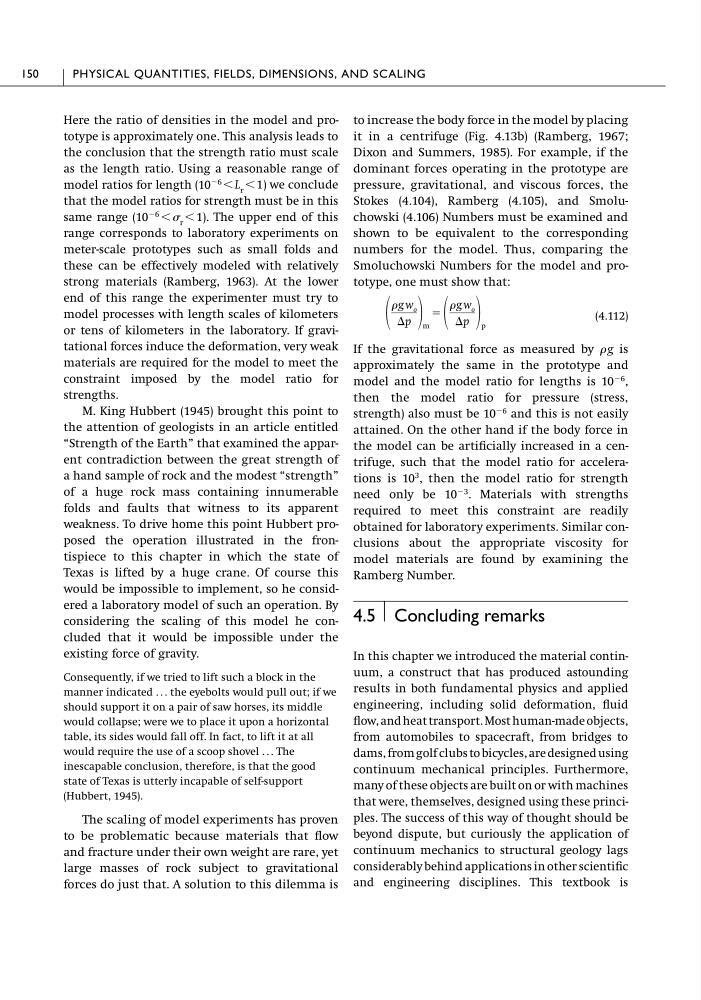
Smoluchowski Numbers for the model and prototype, one must show that:
(4.112)
If the gravitational force as measured by g is
approximately the same in the prototype and
model and the model ratio for lengths is 10
Ϫ6 ,
then the model ratio for pressure (stress,
strength) also must be 10
Ϫ6 and this is not easily
attained. On the other hand if the body force in
the model can be artificially increased in a centrifuge, such that the model ratio for accelerations is 10
3 , then the model ratio for strength
need only be 10
Ϫ3 . Materials with strengths
required to meet this constraint are readily
obtained for laboratory experiments. Similar conclusions about the appropriate viscosity for
model materials are found by examining the
Ramberg Number.
4.5 Concluding remarks
In this chapter we introduced the material continuum, a construct that has produced astounding
results in both fundamental physics and applied
engineering, including solid deformation, fluid
flow, and heat transport. Most human-made objects,
from automobiles to spacecraft, from bridges to
dams, from golf clubs to bicycles, are designed using
continuum mechanical principles. Furthermore,
many of these objects are built on or with machines
that were, themselves, designed using these principles. The success of this way of thought should be
beyond dispute, but curiously the application of
continuum mechanics to structural geology lags
considerably behind applications in other scientific
and engineering disciplines. This textbook is
gw o
⌬p m
ϭ
gw o
⌬p p
150
PHYSICAL QUANTITIES, FIELDS, DIMENSIONS, AND SCALING
the conclusion that the strength ratio must scale
as the length ratio. Using a reasonable range of
model ratios for length (10
Ϫ6 Ͻ L r Ͻ 1) we conclude
that the model ratios for strength must be in this
same range (10
Ϫ6 Ͻ r Ͻ 1). The upper end of this
range corresponds to laboratory experiments on
meter-scale prototypes such as small folds and
these can be effectively modeled with relatively
strong materials (Ramberg, 1963). At the lower
end of this range the experimenter must try to
model processes with length scales of kilometers
or tens of kilometers in the laboratory. If gravitational forces induce the deformation, very weak
materials are required for the model to meet the
constraint imposed by the model ratio for
strengths.
M. King Hubbert (1945) brought this point to
the attention of geologists in an article entitled
“Strength of the Earth” that examined the apparent contradiction between the great strength of
a hand sample of rock and the modest “strength”
of a huge rock mass containing innumerable
folds and faults that witness to its apparent
weakness. To drive home this point Hubbert proposed the operation illustrated in the frontispiece to this chapter in which the state of
Texas is lifted by a huge crane. Of course this
would be impossible to implement, so he considered a laboratory model of such an operation. By
considering the scaling of this model he concluded that it would be impossible under the
existing force of gravity.
Consequently, if we tried to lift such a block in the
manner indicated . . . the eyebolts would pull out; if we
should support it on a pair of saw horses, its middle
would collapse; were we to place it upon a horizontal
table, its sides would fall off. In fact, to lift it at all
would require the use of a scoop shovel . . . The
inescapable conclusion, therefore, is that the good
state of Texas is utterly incapable of self-support
(Hubbert, 1945).
The scaling of model experiments has proven
to be problematic because materials that flow
and fracture under their own weight are rare, yet
large masses of rock subject to gravitational
forces do just that. A solution to this dilemma is
to increase the body force in the model by placing
it in a centrifuge (Fig. 4.13b) (Ramberg, 1967;
Dixon and Summers, 1985). For example, if the
dominant forces operating in the prototype are
pressure, gravitational, and viscous forces, the
Stokes (4.104), Ramberg (4.105), and Smoluchowski (4.106) Numbers must be examined and
shown to be equivalent to the corresponding
numbers for the model. Thus, comparing the
Smoluchowski Numbers for the model and prototype, one must show that:
(4.112)
If the gravitational force as measured by g is
approximately the same in the prototype and
model and the model ratio for lengths is 10
Ϫ6 ,
then the model ratio for pressure (stress,
strength) also must be 10
Ϫ6 and this is not easily
attained. On the other hand if the body force in
the model can be artificially increased in a centrifuge, such that the model ratio for accelerations is 10
3 , then the model ratio for strength
need only be 10
Ϫ3 . Materials with strengths
required to meet this constraint are readily
obtained for laboratory experiments. Similar conclusions about the appropriate viscosity for
model materials are found by examining the
Ramberg Number.
4.5 Concluding remarks
In this chapter we introduced the material continuum, a construct that has produced astounding
results in both fundamental physics and applied
engineering, including solid deformation, fluid
flow, and heat transport. Most human-made objects,
from automobiles to spacecraft, from bridges to
dams, from golf clubs to bicycles, are designed using
continuum mechanical principles. Furthermore,
many of these objects are built on or with machines
that were, themselves, designed using these principles. The success of this way of thought should be
beyond dispute, but curiously the application of
continuum mechanics to structural geology lags
considerably behind applications in other scientific
and engineering disciplines. This textbook is
gw o
⌬p m
ϭ
gw o
⌬p p
150
PHYSICAL QUANTITIES, FIELDS, DIMENSIONS, AND SCALING