

44
4.2.2 Ultraviolet Radiation and DNA
4.2.2.1 UV Radiation Generates Lesions in the DNA Molecule
To better understand the effects of UV rays on DNA, it is necessary to delve into the
DNA structure. The elemental unit of the DNA molecule is called nucleotide, and it
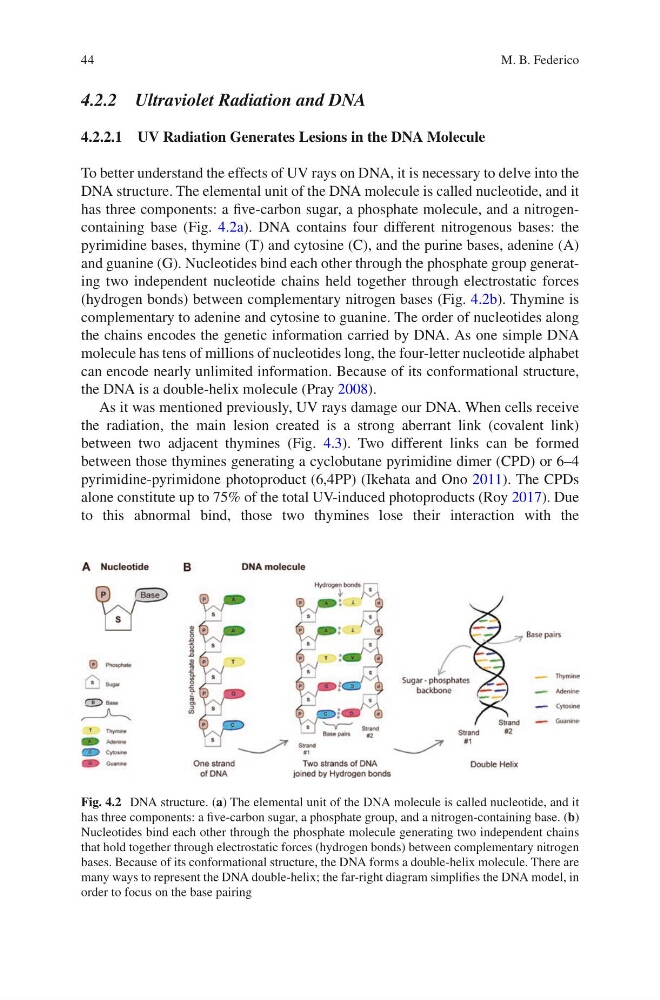
has three components: a five-carbon sugar, a phosphate molecule, and a nitrogencontaining base (Fig. 4.2a). DNA contains four different nitrogenous bases: the
pyrimidine bases, thymine (T) and cytosine (C), and the purine bases, adenine (A)
and guanine (G). Nucleotides bind each other through the phosphate group generating two independent nucleotide chains held together through electrostatic forces
(hydrogen bonds) between complementary nitrogen bases (Fig. 4.2b). Thymine is
complementary to adenine and cytosine to guanine. The order of nucleotides along
the chains encodes the genetic information carried by DNA. As one simple DNA
molecule has tens of millions of nucleotides long, the four-letter nucleotide alphabet
can encode nearly unlimited information. Because of its conformational structure,
the DNA is a double-helix molecule (Pray 2008).
As it was mentioned previously, UV rays damage our DNA. When cells receive
the radiation, the main lesion created is a strong aberrant link (covalent link)
between two adjacent thymines (Fig. 4.3). Two different links can be formed
between those thymines generating a cyclobutane pyrimidine dimer (CPD) or 6–4
pyrimidine-pyrimidone photoproduct (6,4PP) (Ikehata and Ono 2011). The CPDs
alone constitute up to 75% of the total UV-induced photoproducts (Roy 2017). Due
to this abnormal bind, those two thymines lose their interaction with the
Fig. 4.2 DNA structure. (a) The elemental unit of the DNA molecule is called nucleotide, and it
has three components: a five-carbon sugar, a phosphate group, and a nitrogen-containing base. (b)
Nucleotides bind each other through the phosphate molecule generating two independent chains
that hold together through electrostatic forces (hydrogen bonds) between complementary nitrogen
bases. Because of its conformational structure, the DNA forms a double-helix molecule. There are
many ways to represent the DNA double-helix; the far-right diagram simplifies the DNA model, in
order to focus on the base pairing
M. B. Federico
4.2.2 Ultraviolet Radiation and DNA
4.2.2.1 UV Radiation Generates Lesions in the DNA Molecule
To better understand the effects of UV rays on DNA, it is necessary to delve into the
DNA structure. The elemental unit of the DNA molecule is called nucleotide, and it
has three components: a five-carbon sugar, a phosphate molecule, and a nitrogencontaining base (Fig. 4.2a). DNA contains four different nitrogenous bases: the
pyrimidine bases, thymine (T) and cytosine (C), and the purine bases, adenine (A)
and guanine (G). Nucleotides bind each other through the phosphate group generating two independent nucleotide chains held together through electrostatic forces
(hydrogen bonds) between complementary nitrogen bases (Fig. 4.2b). Thymine is
complementary to adenine and cytosine to guanine. The order of nucleotides along
the chains encodes the genetic information carried by DNA. As one simple DNA
molecule has tens of millions of nucleotides long, the four-letter nucleotide alphabet
can encode nearly unlimited information. Because of its conformational structure,
the DNA is a double-helix molecule (Pray 2008).
As it was mentioned previously, UV rays damage our DNA. When cells receive
the radiation, the main lesion created is a strong aberrant link (covalent link)
between two adjacent thymines (Fig. 4.3). Two different links can be formed
between those thymines generating a cyclobutane pyrimidine dimer (CPD) or 6–4
pyrimidine-pyrimidone photoproduct (6,4PP) (Ikehata and Ono 2011). The CPDs
alone constitute up to 75% of the total UV-induced photoproducts (Roy 2017). Due
to this abnormal bind, those two thymines lose their interaction with the
Fig. 4.2 DNA structure. (a) The elemental unit of the DNA molecule is called nucleotide, and it
has three components: a five-carbon sugar, a phosphate group, and a nitrogen-containing base. (b)
Nucleotides bind each other through the phosphate molecule generating two independent chains
that hold together through electrostatic forces (hydrogen bonds) between complementary nitrogen
bases. Because of its conformational structure, the DNA forms a double-helix molecule. There are
many ways to represent the DNA double-helix; the far-right diagram simplifies the DNA model, in
order to focus on the base pairing
M. B. Federico