

41
4.2.1.2 UV Radiation as an Issue for Human Health
Although sun exposure has positive effects on mood and stimulates production of
vitamin D, prolonged UV radiation exposure has proven to be extremely harmful
for humans. The World Environment Conference, held in Rio de Janeiro in 1992,
specifically recommended to “undertake, as a matter of urgency, research on the
effects on human health of the increasing UV radiation reaching the earth’s surface
as a consequence of depletion of the stratospheric ozone layer.” Epidemiological
and scientific evidence strongly connects UV ray’s exposure to several skin cancers
(Griffiths et al. 1998; Norval et al. 2011), and that connection has been extensively
evaluated during the last decades. Overexposure to UV radiation is the main preventable cause of skin cancers – both melanoma (the most serious type) and nonmelanoma skin cancers (NMSC) (Brown et al. 2018). Sixty-five percent of
melanoma cases are associated with exposure to UV rays, and the amount is worse
for NMSC, reaching 90%, including both basal cell carcinoma (BCC) and squamous cell carcinoma (SCC). NMSC has increased and is becoming more prevalent
even in younger age groups; it currently accounts for nearly 15,000 deaths and 3.5
million new cases in the United States alone, representing a major public health
concern (Kim and He 2014). A 10 % ozone depletion was found to give rise to a
16–18% increase in the incidence rate of SCC (men and women), a 19% increase in
the incidence rate of malignant melanoma for men, and a 32% increase in the
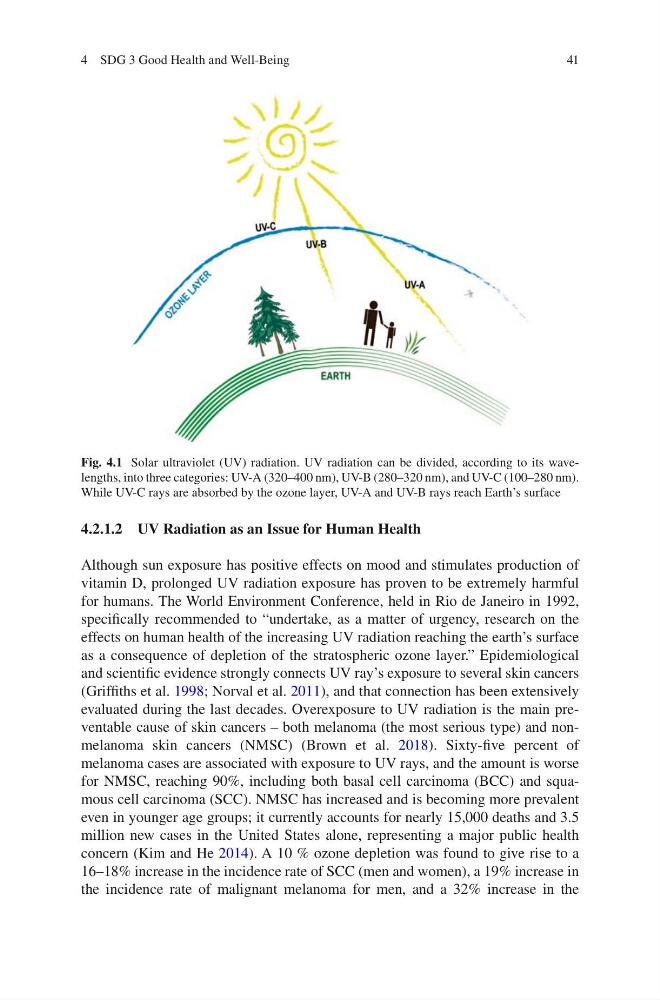
Fig. 4.1 Solar ultraviolet (UV) radiation. UV radiation can be divided, according to its wavelengths, into three categories: UV-A (320–400 nm), UV-B (280–320 nm), and UV-C (100–280 nm).
While UV-C rays are absorbed by the ozone layer, UV-A and UV-B rays reach Earth’s surface
4 SDG 3 Good Health and Well-Being
4.2.1.2 UV Radiation as an Issue for Human Health
Although sun exposure has positive effects on mood and stimulates production of
vitamin D, prolonged UV radiation exposure has proven to be extremely harmful
for humans. The World Environment Conference, held in Rio de Janeiro in 1992,
specifically recommended to “undertake, as a matter of urgency, research on the
effects on human health of the increasing UV radiation reaching the earth’s surface
as a consequence of depletion of the stratospheric ozone layer.” Epidemiological
and scientific evidence strongly connects UV ray’s exposure to several skin cancers
(Griffiths et al. 1998; Norval et al. 2011), and that connection has been extensively
evaluated during the last decades. Overexposure to UV radiation is the main preventable cause of skin cancers – both melanoma (the most serious type) and nonmelanoma skin cancers (NMSC) (Brown et al. 2018). Sixty-five percent of
melanoma cases are associated with exposure to UV rays, and the amount is worse
for NMSC, reaching 90%, including both basal cell carcinoma (BCC) and squamous cell carcinoma (SCC). NMSC has increased and is becoming more prevalent
even in younger age groups; it currently accounts for nearly 15,000 deaths and 3.5
million new cases in the United States alone, representing a major public health
concern (Kim and He 2014). A 10 % ozone depletion was found to give rise to a
16–18% increase in the incidence rate of SCC (men and women), a 19% increase in
the incidence rate of malignant melanoma for men, and a 32% increase in the
Fig. 4.1 Solar ultraviolet (UV) radiation. UV radiation can be divided, according to its wavelengths, into three categories: UV-A (320–400 nm), UV-B (280–320 nm), and UV-C (100–280 nm).
While UV-C rays are absorbed by the ozone layer, UV-A and UV-B rays reach Earth’s surface
4 SDG 3 Good Health and Well-Being