

30
3.3.1.5 Harvesting and Using Compost
Harvest the finished compost by using a shovel. Harvest worm castings by hand
separating the worms from their castings. Incorporate all finished compost into
landscaping or garden spaces by top dressing and watering in or shovel- incorporating
into the soil.
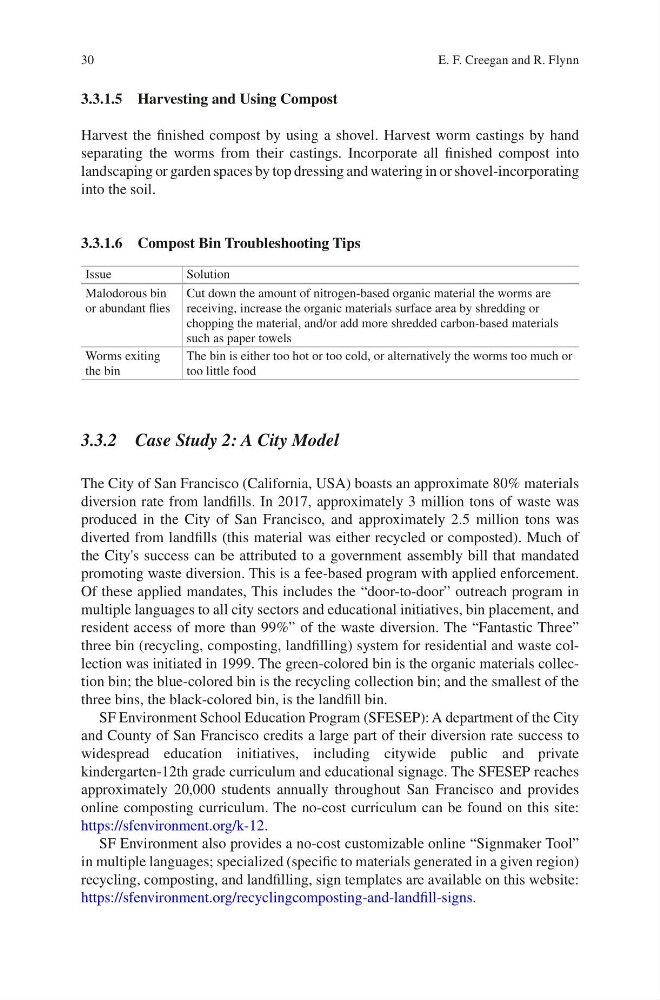
3.3.1.6 Compost Bin Troubleshooting Tips
Issue
Solution
Malodorous bin
or abundant flies
Cut down the amount of nitrogen-based organic material the worms are
receiving, increase the organic materials surface area by shredding or
chopping the material, and/or add more shredded carbon-based materials
such as paper towels
Worms exiting
the bin
The bin is either too hot or too cold, or alternatively the worms too much or
too little food
3.3.2 Case Study 2: A City Model
The City of San Francisco (California, USA) boasts an approximate 80% materials
diversion rate from landfills. In 2017, approximately 3 million tons of waste was
produced in the City of San Francisco, and approximately 2.5 million tons was
diverted from landfills (this material was either recycled or composted). Much of
the City's success can be attributed to a government assembly bill that mandated
promoting waste diversion. This is a fee-based program with applied enforcement.
Of these applied mandates, This includes the “door-to-door” outreach program in
multiple languages to all city sectors and educational initiatives, bin placement, and
resident access of more than 99%” of the waste diversion. The “Fantastic Three”
three bin (recycling, composting, landfilling) system for residential and waste collection was initiated in 1999. The green-colored bin is the organic materials collection bin; the blue-colored bin is the recycling collection bin; and the smallest of the
three bins, the black-colored bin, is the landfill bin.
SF Environment School Education Program (SFESEP): A department of the City
and County of San Francisco credits a large part of their diversion rate success to
widespread education initiatives, including citywide public and private
kindergarten- 12th grade curriculum and educational signage. The SFESEP reaches
approximately 20,000 students annually throughout San Francisco and provides
online composting curriculum. The no-cost curriculum can be found on this site:
https://sfenvironment.org/k-12.
SF Environment also provides a no-cost customizable online “Signmaker Tool”
in multiple languages; specialized (specific to materials generated in a given region)
recycling, composting, and landfilling, sign templates are available on this website:
https://sfenvironment.org/recyclingcomposting-and-landfill-signs.
E. F. Creegan and R. Flynn
3.3.1.5 Harvesting and Using Compost
Harvest the finished compost by using a shovel. Harvest worm castings by hand
separating the worms from their castings. Incorporate all finished compost into
landscaping or garden spaces by top dressing and watering in or shovel- incorporating
into the soil.
3.3.1.6 Compost Bin Troubleshooting Tips
Issue
Solution
Malodorous bin
or abundant flies
Cut down the amount of nitrogen-based organic material the worms are
receiving, increase the organic materials surface area by shredding or
chopping the material, and/or add more shredded carbon-based materials
such as paper towels
Worms exiting
the bin
The bin is either too hot or too cold, or alternatively the worms too much or
too little food
3.3.2 Case Study 2: A City Model
The City of San Francisco (California, USA) boasts an approximate 80% materials
diversion rate from landfills. In 2017, approximately 3 million tons of waste was
produced in the City of San Francisco, and approximately 2.5 million tons was
diverted from landfills (this material was either recycled or composted). Much of
the City's success can be attributed to a government assembly bill that mandated
promoting waste diversion. This is a fee-based program with applied enforcement.
Of these applied mandates, This includes the “door-to-door” outreach program in
multiple languages to all city sectors and educational initiatives, bin placement, and
resident access of more than 99%” of the waste diversion. The “Fantastic Three”
three bin (recycling, composting, landfilling) system for residential and waste collection was initiated in 1999. The green-colored bin is the organic materials collection bin; the blue-colored bin is the recycling collection bin; and the smallest of the
three bins, the black-colored bin, is the landfill bin.
SF Environment School Education Program (SFESEP): A department of the City
and County of San Francisco credits a large part of their diversion rate success to
widespread education initiatives, including citywide public and private
kindergarten- 12th grade curriculum and educational signage. The SFESEP reaches
approximately 20,000 students annually throughout San Francisco and provides
online composting curriculum. The no-cost curriculum can be found on this site:
https://sfenvironment.org/k-12.
SF Environment also provides a no-cost customizable online “Signmaker Tool”
in multiple languages; specialized (specific to materials generated in a given region)
recycling, composting, and landfilling, sign templates are available on this website:
https://sfenvironment.org/recyclingcomposting-and-landfill-signs.
E. F. Creegan and R. Flynn