

281
18.4.1 Republic of Korea Case Study
The interest of Korean businesses in being seen as accountable has grown since
recent years. However, how they are exercising such an accountability is an issue
that deserves nuance attention (Sok and Whang 2014). For the purpose of this analysis, a sample of 30 companies that claim to be adhered to the network’s principles
was selected across different sectors in RoK. The status of accountability in selected
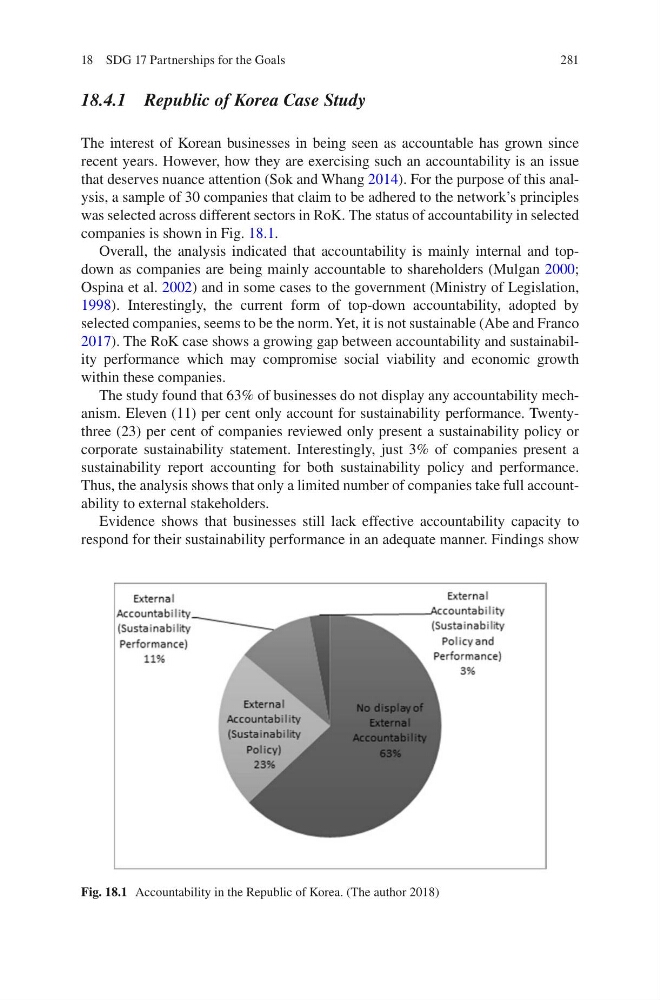
companies is shown in Fig. 18.1.
Overall, the analysis indicated that accountability is mainly internal and topdown as companies are being mainly accountable to shareholders (Mulgan 2000;
Ospina et al. 2002) and in some cases to the government (Ministry of Legislation,
1998). Interestingly, the current form of top-down accountability, adopted by
selected companies, seems to be the norm. Yet, it is not sustainable (Abe and Franco
2017). The RoK case shows a growing gap between accountability and sustainability performance which may compromise social viability and economic growth
within these companies.
The study found that 63% of businesses do not display any accountability mechanism. Eleven (11) per cent only account for sustainability performance. Twentythree (23) per cent of companies reviewed only present a sustainability policy or
corporate sustainability statement. Interestingly, just 3% of companies present a
sustainability report accounting for both sustainability policy and performance.
Thus, the analysis shows that only a limited number of companies take full accountability to external stakeholders.
Evidence shows that businesses still lack effective accountability capacity to
respond for their sustainability performance in an adequate manner. Findings show
Fig. 18.1 Accountability in the Republic of Korea. (The author 2018)
18 SDG 17 Partnerships for the Goals
18.4.1 Republic of Korea Case Study
The interest of Korean businesses in being seen as accountable has grown since
recent years. However, how they are exercising such an accountability is an issue
that deserves nuance attention (Sok and Whang 2014). For the purpose of this analysis, a sample of 30 companies that claim to be adhered to the network’s principles
was selected across different sectors in RoK. The status of accountability in selected
companies is shown in Fig. 18.1.
Overall, the analysis indicated that accountability is mainly internal and topdown as companies are being mainly accountable to shareholders (Mulgan 2000;
Ospina et al. 2002) and in some cases to the government (Ministry of Legislation,
1998). Interestingly, the current form of top-down accountability, adopted by
selected companies, seems to be the norm. Yet, it is not sustainable (Abe and Franco
2017). The RoK case shows a growing gap between accountability and sustainability performance which may compromise social viability and economic growth
within these companies.
The study found that 63% of businesses do not display any accountability mechanism. Eleven (11) per cent only account for sustainability performance. Twentythree (23) per cent of companies reviewed only present a sustainability policy or
corporate sustainability statement. Interestingly, just 3% of companies present a
sustainability report accounting for both sustainability policy and performance.
Thus, the analysis shows that only a limited number of companies take full accountability to external stakeholders.
Evidence shows that businesses still lack effective accountability capacity to
respond for their sustainability performance in an adequate manner. Findings show
Fig. 18.1 Accountability in the Republic of Korea. (The author 2018)
18 SDG 17 Partnerships for the Goals