

200
Industry-Based Development in Antioquia
The current approach to development in some locations of Antioquia led by stakeholders in the region (companies, governments and civil society actors) is intended
to attract and retain human capital for the mining industry. A mining company representative stated: “This is a mining town. Mining is the only livelihood for 80% of
community members” (Table 13.2, Row 1). Minimal attention has been paid by
stakeholders to wider aspects of community wellbeing and long-term resilience. For
instance, a government representative remarked that “Some mining towns in
Antioquia have a strong dependence on mining. This situation has diminished the
possibilities of sustaining communities in the long-term” (Table 13.2, Row 2). In
this context locals are becoming insufficiently resilient to withstand mining-induced
changes and have not been able to realise their full potential. “This is a mining
town… a person who does not go to school becomes a miner. Most of us do not
know anything else than mining, hence, we have to work here and sustain our family
members with the little income we get” (Table 13.2, Row 4), says a community
member. A senior Colombian government representative stated:
Global corporations invest on projects that are convenient for their business such as infrastructure and facilities for mine’s workers rather than on more sustainable legacies for communities adjacent to their operations. This corporate approach is preventing local
communities from achieving development aspirations which questions the notion of sustainable and responsible mining in the region.
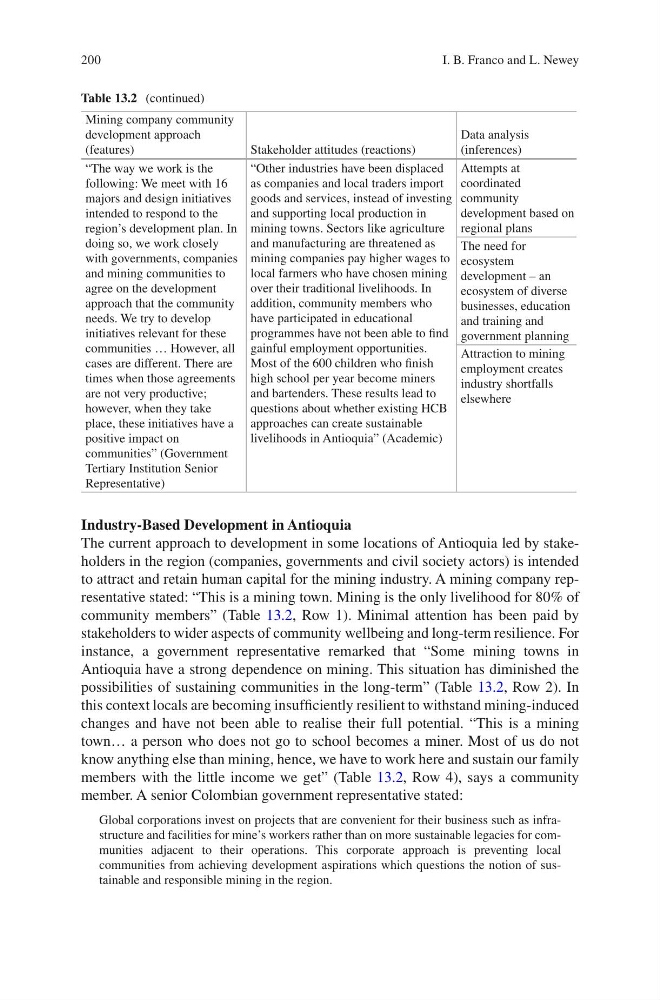
Table 13.2 (continued)
Mining company community
development approach
(features)
Stakeholder attitudes (reactions)
Data analysis
(inferences)
“The way we work is the
following: We meet with 16
majors and design initiatives
intended to respond to the
region’s development plan. In
doing so, we work closely
with governments, companies
and mining communities to
agree on the development
approach that the community
needs. We try to develop
initiatives relevant for these
communities … However, all
cases are different. There are
times when those agreements
are not very productive;
however, when they take
place, these initiatives have a
positive impact on
communities” (Government
Tertiary Institution Senior
Representative)
“Other industries have been displaced
as companies and local traders import
goods and services, instead of investing
and supporting local production in
mining towns. Sectors like agriculture
and manufacturing are threatened as
mining companies pay higher wages to
local farmers who have chosen mining
over their traditional livelihoods. In
addition, community members who
have participated in educational
programmes have not been able to find
gainful employment opportunities.
Most of the 600 children who finish
high school per year become miners
and bartenders. These results lead to
questions about whether existing HCB
approaches can create sustainable
livelihoods in Antioquia” (Academic)
Attempts at
coordinated
community
development based on
regional plans
The need for
ecosystem
development – an
ecosystem of diverse
businesses, education
and training and
government planning
Attraction to mining
employment creates
industry shortfalls
elsewhere
I. B. Franco and L. Newey
Industry-Based Development in Antioquia
The current approach to development in some locations of Antioquia led by stakeholders in the region (companies, governments and civil society actors) is intended
to attract and retain human capital for the mining industry. A mining company representative stated: “This is a mining town. Mining is the only livelihood for 80% of
community members” (Table 13.2, Row 1). Minimal attention has been paid by
stakeholders to wider aspects of community wellbeing and long-term resilience. For
instance, a government representative remarked that “Some mining towns in
Antioquia have a strong dependence on mining. This situation has diminished the
possibilities of sustaining communities in the long-term” (Table 13.2, Row 2). In
this context locals are becoming insufficiently resilient to withstand mining-induced
changes and have not been able to realise their full potential. “This is a mining
town… a person who does not go to school becomes a miner. Most of us do not
know anything else than mining, hence, we have to work here and sustain our family
members with the little income we get” (Table 13.2, Row 4), says a community
member. A senior Colombian government representative stated:
Global corporations invest on projects that are convenient for their business such as infrastructure and facilities for mine’s workers rather than on more sustainable legacies for communities adjacent to their operations. This corporate approach is preventing local
communities from achieving development aspirations which questions the notion of sustainable and responsible mining in the region.
Table 13.2 (continued)
Mining company community
development approach
(features)
Stakeholder attitudes (reactions)
Data analysis
(inferences)
“The way we work is the
following: We meet with 16
majors and design initiatives
intended to respond to the
region’s development plan. In
doing so, we work closely
with governments, companies
and mining communities to
agree on the development
approach that the community
needs. We try to develop
initiatives relevant for these
communities … However, all
cases are different. There are
times when those agreements
are not very productive;
however, when they take
place, these initiatives have a
positive impact on
communities” (Government
Tertiary Institution Senior
Representative)
“Other industries have been displaced
as companies and local traders import
goods and services, instead of investing
and supporting local production in
mining towns. Sectors like agriculture
and manufacturing are threatened as
mining companies pay higher wages to
local farmers who have chosen mining
over their traditional livelihoods. In
addition, community members who
have participated in educational
programmes have not been able to find
gainful employment opportunities.
Most of the 600 children who finish
high school per year become miners
and bartenders. These results lead to
questions about whether existing HCB
approaches can create sustainable
livelihoods in Antioquia” (Academic)
Attempts at
coordinated
community
development based on
regional plans
The need for
ecosystem
development – an
ecosystem of diverse
businesses, education
and training and
government planning
Attraction to mining
employment creates
industry shortfalls
elsewhere
I. B. Franco and L. Newey