

191
also, wellbeing is an increasing focus of national governments as a reaction against
purely economic indicators (Bleys 2012). The Report of the Commission on the
Measurement of Economic Performance and Social Progress initiated by the French
President Nicolas Sarkozy proclaimed that “the time is ripe for our measurement
system to shift in emphasis from measuring economic production to measuring
people’s wellbeing” (Stiglitz et al. 2010: 10).
Based on existing literature, we focus on an eight-dimensional framework of
wellbeing: economic, physical, material, social, cultural, psychological, spiritual
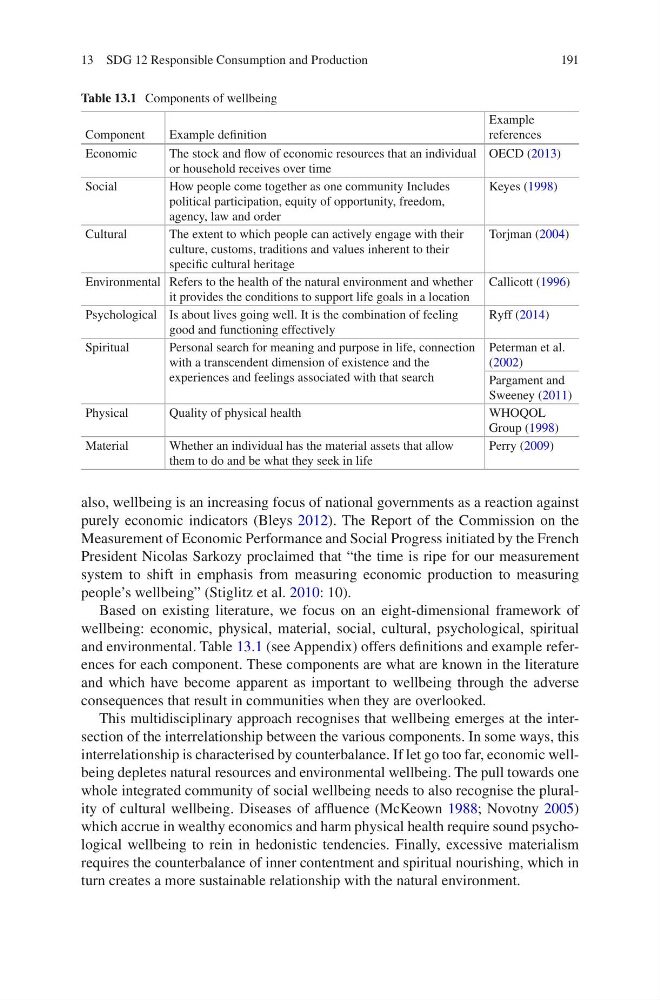
and environmental. Table 13.1 (see Appendix) offers definitions and example references for each component. These components are what are known in the literature
and which have become apparent as important to wellbeing through the adverse
consequences that result in communities when they are overlooked.
This multidisciplinary approach recognises that wellbeing emerges at the intersection of the interrelationship between the various components. In some ways, this
interrelationship is characterised by counterbalance. If let go too far, economic wellbeing depletes natural resources and environmental wellbeing. The pull towards one
whole integrated community of social wellbeing needs to also recognise the plurality of cultural wellbeing. Diseases of affluence (McKeown 1988; Novotny 2005)
which accrue in wealthy economics and harm physical health require sound psychological wellbeing to rein in hedonistic tendencies. Finally, excessive materialism
requires the counterbalance of inner contentment and spiritual nourishing, which in
turn creates a more sustainable relationship with the natural environment.
Table 13.1 Components of wellbeing
Component
Example definition
Example
references
Economic
The stock and flow of economic resources that an individual
or household receives over time
OECD (2013)
Social
How people come together as one community Includes
political participation, equity of opportunity, freedom,
agency, law and order
Keyes (1998)
Cultural
The extent to which people can actively engage with their
culture, customs, traditions and values inherent to their
specific cultural heritage
Torjman (2004)
Environmental Refers to the health of the natural environment and whether
it provides the conditions to support life goals in a location
Callicott (1996)
Psychological Is about lives going well. It is the combination of feeling
good and functioning effectively
Ryff (2014)
Spiritual
Personal search for meaning and purpose in life, connection
with a transcendent dimension of existence and the
experiences and feelings associated with that search
Peterman et al.
(2002)
Pargament and
Sweeney (2011)
Physical
Quality of physical health
WHOQOL
Group (1998)
Material
Whether an individual has the material assets that allow
them to do and be what they seek in life
Perry (2009)
13 SDG 12 Responsible Consumption and Production
also, wellbeing is an increasing focus of national governments as a reaction against
purely economic indicators (Bleys 2012). The Report of the Commission on the
Measurement of Economic Performance and Social Progress initiated by the French
President Nicolas Sarkozy proclaimed that “the time is ripe for our measurement
system to shift in emphasis from measuring economic production to measuring
people’s wellbeing” (Stiglitz et al. 2010: 10).
Based on existing literature, we focus on an eight-dimensional framework of
wellbeing: economic, physical, material, social, cultural, psychological, spiritual
and environmental. Table 13.1 (see Appendix) offers definitions and example references for each component. These components are what are known in the literature
and which have become apparent as important to wellbeing through the adverse
consequences that result in communities when they are overlooked.
This multidisciplinary approach recognises that wellbeing emerges at the intersection of the interrelationship between the various components. In some ways, this
interrelationship is characterised by counterbalance. If let go too far, economic wellbeing depletes natural resources and environmental wellbeing. The pull towards one
whole integrated community of social wellbeing needs to also recognise the plurality of cultural wellbeing. Diseases of affluence (McKeown 1988; Novotny 2005)
which accrue in wealthy economics and harm physical health require sound psychological wellbeing to rein in hedonistic tendencies. Finally, excessive materialism
requires the counterbalance of inner contentment and spiritual nourishing, which in
turn creates a more sustainable relationship with the natural environment.
Table 13.1 Components of wellbeing
Component
Example definition
Example
references
Economic
The stock and flow of economic resources that an individual
or household receives over time
OECD (2013)
Social
How people come together as one community Includes
political participation, equity of opportunity, freedom,
agency, law and order
Keyes (1998)
Cultural
The extent to which people can actively engage with their
culture, customs, traditions and values inherent to their
specific cultural heritage
Torjman (2004)
Environmental Refers to the health of the natural environment and whether
it provides the conditions to support life goals in a location
Callicott (1996)
Psychological Is about lives going well. It is the combination of feeling
good and functioning effectively
Ryff (2014)
Spiritual
Personal search for meaning and purpose in life, connection
with a transcendent dimension of existence and the
experiences and feelings associated with that search
Peterman et al.
(2002)
Pargament and
Sweeney (2011)
Physical
Quality of physical health
WHOQOL
Group (1998)
Material
Whether an individual has the material assets that allow
them to do and be what they seek in life
Perry (2009)
13 SDG 12 Responsible Consumption and Production