

183
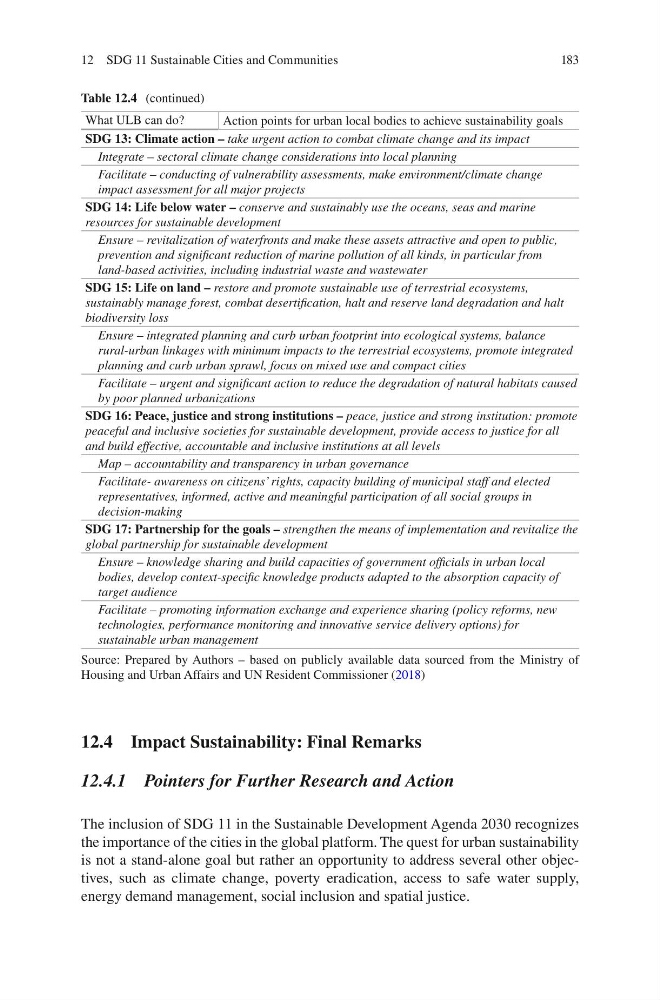
Table 12.4 (continued)
What ULB can do?
Action points for urban local bodies to achieve sustainability goals
SDG 13: Climate action – take urgent action to combat climate change and its impact
Integrate – sectoral climate change considerations into local planning
Facilitate – conducting of vulnerability assessments, make environment/climate change
impact assessment for all major projects
SDG 14: Life below water – conserve and sustainably use the oceans, seas and marine
resources for sustainable development
Ensure – revitalization of waterfronts and make these assets attractive and open to public,
prevention and significant reduction of marine pollution of all kinds, in particular from
land-based activities, including industrial waste and wastewater
SDG 15: Life on land – restore and promote sustainable use of terrestrial ecosystems,
sustainably manage forest, combat desertification, halt and reserve land degradation and halt
biodiversity loss
Ensure – integrated planning and curb urban footprint into ecological systems, balance
rural-urban linkages with minimum impacts to the terrestrial ecosystems, promote integrated
planning and curb urban sprawl, focus on mixed use and compact cities
Facilitate – urgent and significant action to reduce the degradation of natural habitats caused
by poor planned urbanizations
SDG 16: Peace, justice and strong institutions – peace, justice and strong institution: promote
peaceful and inclusive societies for sustainable development, provide access to justice for all
and build effective, accountable and inclusive institutions at all levels
Map – accountability and transparency in urban governance
Facilitate- awareness on citizens’ rights, capacity building of municipal staff and elected
representatives, informed, active and meaningful participation of all social groups in
decision-making
SDG 17: Partnership for the goals – strengthen the means of implementation and revitalize the
global partnership for sustainable development
Ensure – knowledge sharing and build capacities of government officials in urban local
bodies, develop context-specific knowledge products adapted to the absorption capacity of
target audience
Facilitate – promoting information exchange and experience sharing (policy reforms, new
technologies, performance monitoring and innovative service delivery options) for
sustainable urban management
Source: Prepared by Authors – based on publicly available data sourced from the Ministry of
Housing and Urban Affairs and UN Resident Commissioner (2018)
12.4 Impact Sustainability: Final Remarks
12.4.1 Pointers for Further Research and Action
The inclusion of SDG 11 in the Sustainable Development Agenda 2030 recognizes
the importance of the cities in the global platform. The quest for urban sustainability
is not a stand-alone goal but rather an opportunity to address several other objectives, such as climate change, poverty eradication, access to safe water supply,
energy demand management, social inclusion and spatial justice.
12 SDG 11 Sustainable Cities and Communities
Table 12.4 (continued)
What ULB can do?
Action points for urban local bodies to achieve sustainability goals
SDG 13: Climate action – take urgent action to combat climate change and its impact
Integrate – sectoral climate change considerations into local planning
Facilitate – conducting of vulnerability assessments, make environment/climate change
impact assessment for all major projects
SDG 14: Life below water – conserve and sustainably use the oceans, seas and marine
resources for sustainable development
Ensure – revitalization of waterfronts and make these assets attractive and open to public,
prevention and significant reduction of marine pollution of all kinds, in particular from
land-based activities, including industrial waste and wastewater
SDG 15: Life on land – restore and promote sustainable use of terrestrial ecosystems,
sustainably manage forest, combat desertification, halt and reserve land degradation and halt
biodiversity loss
Ensure – integrated planning and curb urban footprint into ecological systems, balance
rural-urban linkages with minimum impacts to the terrestrial ecosystems, promote integrated
planning and curb urban sprawl, focus on mixed use and compact cities
Facilitate – urgent and significant action to reduce the degradation of natural habitats caused
by poor planned urbanizations
SDG 16: Peace, justice and strong institutions – peace, justice and strong institution: promote
peaceful and inclusive societies for sustainable development, provide access to justice for all
and build effective, accountable and inclusive institutions at all levels
Map – accountability and transparency in urban governance
Facilitate- awareness on citizens’ rights, capacity building of municipal staff and elected
representatives, informed, active and meaningful participation of all social groups in
decision-making
SDG 17: Partnership for the goals – strengthen the means of implementation and revitalize the
global partnership for sustainable development
Ensure – knowledge sharing and build capacities of government officials in urban local
bodies, develop context-specific knowledge products adapted to the absorption capacity of
target audience
Facilitate – promoting information exchange and experience sharing (policy reforms, new
technologies, performance monitoring and innovative service delivery options) for
sustainable urban management
Source: Prepared by Authors – based on publicly available data sourced from the Ministry of
Housing and Urban Affairs and UN Resident Commissioner (2018)
12.4 Impact Sustainability: Final Remarks
12.4.1 Pointers for Further Research and Action
The inclusion of SDG 11 in the Sustainable Development Agenda 2030 recognizes
the importance of the cities in the global platform. The quest for urban sustainability
is not a stand-alone goal but rather an opportunity to address several other objectives, such as climate change, poverty eradication, access to safe water supply,
energy demand management, social inclusion and spatial justice.
12 SDG 11 Sustainable Cities and Communities