

160
balances for retirement: the gender wealth gap, the gender pay gap, gendered occupational segregation in the labour market and the care penalty.
11.3.1 Gender Wealth Gap
The gender wealth gap is the difference between men and women’s accumulation of
assets (Ravazzini and Chesters 2018). While the gender pay gap is oriented towards
illustrating the wealth gap in terms of wages, the gender wealth gap depicts a more
fuller picture of the economic disparity between genders. In this regard, the gender
wealth gap aims to be more all-encompassing and focuses on assets, bonds, property, possessions, etc. (Austen et al. 2013). In Australia, the gender wealth gap
between men and women increased from 10.4% to 22.8% between 2002 and 2010
(Committee 2016). This equates to an approximate gap of $46,900 (Austen et al.
2013).
5
A single male under 35 possesses assets worth $120,200 which is approxi5 In this study, Austen et al. (2013, p. 20) note that the increase in the gender wealth gap was primarily driven by the higher rate of increase in the median value of primary home assets held by
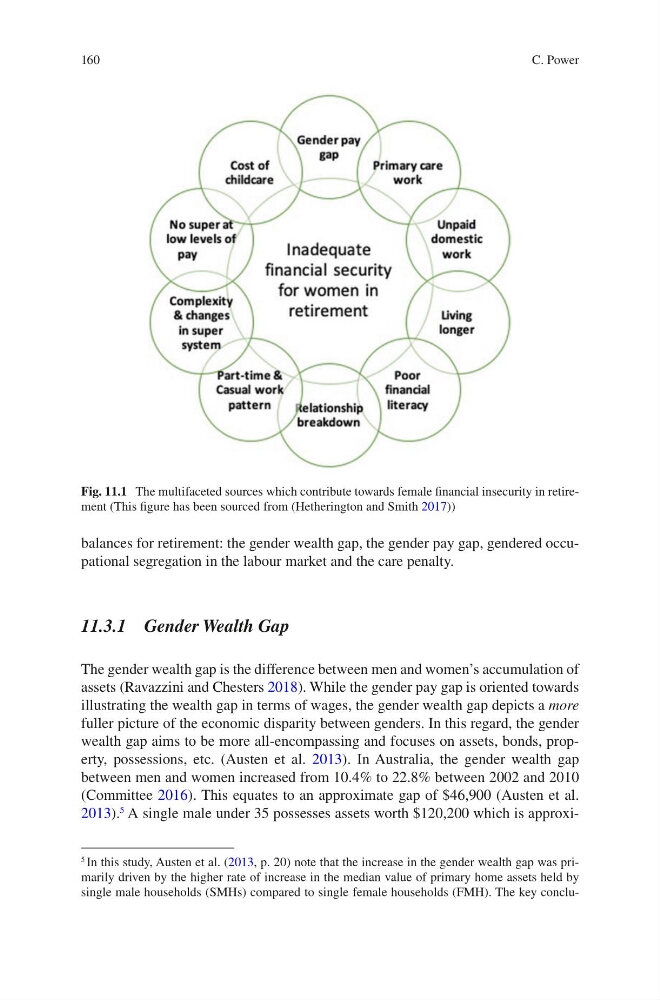
single male households (SMHs) compared to single female households (FMH). The key concluFig. 11.1 The multifaceted sources which contribute towards female financial insecurity in retirement (This figure has been sourced from (Hetherington and Smith 2017))
C. Power
balances for retirement: the gender wealth gap, the gender pay gap, gendered occupational segregation in the labour market and the care penalty.
11.3.1 Gender Wealth Gap
The gender wealth gap is the difference between men and women’s accumulation of
assets (Ravazzini and Chesters 2018). While the gender pay gap is oriented towards
illustrating the wealth gap in terms of wages, the gender wealth gap depicts a more
fuller picture of the economic disparity between genders. In this regard, the gender
wealth gap aims to be more all-encompassing and focuses on assets, bonds, property, possessions, etc. (Austen et al. 2013). In Australia, the gender wealth gap
between men and women increased from 10.4% to 22.8% between 2002 and 2010
(Committee 2016). This equates to an approximate gap of $46,900 (Austen et al.
2013).
5
A single male under 35 possesses assets worth $120,200 which is approxi5 In this study, Austen et al. (2013, p. 20) note that the increase in the gender wealth gap was primarily driven by the higher rate of increase in the median value of primary home assets held by
single male households (SMHs) compared to single female households (FMH). The key concluFig. 11.1 The multifaceted sources which contribute towards female financial insecurity in retirement (This figure has been sourced from (Hetherington and Smith 2017))
C. Power