

157
ing financial equality in retirement. With particular reference to sub-target 10.2, this
chapter argues that there is sufficient scope to expand financial education and literacy programmes, specifically so that they are more tailored to the diverse career
trajectories that women face. Under the recommendations of target 10.2, I will further argue that financial education should be embedded within a national school
curriculum framework. Finally, this chapter will consider how sub- target 10.3 and
10.4 can be employed to dismantle the structural and systemic barriers embedded
within superannuation policy in Australia. The key conclusion arising from this
chapter is that within the framework of the sustainable development goals, there is
ample scope to use the direction of SDG 10 to develop a national agenda which will
ameliorate financial security for women in retirement.
11.2 Surveying the Literature: The Architecture
of Australia’s Retirement Policy
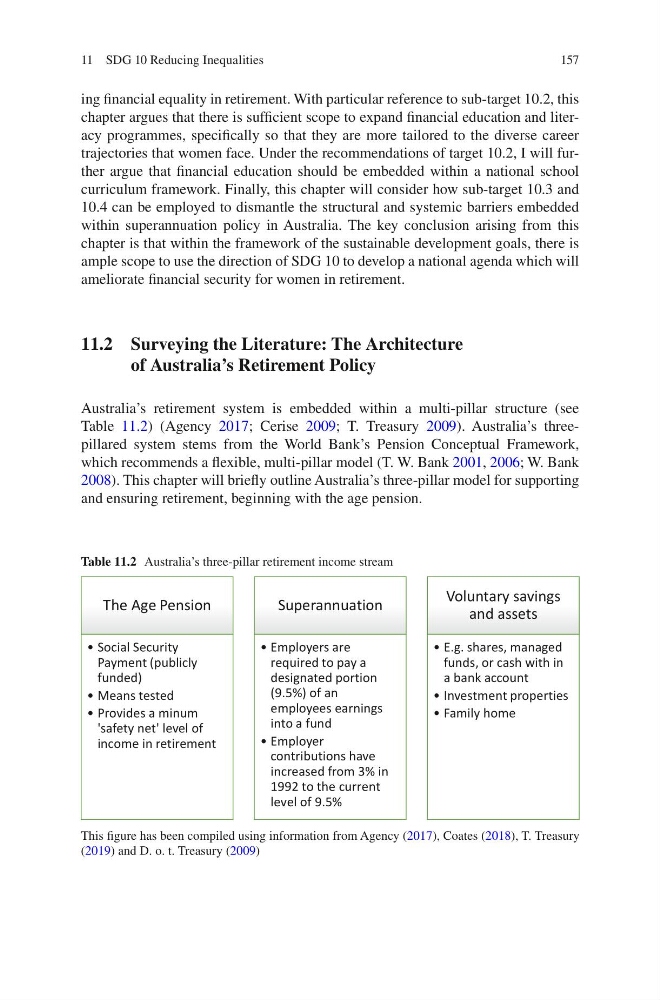
Australia’s retirement system is embedded within a multi-pillar structure (see
Table 11.2) (Agency 2017; Cerise 2009; T. Treasury 2009). Australia’s threepillared system stems from the World Bank’s Pension Conceptual Framework,
which recommends a flexible, multi-pillar model (T. W. Bank 2001, 2006; W. Bank
2008). This chapter will briefly outline Australia’s three-pillar model for supporting
and ensuring retirement, beginning with the age pension.
The Age Pension
• Social Security
Payment (publicly
funded)
• Means tested
• Provides a minum
'safety net' level of
income in retirement
Superannuation
• Employers are
required to pay a
designated portion
(9.5%) of an
employees earnings
into a fund
• Employer
contributions have
increased from 3% in
1992 to the current
level of 9.5%
Voluntary savings
and assets
• E.g. shares, managed
funds, or cash with in
a bank account
• Investment properties
• Family home
Table 11.2 Australia’s three-pillar retirement income stream
This figure has been compiled using information from Agency (2017), Coates (2018), T. Treasury
(2019) and D. o. t. Treasury (2009)
11 SDG 10 Reducing Inequalities
ing financial equality in retirement. With particular reference to sub-target 10.2, this
chapter argues that there is sufficient scope to expand financial education and literacy programmes, specifically so that they are more tailored to the diverse career
trajectories that women face. Under the recommendations of target 10.2, I will further argue that financial education should be embedded within a national school
curriculum framework. Finally, this chapter will consider how sub- target 10.3 and
10.4 can be employed to dismantle the structural and systemic barriers embedded
within superannuation policy in Australia. The key conclusion arising from this
chapter is that within the framework of the sustainable development goals, there is
ample scope to use the direction of SDG 10 to develop a national agenda which will
ameliorate financial security for women in retirement.
11.2 Surveying the Literature: The Architecture
of Australia’s Retirement Policy
Australia’s retirement system is embedded within a multi-pillar structure (see
Table 11.2) (Agency 2017; Cerise 2009; T. Treasury 2009). Australia’s threepillared system stems from the World Bank’s Pension Conceptual Framework,
which recommends a flexible, multi-pillar model (T. W. Bank 2001, 2006; W. Bank
2008). This chapter will briefly outline Australia’s three-pillar model for supporting
and ensuring retirement, beginning with the age pension.
The Age Pension
• Social Security
Payment (publicly
funded)
• Means tested
• Provides a minum
'safety net' level of
income in retirement
Superannuation
• Employers are
required to pay a
designated portion
(9.5%) of an
employees earnings
into a fund
• Employer
contributions have
increased from 3% in
1992 to the current
level of 9.5%
Voluntary savings
and assets
• E.g. shares, managed
funds, or cash with in
a bank account
• Investment properties
• Family home
Table 11.2 Australia’s three-pillar retirement income stream
This figure has been compiled using information from Agency (2017), Coates (2018), T. Treasury
(2019) and D. o. t. Treasury (2009)
11 SDG 10 Reducing Inequalities