

121
released by the United Nations (UN) in 2015. Even before that, fair trade organisations demonstrated their alignment with the Millennium Development Goals established by UN and released in 2008. Prior to this, sustainability values were present
in case studies and social responsibility reports made available by the Fairtrade
Foundation (FF) since 2001.
The Fairtrade (and fair trade) model, through establishing a floor price above the
market price, works to address inequalities in the market and to protect small producers from prices volatility risks. This minimum price standard assures a stable
income to small farmers, which allows them to plan and invest in their production.
Whenever the market price goes above the fair price, the market price is guaranteed
for fair trade producers. A certified fair trade producer will have the guarantee of a
buyer and assurance of a stable income from his production. This trade initiative can
make difference for small producers’ working conditions, livelihoods, their families, the community where they grow food, the local economy and international
trade. At every level of the fair trade supply chain, a degree of social change is
shared. Half of the global population subjected to hunger is constituted by small
farmers (FAO 2012), as such the change promoted by the fair trade model, despite
viewed as small by some analysis of the movement, can have impact for small producers and wealth generation. Fair trade constitutes less than 5% of the global trade,
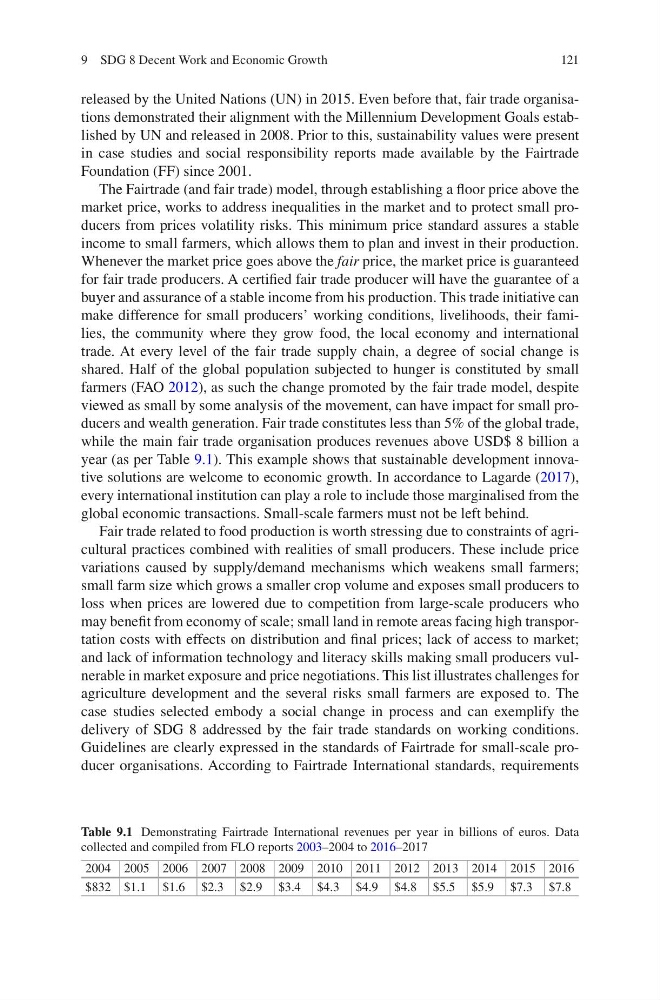
while the main fair trade organisation produces revenues above USD$ 8 billion a
year (as per Table 9.1). This example shows that sustainable development innovative solutions are welcome to economic growth. In accordance to Lagarde (2017),
every international institution can play a role to include those marginalised from the
global economic transactions. Small-scale farmers must not be left behind.
Fair trade related to food production is worth stressing due to constraints of agricultural practices combined with realities of small producers. These include price
variations caused by supply/demand mechanisms which weakens small farmers;
small farm size which grows a smaller crop volume and exposes small producers to
loss when prices are lowered due to competition from large-scale producers who
may benefit from economy of scale; small land in remote areas facing high transportation costs with effects on distribution and final prices; lack of access to market;
and lack of information technology and literacy skills making small producers vulnerable in market exposure and price negotiations. This list illustrates challenges for
agriculture development and the several risks small farmers are exposed to. The
case studies selected embody a social change in process and can exemplify the
delivery of SDG 8 addressed by the fair trade standards on working conditions.
Guidelines are clearly expressed in the standards of Fairtrade for small-scale producer organisations. According to Fairtrade International standards, requirements
Table 9.1 Demonstrating Fairtrade International revenues per year in billions of euros. Data
collected and compiled from FLO reports 2003–2004 to 2016–2017
2004 2005 2006 2007 2008 2009 2010 2011 2012 2013 2014 2015 2016
$832 $1.1 $1.6 $2.3 $2.9 $3.4 $4.3 $4.9 $4.8 $5.5 $5.9 $7.3 $7.8
9 SDG 8 Decent Work and Economic Growth
released by the United Nations (UN) in 2015. Even before that, fair trade organisations demonstrated their alignment with the Millennium Development Goals established by UN and released in 2008. Prior to this, sustainability values were present
in case studies and social responsibility reports made available by the Fairtrade
Foundation (FF) since 2001.
The Fairtrade (and fair trade) model, through establishing a floor price above the
market price, works to address inequalities in the market and to protect small producers from prices volatility risks. This minimum price standard assures a stable
income to small farmers, which allows them to plan and invest in their production.
Whenever the market price goes above the fair price, the market price is guaranteed
for fair trade producers. A certified fair trade producer will have the guarantee of a
buyer and assurance of a stable income from his production. This trade initiative can
make difference for small producers’ working conditions, livelihoods, their families, the community where they grow food, the local economy and international
trade. At every level of the fair trade supply chain, a degree of social change is
shared. Half of the global population subjected to hunger is constituted by small
farmers (FAO 2012), as such the change promoted by the fair trade model, despite
viewed as small by some analysis of the movement, can have impact for small producers and wealth generation. Fair trade constitutes less than 5% of the global trade,
while the main fair trade organisation produces revenues above USD$ 8 billion a
year (as per Table 9.1). This example shows that sustainable development innovative solutions are welcome to economic growth. In accordance to Lagarde (2017),
every international institution can play a role to include those marginalised from the
global economic transactions. Small-scale farmers must not be left behind.
Fair trade related to food production is worth stressing due to constraints of agricultural practices combined with realities of small producers. These include price
variations caused by supply/demand mechanisms which weakens small farmers;
small farm size which grows a smaller crop volume and exposes small producers to
loss when prices are lowered due to competition from large-scale producers who
may benefit from economy of scale; small land in remote areas facing high transportation costs with effects on distribution and final prices; lack of access to market;
and lack of information technology and literacy skills making small producers vulnerable in market exposure and price negotiations. This list illustrates challenges for
agriculture development and the several risks small farmers are exposed to. The
case studies selected embody a social change in process and can exemplify the
delivery of SDG 8 addressed by the fair trade standards on working conditions.
Guidelines are clearly expressed in the standards of Fairtrade for small-scale producer organisations. According to Fairtrade International standards, requirements
Table 9.1 Demonstrating Fairtrade International revenues per year in billions of euros. Data
collected and compiled from FLO reports 2003–2004 to 2016–2017
2004 2005 2006 2007 2008 2009 2010 2011 2012 2013 2014 2015 2016
$832 $1.1 $1.6 $2.3 $2.9 $3.4 $4.3 $4.9 $4.8 $5.5 $5.9 $7.3 $7.8
9 SDG 8 Decent Work and Economic Growth