

66
I. G. Breaban and A. I. Breaban
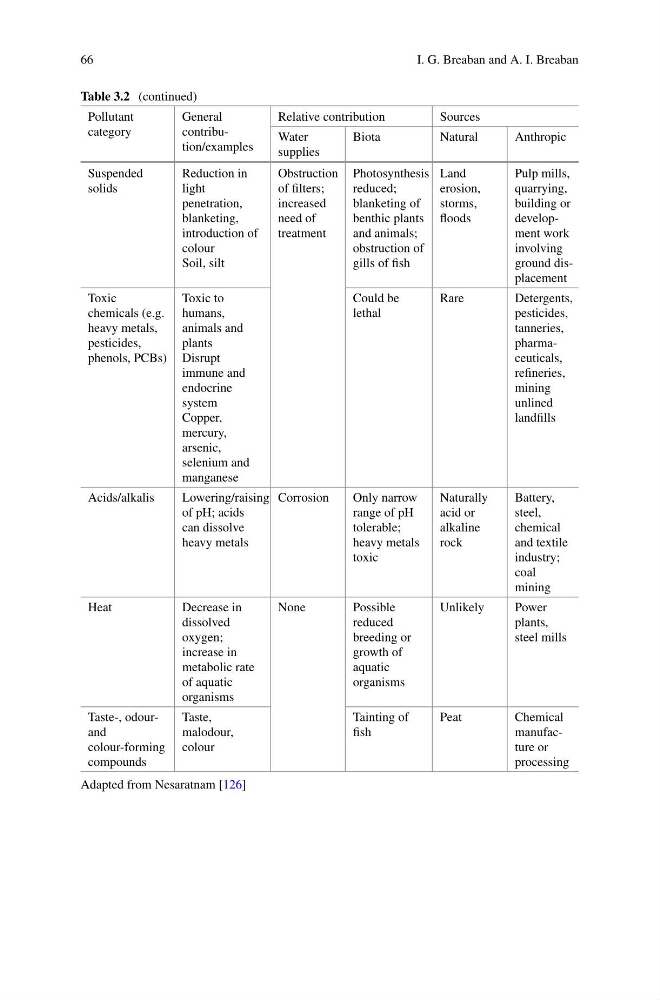
Table 3.2 (continued)
Pollutant
category
General
contribution/examples
Relative contribution
Sources
Water
supplies
Biota
Natural
Anthropic
Suspended
solids
Reduction in
light
penetration,
blanketing,
introduction of
colour
Soil, silt
Obstruction
of filters;
increased
need of
treatment
Photosynthesis
reduced;
blanketing of
benthic plants
and animals;
obstruction of
gills of fish
Land
erosion,
storms,
floods
Pulp mills,
quarrying,
building or
development work
involving
ground displacement
Toxic
chemicals (e.g.
heavy metals,
pesticides,
phenols, PCBs)
Toxic to
humans,
animals and
plants
Disrupt
immune and
endocrine
system
Copper,
mercury,
arsenic,
selenium and
manganese
Could be
lethal
Rare
Detergents,
pesticides,
tanneries,
pharmaceuticals,
refineries,
mining
unlined
landfills
Acids/alkalis
Lowering/raising
of pH; acids
can dissolve
heavy metals
Corrosion
Only narrow
range of pH
tolerable;
heavy metals
toxic
Naturally
acid or
alkaline
rock
Battery,
steel,
chemical
and textile
industry;
coal
mining
Heat
Decrease in
dissolved
oxygen;
increase in
metabolic rate
of aquatic
organisms
None
Possible
reduced
breeding or
growth of
aquatic
organisms
Unlikely
Power
plants,
steel mills
Taste-, odourand
colour-forming
compounds
Taste,
malodour,
colour
Tainting of
fish
Peat
Chemical
manufacture or
processing
Adapted from Nesaratnam [126]
I. G. Breaban and A. I. Breaban
Table 3.2 (continued)
Pollutant
category
General
contribution/examples
Relative contribution
Sources
Water
supplies
Biota
Natural
Anthropic
Suspended
solids
Reduction in
light
penetration,
blanketing,
introduction of
colour
Soil, silt
Obstruction
of filters;
increased
need of
treatment
Photosynthesis
reduced;
blanketing of
benthic plants
and animals;
obstruction of
gills of fish
Land
erosion,
storms,
floods
Pulp mills,
quarrying,
building or
development work
involving
ground displacement
Toxic
chemicals (e.g.
heavy metals,
pesticides,
phenols, PCBs)
Toxic to
humans,
animals and
plants
Disrupt
immune and
endocrine
system
Copper,
mercury,
arsenic,
selenium and
manganese
Could be
lethal
Rare
Detergents,
pesticides,
tanneries,
pharmaceuticals,
refineries,
mining
unlined
landfills
Acids/alkalis
Lowering/raising
of pH; acids
can dissolve
heavy metals
Corrosion
Only narrow
range of pH
tolerable;
heavy metals
toxic
Naturally
acid or
alkaline
rock
Battery,
steel,
chemical
and textile
industry;
coal
mining
Heat
Decrease in
dissolved
oxygen;
increase in
metabolic rate
of aquatic
organisms
None
Possible
reduced
breeding or
growth of
aquatic
organisms
Unlikely
Power
plants,
steel mills
Taste-, odourand
colour-forming
compounds
Taste,
malodour,
colour
Tainting of
fish
Peat
Chemical
manufacture or
processing
Adapted from Nesaratnam [126]