

2 Implementation of EU Water Framework Directive (2000/60/EC) …
39
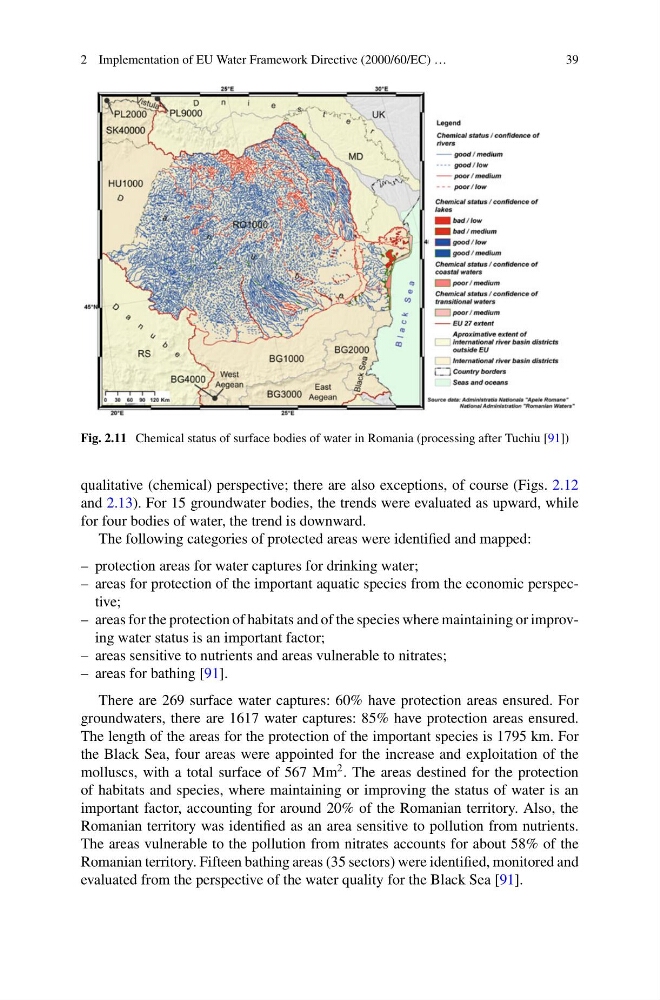
Fig. 2.11 Chemical status of surface bodies of water in Romania (processing after Tuchiu [91])
qualitative (chemical) perspective; there are also exceptions, of course (Figs. 2.12
and 2.13). For 15 groundwater bodies, the trends were evaluated as upward, while
for four bodies of water, the trend is downward.
The following categories of protected areas were identified and mapped:
– protection areas for water captures for drinking water;
– areas for protection of the important aquatic species from the economic perspective;
– areas for the protection of habitats and of the species where maintaining or improving water status is an important factor;
– areas sensitive to nutrients and areas vulnerable to nitrates;
– areas for bathing [91].
There are 269 surface water captures: 60% have protection areas ensured. For
groundwaters, there are 1617 water captures: 85% have protection areas ensured.
The length of the areas for the protection of the important species is 1795 km. For
the Black Sea, four areas were appointed for the increase and exploitation of the
molluscs, with a total surface of 567 Mm
2 . The areas destined for the protection
of habitats and species, where maintaining or improving the status of water is an
important factor, accounting for around 20% of the Romanian territory. Also, the
Romanian territory was identified as an area sensitive to pollution from nutrients.
The areas vulnerable to the pollution from nitrates accounts for about 58% of the
Romanian territory. Fifteen bathing areas (35 sectors) were identified, monitored and
evaluated from the perspective of the water quality for the Black Sea [91].
39
Fig. 2.11 Chemical status of surface bodies of water in Romania (processing after Tuchiu [91])
qualitative (chemical) perspective; there are also exceptions, of course (Figs. 2.12
and 2.13). For 15 groundwater bodies, the trends were evaluated as upward, while
for four bodies of water, the trend is downward.
The following categories of protected areas were identified and mapped:
– protection areas for water captures for drinking water;
– areas for protection of the important aquatic species from the economic perspective;
– areas for the protection of habitats and of the species where maintaining or improving water status is an important factor;
– areas sensitive to nutrients and areas vulnerable to nitrates;
– areas for bathing [91].
There are 269 surface water captures: 60% have protection areas ensured. For
groundwaters, there are 1617 water captures: 85% have protection areas ensured.
The length of the areas for the protection of the important species is 1795 km. For
the Black Sea, four areas were appointed for the increase and exploitation of the
molluscs, with a total surface of 567 Mm
2 . The areas destined for the protection
of habitats and species, where maintaining or improving the status of water is an
important factor, accounting for around 20% of the Romanian territory. Also, the
Romanian territory was identified as an area sensitive to pollution from nutrients.
The areas vulnerable to the pollution from nitrates accounts for about 58% of the
Romanian territory. Fifteen bathing areas (35 sectors) were identified, monitored and
evaluated from the perspective of the water quality for the Black Sea [91].