

318
L. Zaharia et al.
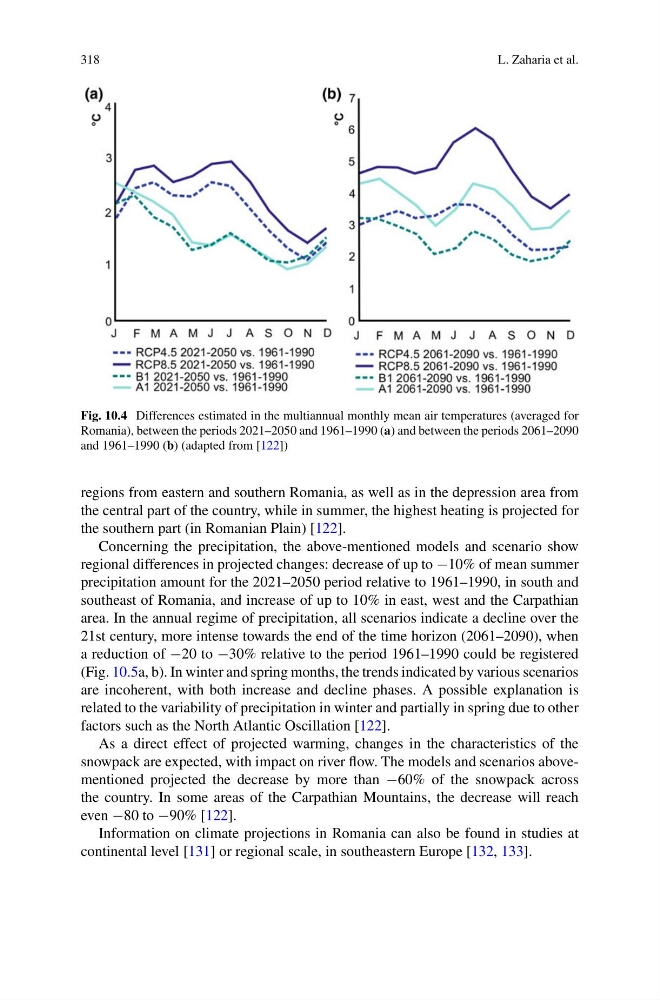
Fig. 10.4 Differences estimated in the multiannual monthly mean air temperatures (averaged for
Romania), between the periods 2021–2050 and 1961–1990 (a) and between the periods 2061–2090
and 1961–1990 (b) (adapted from [122])
regions from eastern and southern Romania, as well as in the depression area from
the central part of the country, while in summer, the highest heating is projected for
the southern part (in Romanian Plain) [122].
Concerning the precipitation, the above-mentioned models and scenario show
regional differences in projected changes: decrease of up to −10% of mean summer
precipitation amount for the 2021–2050 period relative to 1961–1990, in south and
southeast of Romania, and increase of up to 10% in east, west and the Carpathian
area. In the annual regime of precipitation, all scenarios indicate a decline over the
21st century, more intense towards the end of the time horizon (2061–2090), when
a reduction of −20 to −30% relative to the period 1961–1990 could be registered
(Fig. 10.5a, b). In winter and spring months, the trends indicated by various scenarios
are incoherent, with both increase and decline phases. A possible explanation is
related to the variability of precipitation in winter and partially in spring due to other
factors such as the North Atlantic Oscillation [122].
As a direct effect of projected warming, changes in the characteristics of the
snowpack are expected, with impact on river flow. The models and scenarios abovementioned projected the decrease by more than −60% of the snowpack across
the country. In some areas of the Carpathian Mountains, the decrease will reach
even −80 to −90% [122].
Information on climate projections in Romania can also be found in studies at
continental level [131] or regional scale, in southeastern Europe [132, 133].
L. Zaharia et al.
Fig. 10.4 Differences estimated in the multiannual monthly mean air temperatures (averaged for
Romania), between the periods 2021–2050 and 1961–1990 (a) and between the periods 2061–2090
and 1961–1990 (b) (adapted from [122])
regions from eastern and southern Romania, as well as in the depression area from
the central part of the country, while in summer, the highest heating is projected for
the southern part (in Romanian Plain) [122].
Concerning the precipitation, the above-mentioned models and scenario show
regional differences in projected changes: decrease of up to −10% of mean summer
precipitation amount for the 2021–2050 period relative to 1961–1990, in south and
southeast of Romania, and increase of up to 10% in east, west and the Carpathian
area. In the annual regime of precipitation, all scenarios indicate a decline over the
21st century, more intense towards the end of the time horizon (2061–2090), when
a reduction of −20 to −30% relative to the period 1961–1990 could be registered
(Fig. 10.5a, b). In winter and spring months, the trends indicated by various scenarios
are incoherent, with both increase and decline phases. A possible explanation is
related to the variability of precipitation in winter and partially in spring due to other
factors such as the North Atlantic Oscillation [122].
As a direct effect of projected warming, changes in the characteristics of the
snowpack are expected, with impact on river flow. The models and scenarios abovementioned projected the decrease by more than −60% of the snowpack across
the country. In some areas of the Carpathian Mountains, the decrease will reach
even −80 to −90% [122].
Information on climate projections in Romania can also be found in studies at
continental level [131] or regional scale, in southeastern Europe [132, 133].