

190
A. Constantin and C. St. Nitescu
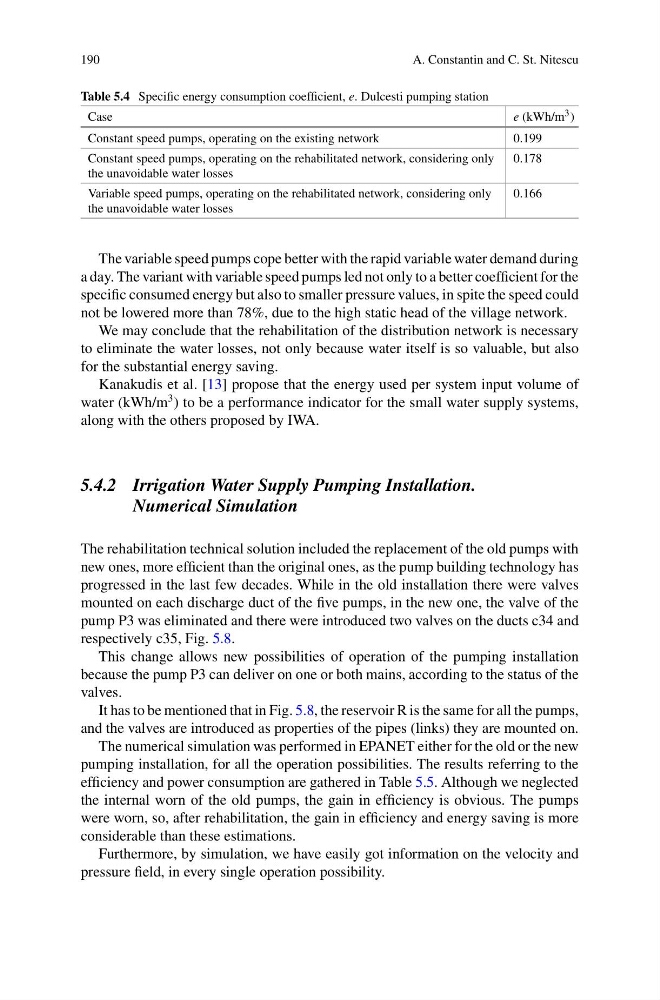
Table 5.4 Specific energy consumption coefficient, e. Dulcesti pumping station
Case
e (kWh/m 3 )
Constant speed pumps, operating on the existing network
0.199
Constant speed pumps, operating on the rehabilitated network, considering only
the unavoidable water losses
0.178
Variable speed pumps, operating on the rehabilitated network, considering only
the unavoidable water losses
0.166
The variable speed pumps cope better with the rapid variable water demand during
a day. The variant with variable speed pumps led not only to a better coefficient for the
specific consumed energy but also to smaller pressure values, in spite the speed could
not be lowered more than 78%, due to the high static head of the village network.
We may conclude that the rehabilitation of the distribution network is necessary
to eliminate the water losses, not only because water itself is so valuable, but also
for the substantial energy saving.
Kanakudis et al. [13] propose that the energy used per system input volume of
water (kWh/m
3 ) to be a performance indicator for the small water supply systems,
along with the others proposed by IWA.
5.4.2 Irrigation Water Supply Pumping Installation.
Numerical Simulation
The rehabilitation technical solution included the replacement of the old pumps with
new ones, more efficient than the original ones, as the pump building technology has
progressed in the last few decades. While in the old installation there were valves
mounted on each discharge duct of the five pumps, in the new one, the valve of the
pump P3 was eliminated and there were introduced two valves on the ducts c34 and
respectively c35, Fig. 5.8.
This change allows new possibilities of operation of the pumping installation
because the pump P3 can deliver on one or both mains, according to the status of the
valves.
It has to be mentioned that in Fig. 5.8, the reservoir R is the same for all the pumps,
and the valves are introduced as properties of the pipes (links) they are mounted on.
The numerical simulation was performed in EPANET either for the old or the new
pumping installation, for all the operation possibilities. The results referring to the
efficiency and power consumption are gathered in Table 5.5. Although we neglected
the internal worn of the old pumps, the gain in efficiency is obvious. The pumps
were worn, so, after rehabilitation, the gain in efficiency and energy saving is more
considerable than these estimations.
Furthermore, by simulation, we have easily got information on the velocity and
pressure field, in every single operation possibility.
A. Constantin and C. St. Nitescu
Table 5.4 Specific energy consumption coefficient, e. Dulcesti pumping station
Case
e (kWh/m 3 )
Constant speed pumps, operating on the existing network
0.199
Constant speed pumps, operating on the rehabilitated network, considering only
the unavoidable water losses
0.178
Variable speed pumps, operating on the rehabilitated network, considering only
the unavoidable water losses
0.166
The variable speed pumps cope better with the rapid variable water demand during
a day. The variant with variable speed pumps led not only to a better coefficient for the
specific consumed energy but also to smaller pressure values, in spite the speed could
not be lowered more than 78%, due to the high static head of the village network.
We may conclude that the rehabilitation of the distribution network is necessary
to eliminate the water losses, not only because water itself is so valuable, but also
for the substantial energy saving.
Kanakudis et al. [13] propose that the energy used per system input volume of
water (kWh/m
3 ) to be a performance indicator for the small water supply systems,
along with the others proposed by IWA.
5.4.2 Irrigation Water Supply Pumping Installation.
Numerical Simulation
The rehabilitation technical solution included the replacement of the old pumps with
new ones, more efficient than the original ones, as the pump building technology has
progressed in the last few decades. While in the old installation there were valves
mounted on each discharge duct of the five pumps, in the new one, the valve of the
pump P3 was eliminated and there were introduced two valves on the ducts c34 and
respectively c35, Fig. 5.8.
This change allows new possibilities of operation of the pumping installation
because the pump P3 can deliver on one or both mains, according to the status of the
valves.
It has to be mentioned that in Fig. 5.8, the reservoir R is the same for all the pumps,
and the valves are introduced as properties of the pipes (links) they are mounted on.
The numerical simulation was performed in EPANET either for the old or the new
pumping installation, for all the operation possibilities. The results referring to the
efficiency and power consumption are gathered in Table 5.5. Although we neglected
the internal worn of the old pumps, the gain in efficiency is obvious. The pumps
were worn, so, after rehabilitation, the gain in efficiency and energy saving is more
considerable than these estimations.
Furthermore, by simulation, we have easily got information on the velocity and
pressure field, in every single operation possibility.