

186
A. Constantin and C. St. Nitescu
Table 5.3 Technical parameters for main duty points. Galesu pumping station
Duty point
Parameter
Old PS
New PS
H max = 34 m, Q = 5400 m 3 /h (on one single main)
η p (%)
82
89
P a (kW)
2215
1575
H min = 29 m, Q p = 2,760 m 3 /h (one pump)
η p (%)
73
87
P a (kW)
400
315
where Q discharge flow rate; H total pumping head
η p pump’s efficiency; Pa absorbed electric power
The pumps have individual suction pipelines. On the discharge pipeline system,
there is a particular connection for the middle pump that can deliver on each one
of the two mains and also on both mains simultaneously. The discharge duct of the
pump P3 (the middle one) splits immediately after it exits the building and each
of its branches is connected to other individual discharge ducts. Both branches are
provided with butterfly valve. Therefore, there are more operation possibilities: one
or more pumps, delivering on one or both mains. The installation is symmetrical
from a hydraulic viewpoint.
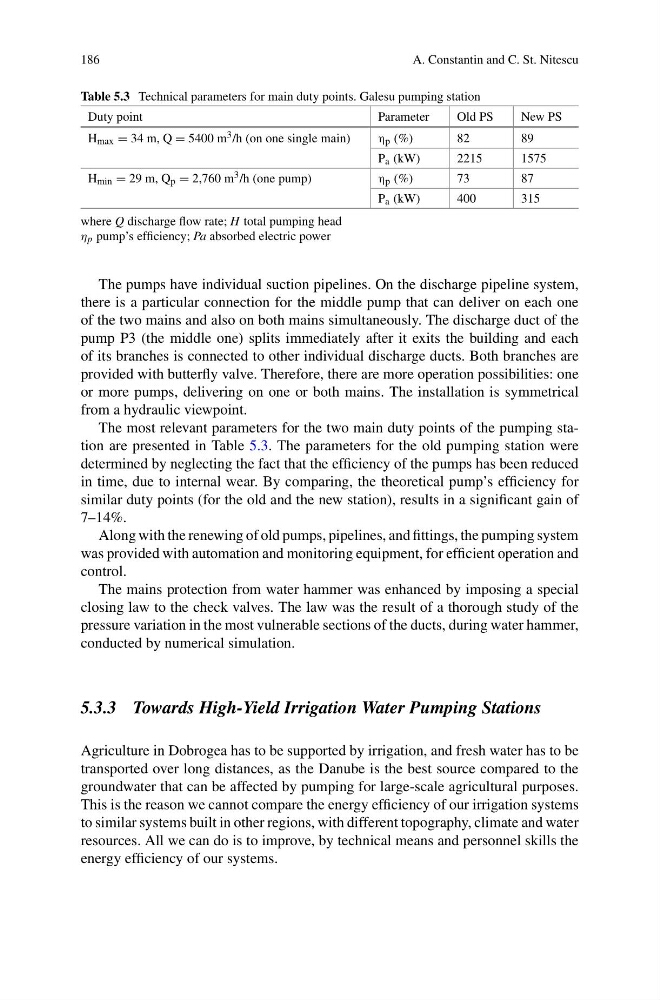
The most relevant parameters for the two main duty points of the pumping station are presented in Table 5.3. The parameters for the old pumping station were
determined by neglecting the fact that the efficiency of the pumps has been reduced
in time, due to internal wear. By comparing, the theoretical pump’s efficiency for
similar duty points (for the old and the new station), results in a significant gain of
7–14%.
Along with the renewing of old pumps, pipelines, and fittings, the pumping system
was provided with automation and monitoring equipment, for efficient operation and
control.
The mains protection from water hammer was enhanced by imposing a special
closing law to the check valves. The law was the result of a thorough study of the
pressure variation in the most vulnerable sections of the ducts, during water hammer,
conducted by numerical simulation.
5.3.3 Towards High-Yield Irrigation Water Pumping Stations
Agriculture in Dobrogea has to be supported by irrigation, and fresh water has to be
transported over long distances, as the Danube is the best source compared to the
groundwater that can be affected by pumping for large-scale agricultural purposes.
This is the reason we cannot compare the energy efficiency of our irrigation systems
to similar systems built in other regions, with different topography, climate and water
resources. All we can do is to improve, by technical means and personnel skills the
energy efficiency of our systems.
A. Constantin and C. St. Nitescu
Table 5.3 Technical parameters for main duty points. Galesu pumping station
Duty point
Parameter
Old PS
New PS
H max = 34 m, Q = 5400 m 3 /h (on one single main)
η p (%)
82
89
P a (kW)
2215
1575
H min = 29 m, Q p = 2,760 m 3 /h (one pump)
η p (%)
73
87
P a (kW)
400
315
where Q discharge flow rate; H total pumping head
η p pump’s efficiency; Pa absorbed electric power
The pumps have individual suction pipelines. On the discharge pipeline system,
there is a particular connection for the middle pump that can deliver on each one
of the two mains and also on both mains simultaneously. The discharge duct of the
pump P3 (the middle one) splits immediately after it exits the building and each
of its branches is connected to other individual discharge ducts. Both branches are
provided with butterfly valve. Therefore, there are more operation possibilities: one
or more pumps, delivering on one or both mains. The installation is symmetrical
from a hydraulic viewpoint.
The most relevant parameters for the two main duty points of the pumping station are presented in Table 5.3. The parameters for the old pumping station were
determined by neglecting the fact that the efficiency of the pumps has been reduced
in time, due to internal wear. By comparing, the theoretical pump’s efficiency for
similar duty points (for the old and the new station), results in a significant gain of
7–14%.
Along with the renewing of old pumps, pipelines, and fittings, the pumping system
was provided with automation and monitoring equipment, for efficient operation and
control.
The mains protection from water hammer was enhanced by imposing a special
closing law to the check valves. The law was the result of a thorough study of the
pressure variation in the most vulnerable sections of the ducts, during water hammer,
conducted by numerical simulation.
5.3.3 Towards High-Yield Irrigation Water Pumping Stations
Agriculture in Dobrogea has to be supported by irrigation, and fresh water has to be
transported over long distances, as the Danube is the best source compared to the
groundwater that can be affected by pumping for large-scale agricultural purposes.
This is the reason we cannot compare the energy efficiency of our irrigation systems
to similar systems built in other regions, with different topography, climate and water
resources. All we can do is to improve, by technical means and personnel skills the
energy efficiency of our systems.