

4 Management of Surfaces Water Resources—Ecological Status …
163
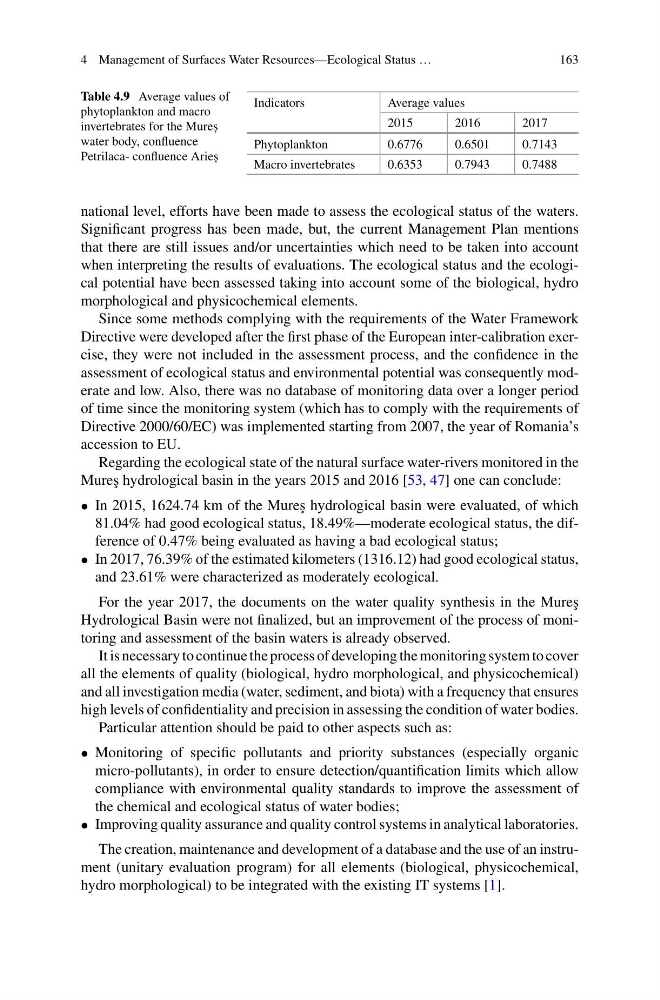
Table 4.9 Average values of
phytoplankton and macro
invertebrates for the Mures ,
water body, confluence
Petrilaca- confluence Aries ,
Indicators
Average values
2015
2016
2017
Phytoplankton
0.6776
0.6501
0.7143
Macro invertebrates
0.6353
0.7943
0.7488
national level, efforts have been made to assess the ecological status of the waters.
Significant progress has been made, but, the current Management Plan mentions
that there are still issues and/or uncertainties which need to be taken into account
when interpreting the results of evaluations. The ecological status and the ecological potential have been assessed taking into account some of the biological, hydro
morphological and physicochemical elements.
Since some methods complying with the requirements of the Water Framework
Directive were developed after the first phase of the European inter-calibration exercise, they were not included in the assessment process, and the confidence in the
assessment of ecological status and environmental potential was consequently moderate and low. Also, there was no database of monitoring data over a longer period
of time since the monitoring system (which has to comply with the requirements of
Directive 2000/60/EC) was implemented starting from 2007, the year of Romania’s
accession to EU.
Regarding the ecological state of the natural surface water-rivers monitored in the
Mure¸ s hydrological basin in the years 2015 and 2016 [53, 47] one can conclude:
• In 2015, 1624.74 km of the Mure¸ s hydrological basin were evaluated, of which
81.04% had good ecological status, 18.49%—moderate ecological status, the difference of 0.47% being evaluated as having a bad ecological status;
• In 2017, 76.39% of the estimated kilometers (1316.12) had good ecological status,
and 23.61% were characterized as moderately ecological.
For the year 2017, the documents on the water quality synthesis in the Mure¸ s
Hydrological Basin were not finalized, but an improvement of the process of monitoring and assessment of the basin waters is already observed.
It is necessary to continue the process of developing the monitoring system to cover
all the elements of quality (biological, hydro morphological, and physicochemical)
and all investigation media (water, sediment, and biota) with a frequency that ensures
high levels of confidentiality and precision in assessing the condition of water bodies.
Particular attention should be paid to other aspects such as:
• Monitoring of specific pollutants and priority substances (especially organic
micro-pollutants), in order to ensure detection/quantification limits which allow
compliance with environmental quality standards to improve the assessment of
the chemical and ecological status of water bodies;
• Improving quality assurance and quality control systems in analytical laboratories.
The creation, maintenance and development of a database and the use of an instrument (unitary evaluation program) for all elements (biological, physicochemical,
hydro morphological) to be integrated with the existing IT systems [1].
163
Table 4.9 Average values of
phytoplankton and macro
invertebrates for the Mures ,
water body, confluence
Petrilaca- confluence Aries ,
Indicators
Average values
2015
2016
2017
Phytoplankton
0.6776
0.6501
0.7143
Macro invertebrates
0.6353
0.7943
0.7488
national level, efforts have been made to assess the ecological status of the waters.
Significant progress has been made, but, the current Management Plan mentions
that there are still issues and/or uncertainties which need to be taken into account
when interpreting the results of evaluations. The ecological status and the ecological potential have been assessed taking into account some of the biological, hydro
morphological and physicochemical elements.
Since some methods complying with the requirements of the Water Framework
Directive were developed after the first phase of the European inter-calibration exercise, they were not included in the assessment process, and the confidence in the
assessment of ecological status and environmental potential was consequently moderate and low. Also, there was no database of monitoring data over a longer period
of time since the monitoring system (which has to comply with the requirements of
Directive 2000/60/EC) was implemented starting from 2007, the year of Romania’s
accession to EU.
Regarding the ecological state of the natural surface water-rivers monitored in the
Mure¸ s hydrological basin in the years 2015 and 2016 [53, 47] one can conclude:
• In 2015, 1624.74 km of the Mure¸ s hydrological basin were evaluated, of which
81.04% had good ecological status, 18.49%—moderate ecological status, the difference of 0.47% being evaluated as having a bad ecological status;
• In 2017, 76.39% of the estimated kilometers (1316.12) had good ecological status,
and 23.61% were characterized as moderately ecological.
For the year 2017, the documents on the water quality synthesis in the Mure¸ s
Hydrological Basin were not finalized, but an improvement of the process of monitoring and assessment of the basin waters is already observed.
It is necessary to continue the process of developing the monitoring system to cover
all the elements of quality (biological, hydro morphological, and physicochemical)
and all investigation media (water, sediment, and biota) with a frequency that ensures
high levels of confidentiality and precision in assessing the condition of water bodies.
Particular attention should be paid to other aspects such as:
• Monitoring of specific pollutants and priority substances (especially organic
micro-pollutants), in order to ensure detection/quantification limits which allow
compliance with environmental quality standards to improve the assessment of
the chemical and ecological status of water bodies;
• Improving quality assurance and quality control systems in analytical laboratories.
The creation, maintenance and development of a database and the use of an instrument (unitary evaluation program) for all elements (biological, physicochemical,
hydro morphological) to be integrated with the existing IT systems [1].