

98
I. G. Breaban and A. I. Breaban
The following criteria were used to assess the quantitative status of groundwater
bodies:
– water balance;
– connection with surface water;
– influence on groundwater ecosystems dependent on groundwater;
– intrusion of saline water or other intrusions.
The freatic pollution is often an almost irreversible phenomenon, with significant
consequences on the use of the underground water supply for drinking purposes, and
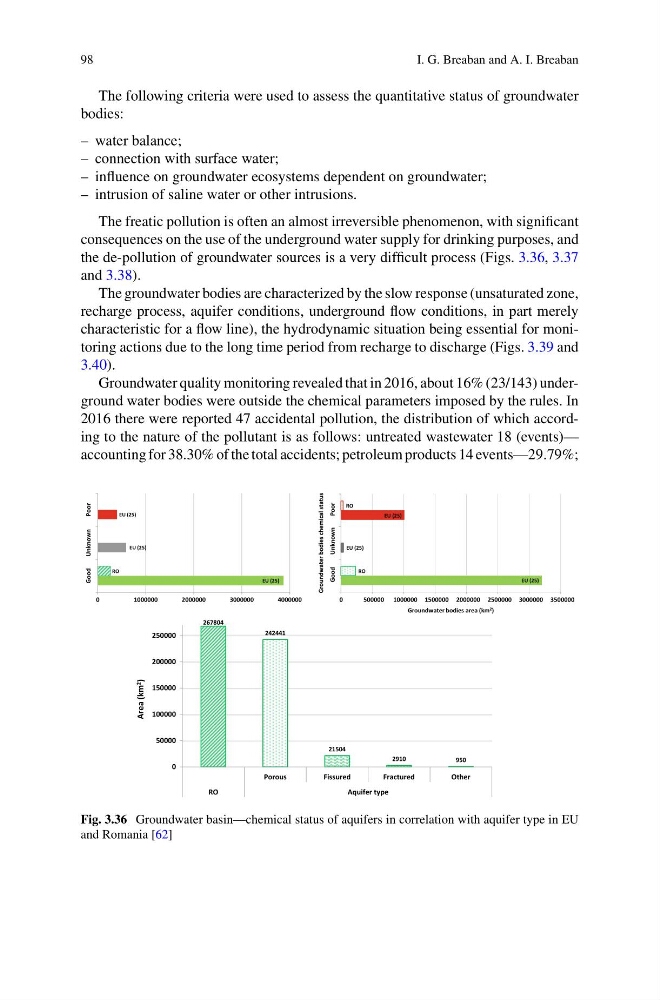
the de-pollution of groundwater sources is a very difficult process (Figs. 3.36, 3.37
and 3.38).
The groundwater bodies are characterized by the slow response (unsaturated zone,
recharge process, aquifer conditions, underground flow conditions, in part merely
characteristic for a flow line), the hydrodynamic situation being essential for monitoring actions due to the long time period from recharge to discharge (Figs. 3.39 and
3.40).
Groundwater quality monitoring revealed that in 2016, about 16% (23/143) underground water bodies were outside the chemical parameters imposed by the rules. In
2016 there were reported 47 accidental pollution, the distribution of which according to the nature of the pollutant is as follows: untreated wastewater 18 (events)—
accounting for 38.30% of the total accidents; petroleum products 14 events—29.79%;
EU (25)
EU (25)
EU (25)
RO
0
1000000
2000000
3000000
4000000
Good
Unknown
Poor
267804
242441
21504
2910
950
0
50000
100000
150000
200000
250000
Porous
Fissured
Fractured
Other
Aquifer type
RO
Area (km 2
)
EU (25)
EU (25)
EU (25)
RO
RO
0
500000 1000000 1500000 2000000 2500000 3000000 3500000
Good
Unknown
Poor
Groundwater bodies area (km 2 )
Groundwater bodies chemical status
Fig. 3.36 Groundwater basin—chemical status of aquifers in correlation with aquifer type in EU
and Romania [62]
I. G. Breaban and A. I. Breaban
The following criteria were used to assess the quantitative status of groundwater
bodies:
– water balance;
– connection with surface water;
– influence on groundwater ecosystems dependent on groundwater;
– intrusion of saline water or other intrusions.
The freatic pollution is often an almost irreversible phenomenon, with significant
consequences on the use of the underground water supply for drinking purposes, and
the de-pollution of groundwater sources is a very difficult process (Figs. 3.36, 3.37
and 3.38).
The groundwater bodies are characterized by the slow response (unsaturated zone,
recharge process, aquifer conditions, underground flow conditions, in part merely
characteristic for a flow line), the hydrodynamic situation being essential for monitoring actions due to the long time period from recharge to discharge (Figs. 3.39 and
3.40).
Groundwater quality monitoring revealed that in 2016, about 16% (23/143) underground water bodies were outside the chemical parameters imposed by the rules. In
2016 there were reported 47 accidental pollution, the distribution of which according to the nature of the pollutant is as follows: untreated wastewater 18 (events)—
accounting for 38.30% of the total accidents; petroleum products 14 events—29.79%;
EU (25)
EU (25)
EU (25)
RO
0
1000000
2000000
3000000
4000000
Good
Unknown
Poor
267804
242441
21504
2910
950
0
50000
100000
150000
200000
250000
Porous
Fissured
Fractured
Other
Aquifer type
RO
Area (km 2
)
EU (25)
EU (25)
EU (25)
RO
RO
0
500000 1000000 1500000 2000000 2500000 3000000 3500000
Good
Unknown
Poor
Groundwater bodies area (km 2 )
Groundwater bodies chemical status
Fig. 3.36 Groundwater basin—chemical status of aquifers in correlation with aquifer type in EU
and Romania [62]