

62
The objectives of this study are to (1) determine the water quantity/quality status
of three contiguous aquifers in semi-urbanized areas in Northern Mexico, (2)
explore a possible relationship between WL and water quality to changes in land use
for scales of the Chihuahuan Desert and the socio-ecological system in study, and
(3) draft recommendations towards the implementation of measures that will
enhance sustainability.
Materials and Methods
Study Area
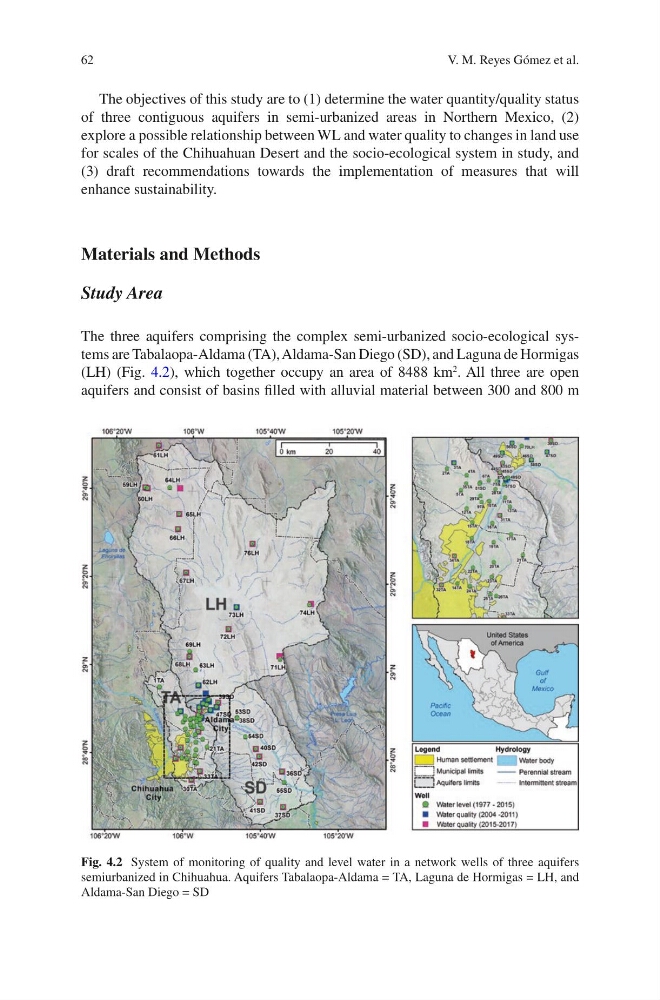
The three aquifers comprising the complex semi-urbanized socio-ecological systems are Tabalaopa-Aldama (TA), Aldama-San Diego (SD), and Laguna de Hormigas
(LH) (Fig. 4.2), which together occupy an area of 8488 km
2
. All three are open
aquifers and consist of basins filled with alluvial material between 300 and 800 m
Fig. 4.2 System of monitoring of quality and level water in a network wells of three aquifers
semiurbanized in Chihuahua. Aquifers Tabalaopa-Aldama = TA, Laguna de Hormigas = LH, and
Aldama-San Diego = SD
V. M. Reyes Gómez et al.
The objectives of this study are to (1) determine the water quantity/quality status
of three contiguous aquifers in semi-urbanized areas in Northern Mexico, (2)
explore a possible relationship between WL and water quality to changes in land use
for scales of the Chihuahuan Desert and the socio-ecological system in study, and
(3) draft recommendations towards the implementation of measures that will
enhance sustainability.
Materials and Methods
Study Area
The three aquifers comprising the complex semi-urbanized socio-ecological systems are Tabalaopa-Aldama (TA), Aldama-San Diego (SD), and Laguna de Hormigas
(LH) (Fig. 4.2), which together occupy an area of 8488 km
2
. All three are open
aquifers and consist of basins filled with alluvial material between 300 and 800 m
Fig. 4.2 System of monitoring of quality and level water in a network wells of three aquifers
semiurbanized in Chihuahua. Aquifers Tabalaopa-Aldama = TA, Laguna de Hormigas = LH, and
Aldama-San Diego = SD
V. M. Reyes Gómez et al.