

338
Introduction
In territories like drylands—already made more fragile by climate change and by
their context, in itself more difficult—the progressive marginalization of populations from the attention of policy makers and from economic circuits has provoked
a vicious circle: depopulation, abandonment of the territory, economic unproductivity, which multiplies the depopulation, and so on. In such a framework, it is evident
that administrative planning plays a decisive role with a broad vision and capable of
considering all the relevant social, economic, and environmental aspects (Zortea
and Lucatello 2016).
A transversal approach is needed and expressed by the principle 4 of the Rio
Declaration on Environment and Development (UNCED 1992) with an integration
of the various environmental aspects and impacts within all the components of the
administrative and political management of a territory that is broad and disrupted,
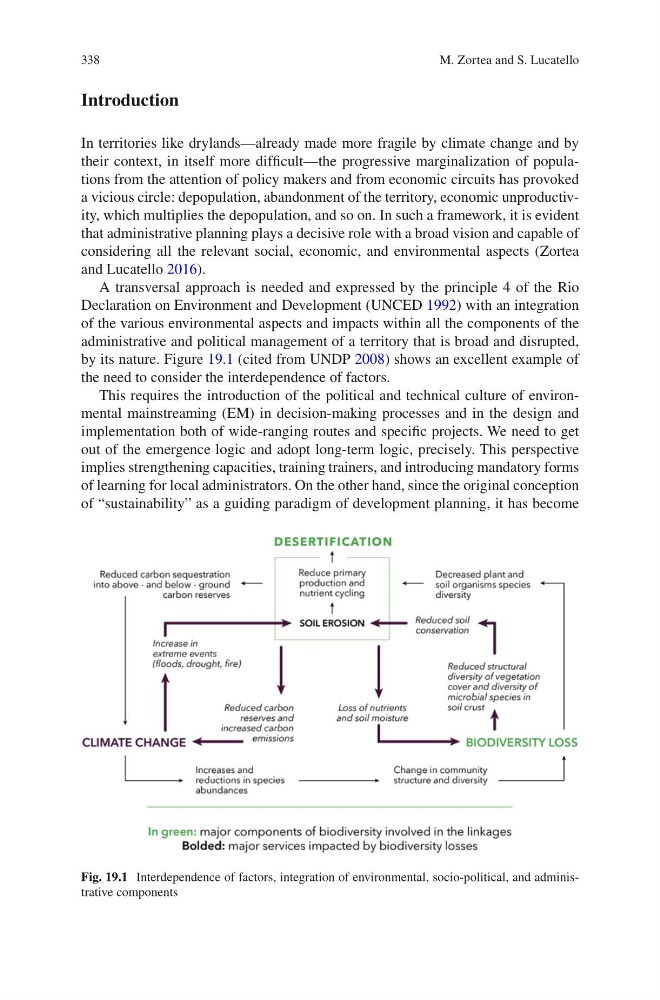
by its nature. Figure 19.1 (cited from UNDP 2008) shows an excellent example of
the need to consider the interdependence of factors.
This requires the introduction of the political and technical culture of environmental mainstreaming (EM) in decision-making processes and in the design and
implementation both of wide-ranging routes and specific projects. We need to get
out of the emergence logic and adopt long-term logic, precisely. This perspective
implies strengthening capacities, training trainers, and introducing mandatory forms
of learning for local administrators. On the other hand, since the original conception
of “sustainability” as a guiding paradigm of development planning, it has become
Fig. 19.1 Interdependence of factors, integration of environmental, socio-political, and administrative components
M. Zortea and S. Lucatello
Introduction
In territories like drylands—already made more fragile by climate change and by
their context, in itself more difficult—the progressive marginalization of populations from the attention of policy makers and from economic circuits has provoked
a vicious circle: depopulation, abandonment of the territory, economic unproductivity, which multiplies the depopulation, and so on. In such a framework, it is evident
that administrative planning plays a decisive role with a broad vision and capable of
considering all the relevant social, economic, and environmental aspects (Zortea
and Lucatello 2016).
A transversal approach is needed and expressed by the principle 4 of the Rio
Declaration on Environment and Development (UNCED 1992) with an integration
of the various environmental aspects and impacts within all the components of the
administrative and political management of a territory that is broad and disrupted,
by its nature. Figure 19.1 (cited from UNDP 2008) shows an excellent example of
the need to consider the interdependence of factors.
This requires the introduction of the political and technical culture of environmental mainstreaming (EM) in decision-making processes and in the design and
implementation both of wide-ranging routes and specific projects. We need to get
out of the emergence logic and adopt long-term logic, precisely. This perspective
implies strengthening capacities, training trainers, and introducing mandatory forms
of learning for local administrators. On the other hand, since the original conception
of “sustainability” as a guiding paradigm of development planning, it has become
Fig. 19.1 Interdependence of factors, integration of environmental, socio-political, and administrative components
M. Zortea and S. Lucatello