

274
barriers between artists from different cultures were much smaller than one could
have expected when a traditional, popular, and highly sophisticated ritual met a
modern, less accessible form of art. Instead of a clash between the Ahwash tradition
and contemporary dance and music, a continuous flow between the expressive
forms could be observed.
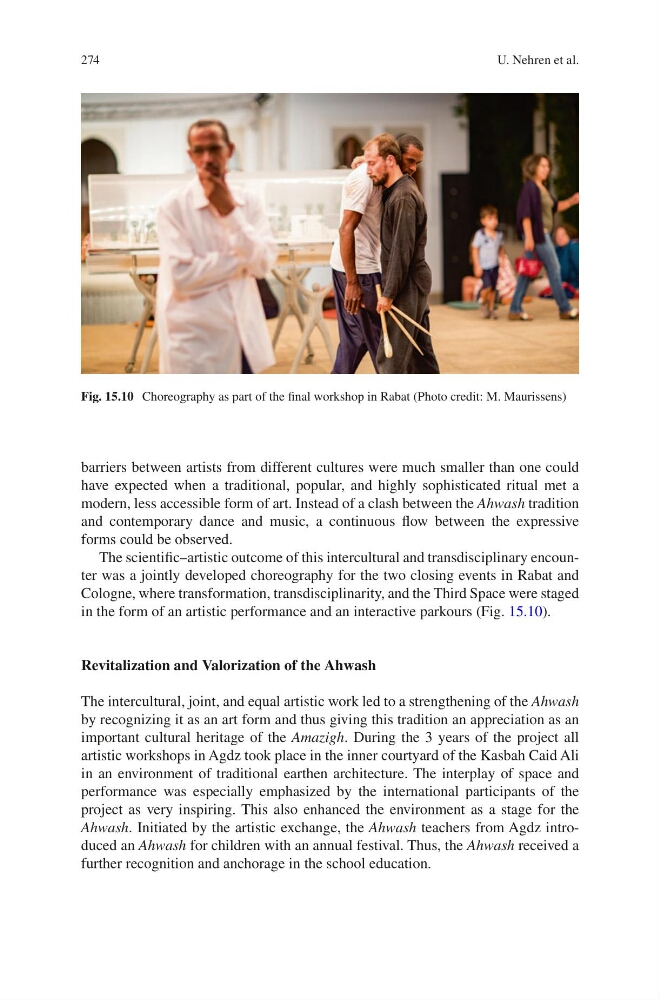
The scientific–artistic outcome of this intercultural and transdisciplinary encounter was a jointly developed choreography for the two closing events in Rabat and
Cologne, where transformation, transdisciplinarity, and the Third Space were staged
in the form of an artistic performance and an interactive parkours (Fig. 15.10).
Revitalization and Valorization of the Ahwash
The intercultural, joint, and equal artistic work led to a strengthening of the Ahwash
by recognizing it as an art form and thus giving this tradition an appreciation as an
important cultural heritage of the Amazigh. During the 3 years of the project all
artistic workshops in Agdz took place in the inner courtyard of the Kasbah Caid Ali
in an environment of traditional earthen architecture. The interplay of space and
performance was especially emphasized by the international participants of the
project as very inspiring. This also enhanced the environment as a stage for the
Ahwash. Initiated by the artistic exchange, the Ahwash teachers from Agdz introduced an Ahwash for children with an annual festival. Thus, the Ahwash received a
further recognition and anchorage in the school education.
Fig. 15.10 Choreography as part of the final workshop in Rabat (Photo credit: M. Maurissens)
U. Nehren et al.
barriers between artists from different cultures were much smaller than one could
have expected when a traditional, popular, and highly sophisticated ritual met a
modern, less accessible form of art. Instead of a clash between the Ahwash tradition
and contemporary dance and music, a continuous flow between the expressive
forms could be observed.
The scientific–artistic outcome of this intercultural and transdisciplinary encounter was a jointly developed choreography for the two closing events in Rabat and
Cologne, where transformation, transdisciplinarity, and the Third Space were staged
in the form of an artistic performance and an interactive parkours (Fig. 15.10).
Revitalization and Valorization of the Ahwash
The intercultural, joint, and equal artistic work led to a strengthening of the Ahwash
by recognizing it as an art form and thus giving this tradition an appreciation as an
important cultural heritage of the Amazigh. During the 3 years of the project all
artistic workshops in Agdz took place in the inner courtyard of the Kasbah Caid Ali
in an environment of traditional earthen architecture. The interplay of space and
performance was especially emphasized by the international participants of the
project as very inspiring. This also enhanced the environment as a stage for the
Ahwash. Initiated by the artistic exchange, the Ahwash teachers from Agdz introduced an Ahwash for children with an annual festival. Thus, the Ahwash received a
further recognition and anchorage in the school education.
Fig. 15.10 Choreography as part of the final workshop in Rabat (Photo credit: M. Maurissens)
U. Nehren et al.