

173
initiative of the director of the Reserve to promote strong local participation.
Therefore, while the RBM represents a positive example from CONANP, overall
there is still low feedback among local inhabitants and government institutions at
other scales. This council is still trying to improve cohesion and seeking better local
participation to mediate land use and internal conflict, access to information and a
voice in the reserve management scheme. While it is not the scope of the present
chapter and it is not necessarily the case in the RBM, CONANP has been criticized
for its top- down management approaches and lack of adequate management plans.
Protected land is widely dispersed, often remote and not connected throughout the
country, and their stewardship mainly follows a neoliberal conservation model,
which responds almost exclusively to economic valuation and mercantilization of
nature, with a utopic fascination for sustainable development (i.e., Durand 2014;
Guzmán 2016).
Another group of interest is composed of different research groups that are present intermittently in the BRM. As it was described earlier, these groups have been
present ever since the foundation of the reserve and while they seek to generate
scientific knowledge that can potentially serve the government, settlers, and NGOs
in designing local development and/or conservation projects, there has not been a
direct link between this group and others, especially with the local residents.
Therefore, this situation highlights the importance of generating place-based knowledge in collaboration with the different actors involved (Agrawal and Gibson 1999).
In case of BRM, the conducted interviews revealed two main topics for applied
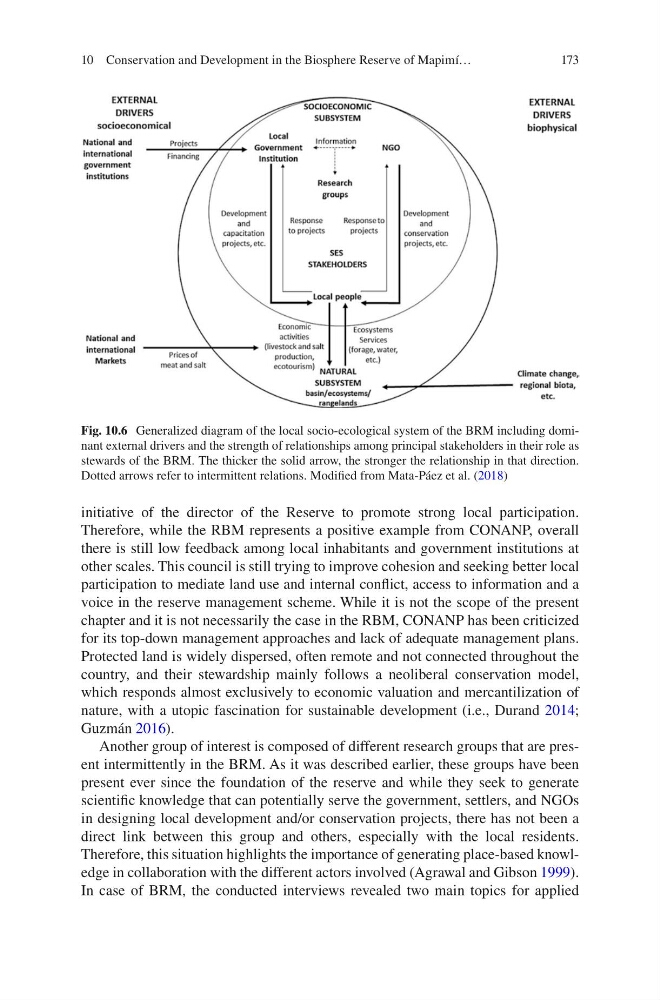
Fig. 10.6 Generalized diagram of the local socio-ecological system of the BRM including dominant external drivers and the strength of relationships among principal stakeholders in their role as
stewards of the BRM. The thicker the solid arrow, the stronger the relationship in that direction.
Dotted arrows refer to intermittent relations. Modified from Mata-Páez et al. (2018)
10 Conservation and Development in the Biosphere Reserve of Mapimí…
initiative of the director of the Reserve to promote strong local participation.
Therefore, while the RBM represents a positive example from CONANP, overall
there is still low feedback among local inhabitants and government institutions at
other scales. This council is still trying to improve cohesion and seeking better local
participation to mediate land use and internal conflict, access to information and a
voice in the reserve management scheme. While it is not the scope of the present
chapter and it is not necessarily the case in the RBM, CONANP has been criticized
for its top- down management approaches and lack of adequate management plans.
Protected land is widely dispersed, often remote and not connected throughout the
country, and their stewardship mainly follows a neoliberal conservation model,
which responds almost exclusively to economic valuation and mercantilization of
nature, with a utopic fascination for sustainable development (i.e., Durand 2014;
Guzmán 2016).
Another group of interest is composed of different research groups that are present intermittently in the BRM. As it was described earlier, these groups have been
present ever since the foundation of the reserve and while they seek to generate
scientific knowledge that can potentially serve the government, settlers, and NGOs
in designing local development and/or conservation projects, there has not been a
direct link between this group and others, especially with the local residents.
Therefore, this situation highlights the importance of generating place-based knowledge in collaboration with the different actors involved (Agrawal and Gibson 1999).
In case of BRM, the conducted interviews revealed two main topics for applied
Fig. 10.6 Generalized diagram of the local socio-ecological system of the BRM including dominant external drivers and the strength of relationships among principal stakeholders in their role as
stewards of the BRM. The thicker the solid arrow, the stronger the relationship in that direction.
Dotted arrows refer to intermittent relations. Modified from Mata-Páez et al. (2018)
10 Conservation and Development in the Biosphere Reserve of Mapimí…