

87
Groundwater Users’ Participation and Perception
in Maneadero Valley
In this section we analyse the results of a survey carried out between August 14th
and November 9th on 2017 with a group of farmers (groundwater users with a concession) in Maneadero Valley (n = 52). The objective of the survey was to document
aspects regarding socioeconomic attributes, attitudes towards public participation
and agricultural and water management practices, and then, to propose recommendations to improve groundwater management and governance.
The instrument consisted of 27 questions divided into three sections of variables:
(1) sociodemographic, (2) public participation in water management and governance and (3) agricultural practices and implemented solutions to groundwater scarcity and pollution. The questionnaire was designed as a result of prior research,
interviews with experts and communication with the technical manager of COTAS
Maneadero. To carry out the surveys we use the office of the COTAS. The surveys
were conducted in person and individually with farmers.
Previously, we have been acting as active observers in water meetings and forums
in Baja California where Maneadero Valley is mentioned, in order to gather information on the context, stakeholders and how the decisions on quantity and quality
of water supply are taken. We also have done field work that provides a general
Component
Variables
Human (socio-economic,
governance) subsystem
influenced by the water
subsystem
• Population growth and immigration in Ensenada: demand of
water, sanitation and public health services
• Economic activities and land-use changes: agricultural,
public-urban, services, domestic, livestock and industrial uses
• Markets and prices
• Competing users
• Ineffective water policies: regulations of water quantity and
quality without follow-up, excessive number of concessions,
absence of an integrated water management plan
• Inadequate institutional arrangements
• Outdated legal framework to reduce groundwater variations
• Alternative water sources: RW reuse in foraging and flower
crops, groundwater recharge through incidental discharges on
riverbeds and private use of desalination plants
• No capacity of water users to influence decision-making, even
though COTAS
• Variety of social actors
– COTAS
– State agencies (CONAGUA, SEDAGRO, CESPE)
– Local level administrative staff
– Water users (farmers), landowners, producers
– Academics, NGOs, farmworkers
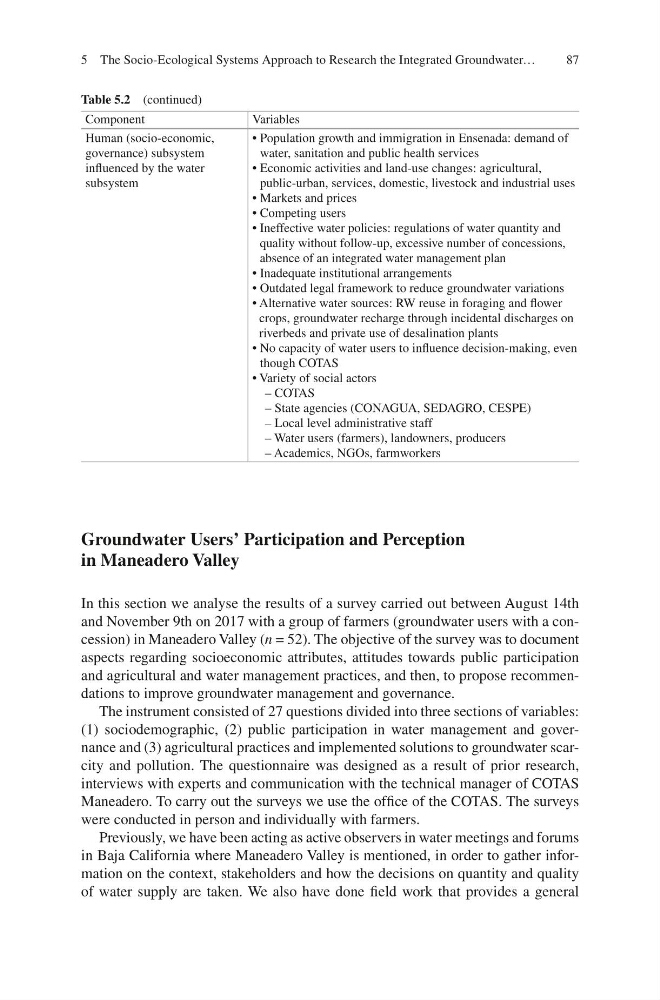
Table 5.2 (continued)
5 The Socio-Ecological Systems Approach to Research the Integrated Groundwater…
Groundwater Users’ Participation and Perception
in Maneadero Valley
In this section we analyse the results of a survey carried out between August 14th
and November 9th on 2017 with a group of farmers (groundwater users with a concession) in Maneadero Valley (n = 52). The objective of the survey was to document
aspects regarding socioeconomic attributes, attitudes towards public participation
and agricultural and water management practices, and then, to propose recommendations to improve groundwater management and governance.
The instrument consisted of 27 questions divided into three sections of variables:
(1) sociodemographic, (2) public participation in water management and governance and (3) agricultural practices and implemented solutions to groundwater scarcity and pollution. The questionnaire was designed as a result of prior research,
interviews with experts and communication with the technical manager of COTAS
Maneadero. To carry out the surveys we use the office of the COTAS. The surveys
were conducted in person and individually with farmers.
Previously, we have been acting as active observers in water meetings and forums
in Baja California where Maneadero Valley is mentioned, in order to gather information on the context, stakeholders and how the decisions on quantity and quality
of water supply are taken. We also have done field work that provides a general
Component
Variables
Human (socio-economic,
governance) subsystem
influenced by the water
subsystem
• Population growth and immigration in Ensenada: demand of
water, sanitation and public health services
• Economic activities and land-use changes: agricultural,
public-urban, services, domestic, livestock and industrial uses
• Markets and prices
• Competing users
• Ineffective water policies: regulations of water quantity and
quality without follow-up, excessive number of concessions,
absence of an integrated water management plan
• Inadequate institutional arrangements
• Outdated legal framework to reduce groundwater variations
• Alternative water sources: RW reuse in foraging and flower
crops, groundwater recharge through incidental discharges on
riverbeds and private use of desalination plants
• No capacity of water users to influence decision-making, even
though COTAS
• Variety of social actors
– COTAS
– State agencies (CONAGUA, SEDAGRO, CESPE)
– Local level administrative staff
– Water users (farmers), landowners, producers
– Academics, NGOs, farmworkers
Table 5.2 (continued)
5 The Socio-Ecological Systems Approach to Research the Integrated Groundwater…