

types. It also considers the influences of meteorological conditions including temperature, solar radiation and humidity on the canopy resistance. The Wesely scheme
is now widely used in air quality models at different spatial scales. Using prescribed
vegetation and soil parameters to characterize the underlying surface in the scheme
may result in large errors. A verification of the Wesely scheme by Wu et al. (2012)
using PAN dry deposition rates observed in the coniferous Duke Forest in the United
States found that it underestimated the dry deposition rates due to overestimates of
the canopy stomatal resistance and stratum corneum resistance.
The Wesely scheme considers the surface as a uniform ‘big leaf’, but the real
canopy structure is more complex. Meyers et al. (1998) developed a multilayer dry
deposition model based on the study of Baldocchi et al. (1987). The model uses the
Norman (1979) canopy radiation transmission model to calculate the amount of
photosynthetically available radiation and the ratio of sunlit/shaded leaf for further
calculating the stomatal resistance in each layer. The Meyers multilayer model
(Meyers et al. 1998) has been applied to estimate the V d of NO 2 , HNO 3 , SO 2 , O 3
and particulate matter at CASTNET sites. Multilayer models require more detailed
canopy morphological parameters (e.g. leaf area index vertical profile, leaf angle,
canopy height), which are often difficult to obtain at a regional scale. They are thus
more commonly used in single point deposition modelling and less often for regional
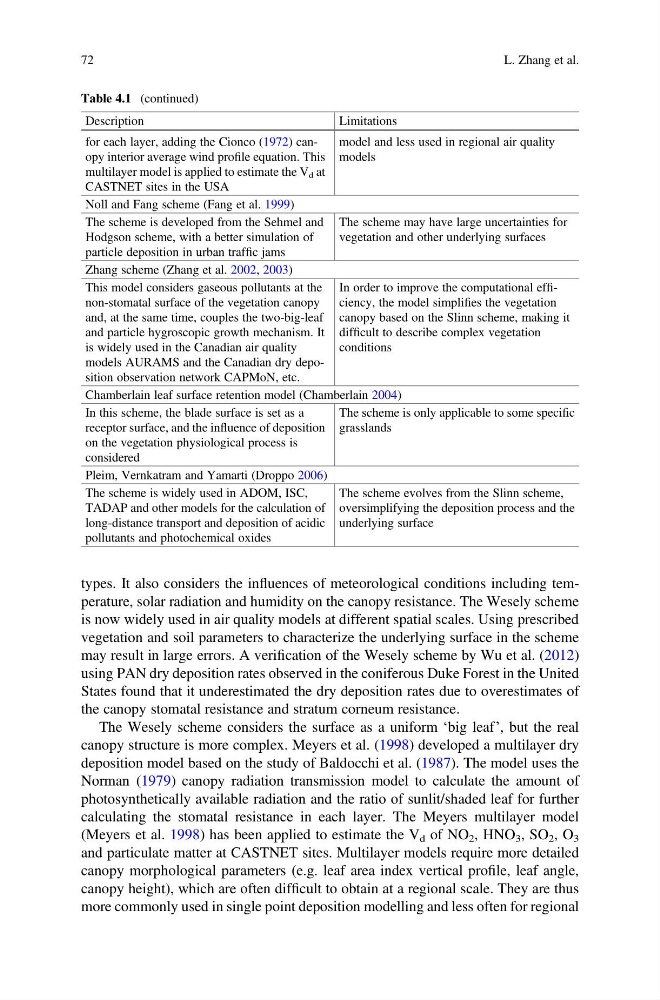
Table 4.1 (continued)
Description
Limitations
for each layer, adding the Cionco (1972) canopy interior average wind profile equation. This
multilayer model is applied to estimate the V d at
CASTNET sites in the USA
model and less used in regional air quality
models
Noll and Fang scheme (Fang et al. 1999)
The scheme is developed from the Sehmel and
Hodgson scheme, with a better simulation of
particle deposition in urban traffic jams
The scheme may have large uncertainties for
vegetation and other underlying surfaces
Zhang scheme (Zhang et al. 2002, 2003)
This model considers gaseous pollutants at the
non-stomatal surface of the vegetation canopy
and, at the same time, couples the two-big-leaf
and particle hygroscopic growth mechanism. It
is widely used in the Canadian air quality
models AURAMS and the Canadian dry deposition observation network CAPMoN, etc.
In order to improve the computational efficiency, the model simplifies the vegetation
canopy based on the Slinn scheme, making it
difficult to describe complex vegetation
conditions
Chamberlain leaf surface retention model (Chamberlain 2004)
In this scheme, the blade surface is set as a
receptor surface, and the influence of deposition
on the vegetation physiological process is
considered
The scheme is only applicable to some specific
grasslands
Pleim, Vernkatram and Yamarti (Droppo 2006)
The scheme is widely used in ADOM, ISC,
TADAP and other models for the calculation of
long-distance transport and deposition of acidic
pollutants and photochemical oxides
The scheme evolves from the Slinn scheme,
oversimplifying the deposition process and the
underlying surface
72
L. Zhang et al.
is now widely used in air quality models at different spatial scales. Using prescribed
vegetation and soil parameters to characterize the underlying surface in the scheme
may result in large errors. A verification of the Wesely scheme by Wu et al. (2012)
using PAN dry deposition rates observed in the coniferous Duke Forest in the United
States found that it underestimated the dry deposition rates due to overestimates of
the canopy stomatal resistance and stratum corneum resistance.
The Wesely scheme considers the surface as a uniform ‘big leaf’, but the real
canopy structure is more complex. Meyers et al. (1998) developed a multilayer dry
deposition model based on the study of Baldocchi et al. (1987). The model uses the
Norman (1979) canopy radiation transmission model to calculate the amount of
photosynthetically available radiation and the ratio of sunlit/shaded leaf for further
calculating the stomatal resistance in each layer. The Meyers multilayer model
(Meyers et al. 1998) has been applied to estimate the V d of NO 2 , HNO 3 , SO 2 , O 3
and particulate matter at CASTNET sites. Multilayer models require more detailed
canopy morphological parameters (e.g. leaf area index vertical profile, leaf angle,
canopy height), which are often difficult to obtain at a regional scale. They are thus
more commonly used in single point deposition modelling and less often for regional
Table 4.1 (continued)
Description
Limitations
for each layer, adding the Cionco (1972) canopy interior average wind profile equation. This
multilayer model is applied to estimate the V d at
CASTNET sites in the USA
model and less used in regional air quality
models
Noll and Fang scheme (Fang et al. 1999)
The scheme is developed from the Sehmel and
Hodgson scheme, with a better simulation of
particle deposition in urban traffic jams
The scheme may have large uncertainties for
vegetation and other underlying surfaces
Zhang scheme (Zhang et al. 2002, 2003)
This model considers gaseous pollutants at the
non-stomatal surface of the vegetation canopy
and, at the same time, couples the two-big-leaf
and particle hygroscopic growth mechanism. It
is widely used in the Canadian air quality
models AURAMS and the Canadian dry deposition observation network CAPMoN, etc.
In order to improve the computational efficiency, the model simplifies the vegetation
canopy based on the Slinn scheme, making it
difficult to describe complex vegetation
conditions
Chamberlain leaf surface retention model (Chamberlain 2004)
In this scheme, the blade surface is set as a
receptor surface, and the influence of deposition
on the vegetation physiological process is
considered
The scheme is only applicable to some specific
grasslands
Pleim, Vernkatram and Yamarti (Droppo 2006)
The scheme is widely used in ADOM, ISC,
TADAP and other models for the calculation of
long-distance transport and deposition of acidic
pollutants and photochemical oxides
The scheme evolves from the Slinn scheme,
oversimplifying the deposition process and the
underlying surface
72
L. Zhang et al.