

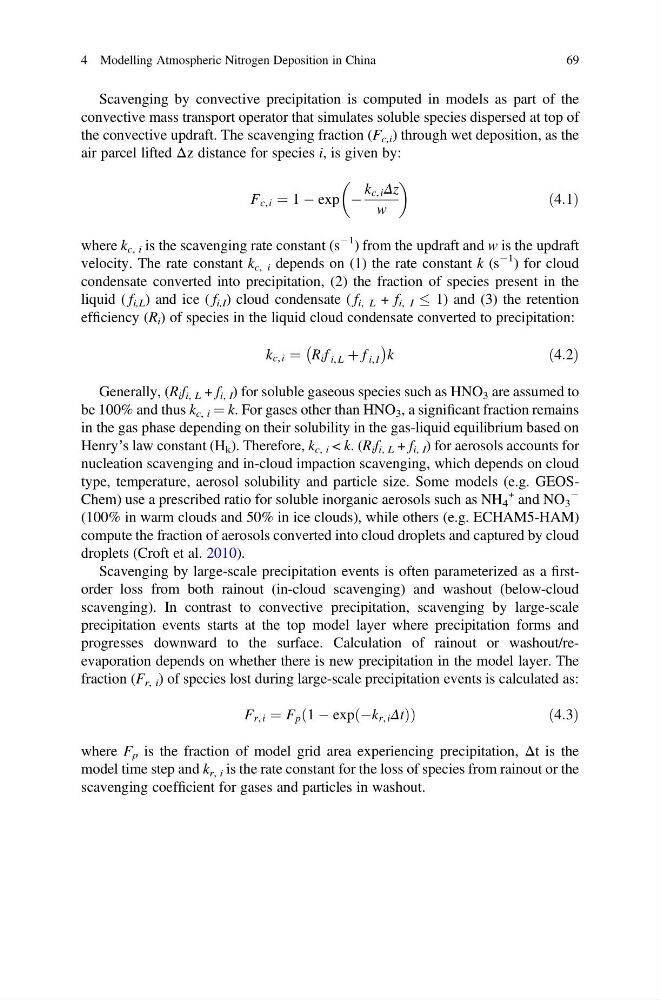
Scavenging by convective precipitation is computed in models as part of the
convective mass transport operator that simulates soluble species dispersed at top of
the convective updraft. The scavenging fraction (F c,i ) through wet deposition, as the
air parcel lifted Δz distance for species i, is given by:
F c, i ¼ 1 À exp À
k c, i Δz
w
ð4:1Þ
where k c, i is the scavenging rate constant (s
À1 ) from the updraft and w is the updraft
velocity. The rate constant k c, i depends on (1) the rate constant k (s
À1 ) for cloud
condensate converted into precipitation, (2) the fraction of species present in the
liquid ( f i,L ) and ice ( f i,I ) cloud condensate ( f i, L + f i, I 1) and (3) the retention
efficiency (R i ) of species in the liquid cloud condensate converted to precipitation:
k c, i ¼ R i f i, L þ f i, I
À
Á
k
ð4:2Þ
Generally, (R i f i, L + f i, I ) for soluble gaseous species such as HNO 3 are assumed to
be 100% and thus k c, i ¼ k. For gases other than HNO 3 , a significant fraction remains
in the gas phase depending on their solubility in the gas-liquid equilibrium based on
Henry’s law constant (H k ). Therefore, k c, i < k. (R i f i, L + f i, I ) for aerosols accounts for
nucleation scavenging and in-cloud impaction scavenging, which depends on cloud
type, temperature, aerosol solubility and particle size. Some models (e.g. GEOSChem) use a prescribed ratio for soluble inorganic aerosols such as NH 4
+ and NO 3
À
(100% in warm clouds and 50% in ice clouds), while others (e.g. ECHAM5-HAM)
compute the fraction of aerosols converted into cloud droplets and captured by cloud
droplets (Croft et al. 2010).
Scavenging by large-scale precipitation events is often parameterized as a firstorder loss from both rainout (in-cloud scavenging) and washout (below-cloud
scavenging). In contrast to convective precipitation, scavenging by large-scale
precipitation events starts at the top model layer where precipitation forms and
progresses downward to the surface. Calculation of rainout or washout/reevaporation depends on whether there is new precipitation in the model layer. The
fraction (F r, i ) of species lost during large-scale precipitation events is calculated as:
F r, i ¼ F p 1 À exp Àk r, i Δt
ð
Þ
ð
Þ
ð 4:3Þ
where F p is the fraction of model grid area experiencing precipitation, Δt is the
model time step and k r, i is the rate constant for the loss of species from rainout or the
scavenging coefficient for gases and particles in washout.
4 Modelling Atmospheric Nitrogen Deposition in China
69
convective mass transport operator that simulates soluble species dispersed at top of
the convective updraft. The scavenging fraction (F c,i ) through wet deposition, as the
air parcel lifted Δz distance for species i, is given by:
F c, i ¼ 1 À exp À
k c, i Δz
w
ð4:1Þ
where k c, i is the scavenging rate constant (s
À1 ) from the updraft and w is the updraft
velocity. The rate constant k c, i depends on (1) the rate constant k (s
À1 ) for cloud
condensate converted into precipitation, (2) the fraction of species present in the
liquid ( f i,L ) and ice ( f i,I ) cloud condensate ( f i, L + f i, I 1) and (3) the retention
efficiency (R i ) of species in the liquid cloud condensate converted to precipitation:
k c, i ¼ R i f i, L þ f i, I
À
Á
k
ð4:2Þ
Generally, (R i f i, L + f i, I ) for soluble gaseous species such as HNO 3 are assumed to
be 100% and thus k c, i ¼ k. For gases other than HNO 3 , a significant fraction remains
in the gas phase depending on their solubility in the gas-liquid equilibrium based on
Henry’s law constant (H k ). Therefore, k c, i < k. (R i f i, L + f i, I ) for aerosols accounts for
nucleation scavenging and in-cloud impaction scavenging, which depends on cloud
type, temperature, aerosol solubility and particle size. Some models (e.g. GEOSChem) use a prescribed ratio for soluble inorganic aerosols such as NH 4
+ and NO 3
À
(100% in warm clouds and 50% in ice clouds), while others (e.g. ECHAM5-HAM)
compute the fraction of aerosols converted into cloud droplets and captured by cloud
droplets (Croft et al. 2010).
Scavenging by large-scale precipitation events is often parameterized as a firstorder loss from both rainout (in-cloud scavenging) and washout (below-cloud
scavenging). In contrast to convective precipitation, scavenging by large-scale
precipitation events starts at the top model layer where precipitation forms and
progresses downward to the surface. Calculation of rainout or washout/reevaporation depends on whether there is new precipitation in the model layer. The
fraction (F r, i ) of species lost during large-scale precipitation events is calculated as:
F r, i ¼ F p 1 À exp Àk r, i Δt
ð
Þ
ð
Þ
ð 4:3Þ
where F p is the fraction of model grid area experiencing precipitation, Δt is the
model time step and k r, i is the rate constant for the loss of species from rainout or the
scavenging coefficient for gases and particles in washout.
4 Modelling Atmospheric Nitrogen Deposition in China
69