

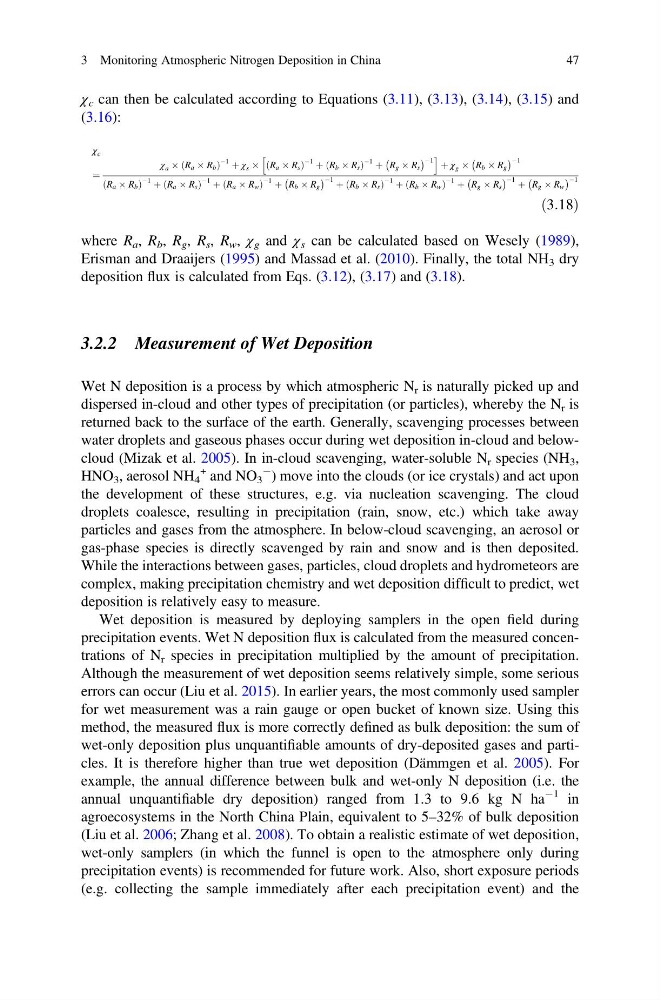
χ c can then be calculated according to Equations (3.11), (3.13), (3.14), (3.15) and
(3.16):
χ c
¼
χ a  R a  R b
ð
Þ
À1 þ χ s  R a  R s
ð
Þ
À1 þ R b  R s
ð
Þ
À1 þ R g  R s
À
Á À1
h
i
þ χ g  R b  R g
À
Á À1
Ra  Rb
ð
Þ
À1 þ Ra  Rs
ð
Þ
À1 þ Ra  Rw
ð
Þ
À1 þ Rb  Rg
À
Á À1 þ Rb  Rs
ð
Þ
À1 þ Rb  Rw
ð
Þ
À1 þ Rg  Rs
À
Á À1 þ Rg  Rw
À
Á À1
ð3:18Þ
where R a , R b , R g , R s , R w , χ g and χ s can be calculated based on Wesely (1989),
Erisman and Draaijers (1995) and Massad et al. (2010). Finally, the total NH 3 dry
deposition flux is calculated from Eqs. (3.12), (3.17) and (3.18).
3.2.2 Measurement of Wet Deposition
Wet N deposition is a process by which atmospheric N r is naturally picked up and
dispersed in-cloud and other types of precipitation (or particles), whereby the N r is
returned back to the surface of the earth. Generally, scavenging processes between
water droplets and gaseous phases occur during wet deposition in-cloud and belowcloud (Mizak et al. 2005). In in-cloud scavenging, water-soluble N r species (NH 3 ,
HNO 3 , aerosol NH 4
+ and NO 3
À ) move into the clouds (or ice crystals) and act upon
the development of these structures, e.g. via nucleation scavenging. The cloud
droplets coalesce, resulting in precipitation (rain, snow, etc.) which take away
particles and gases from the atmosphere. In below-cloud scavenging, an aerosol or
gas-phase species is directly scavenged by rain and snow and is then deposited.
While the interactions between gases, particles, cloud droplets and hydrometeors are
complex, making precipitation chemistry and wet deposition difficult to predict, wet
deposition is relatively easy to measure.
Wet deposition is measured by deploying samplers in the open field during
precipitation events. Wet N deposition flux is calculated from the measured concentrations of N r species in precipitation multiplied by the amount of precipitation.
Although the measurement of wet deposition seems relatively simple, some serious
errors can occur (Liu et al. 2015). In earlier years, the most commonly used sampler
for wet measurement was a rain gauge or open bucket of known size. Using this
method, the measured flux is more correctly defined as bulk deposition: the sum of
wet-only deposition plus unquantifiable amounts of dry-deposited gases and particles. It is therefore higher than true wet deposition (Dämmgen et al. 2005). For
example, the annual difference between bulk and wet-only N deposition (i.e. the
annual unquantifiable dry deposition) ranged from 1.3 to 9.6 kg N ha
À1 in
agroecosystems in the North China Plain, equivalent to 5–32% of bulk deposition
(Liu et al. 2006; Zhang et al. 2008). To obtain a realistic estimate of wet deposition,
wet-only samplers (in which the funnel is open to the atmosphere only during
precipitation events) is recommended for future work. Also, short exposure periods
(e.g. collecting the sample immediately after each precipitation event) and the
3 Monitoring Atmospheric Nitrogen Deposition in China
47
(3.16):
χ c
¼
χ a  R a  R b
ð
Þ
À1 þ χ s  R a  R s
ð
Þ
À1 þ R b  R s
ð
Þ
À1 þ R g  R s
À
Á À1
h
i
þ χ g  R b  R g
À
Á À1
Ra  Rb
ð
Þ
À1 þ Ra  Rs
ð
Þ
À1 þ Ra  Rw
ð
Þ
À1 þ Rb  Rg
À
Á À1 þ Rb  Rs
ð
Þ
À1 þ Rb  Rw
ð
Þ
À1 þ Rg  Rs
À
Á À1 þ Rg  Rw
À
Á À1
ð3:18Þ
where R a , R b , R g , R s , R w , χ g and χ s can be calculated based on Wesely (1989),
Erisman and Draaijers (1995) and Massad et al. (2010). Finally, the total NH 3 dry
deposition flux is calculated from Eqs. (3.12), (3.17) and (3.18).
3.2.2 Measurement of Wet Deposition
Wet N deposition is a process by which atmospheric N r is naturally picked up and
dispersed in-cloud and other types of precipitation (or particles), whereby the N r is
returned back to the surface of the earth. Generally, scavenging processes between
water droplets and gaseous phases occur during wet deposition in-cloud and belowcloud (Mizak et al. 2005). In in-cloud scavenging, water-soluble N r species (NH 3 ,
HNO 3 , aerosol NH 4
+ and NO 3
À ) move into the clouds (or ice crystals) and act upon
the development of these structures, e.g. via nucleation scavenging. The cloud
droplets coalesce, resulting in precipitation (rain, snow, etc.) which take away
particles and gases from the atmosphere. In below-cloud scavenging, an aerosol or
gas-phase species is directly scavenged by rain and snow and is then deposited.
While the interactions between gases, particles, cloud droplets and hydrometeors are
complex, making precipitation chemistry and wet deposition difficult to predict, wet
deposition is relatively easy to measure.
Wet deposition is measured by deploying samplers in the open field during
precipitation events. Wet N deposition flux is calculated from the measured concentrations of N r species in precipitation multiplied by the amount of precipitation.
Although the measurement of wet deposition seems relatively simple, some serious
errors can occur (Liu et al. 2015). In earlier years, the most commonly used sampler
for wet measurement was a rain gauge or open bucket of known size. Using this
method, the measured flux is more correctly defined as bulk deposition: the sum of
wet-only deposition plus unquantifiable amounts of dry-deposited gases and particles. It is therefore higher than true wet deposition (Dämmgen et al. 2005). For
example, the annual difference between bulk and wet-only N deposition (i.e. the
annual unquantifiable dry deposition) ranged from 1.3 to 9.6 kg N ha
À1 in
agroecosystems in the North China Plain, equivalent to 5–32% of bulk deposition
(Liu et al. 2006; Zhang et al. 2008). To obtain a realistic estimate of wet deposition,
wet-only samplers (in which the funnel is open to the atmosphere only during
precipitation events) is recommended for future work. Also, short exposure periods
(e.g. collecting the sample immediately after each precipitation event) and the
3 Monitoring Atmospheric Nitrogen Deposition in China
47