

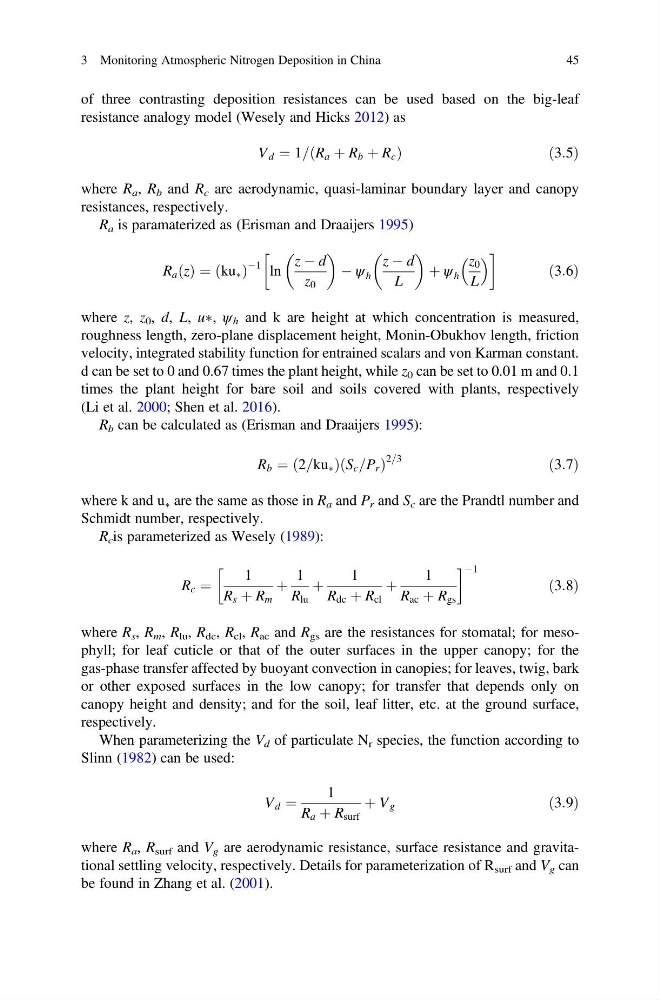
of three contrasting deposition resistances can be used based on the big-leaf
resistance analogy model (Wesely and Hicks 2012) as
V d ¼ 1= R a þ R b þ R c
ð
Þ
ð 3:5Þ
where R a , R b and R c are aerodynamic, quasi-laminar boundary layer and canopy
resistances, respectively.
R a is paramaterized as (Erisman and Draaijers 1995)
R a z
ð Þ ¼ ku Ã
ð Þ
À1 ln
z À d
z 0
À ψ h
z À d
L
þ ψ h
z 0
L
!
ð3:6Þ
where z, z 0 , d, L, uÃ, ψ h and k are height at which concentration is measured,
roughness length, zero-plane displacement height, Monin-Obukhov length, friction
velocity, integrated stability function for entrained scalars and von Karman constant.
d can be set to 0 and 0.67 times the plant height, while z 0 can be set to 0.01 m and 0.1
times the plant height for bare soil and soils covered with plants, respectively
(Li et al. 2000; Shen et al. 2016).
R b can be calculated as (Erisman and Draaijers 1995):
R b ¼ 2=ku Ã
ð
Þ S c =P r
ð
Þ
2=3
ð3:7Þ
where k and u à are the same as those in R a and P r and S c are the Prandtl number and
Schmidt number, respectively.
R c is parameterized as Wesely (1989):
R c ¼
1
R s þ R m
þ
1
R lu
þ
1
R dc þ R cl
þ
1
R ac þ R gs
! À1
ð3:8Þ
where R s , R m , R lu , R dc , R cl , R ac and R gs are the resistances for stomatal; for mesophyll; for leaf cuticle or that of the outer surfaces in the upper canopy; for the
gas-phase transfer affected by buoyant convection in canopies; for leaves, twig, bark
or other exposed surfaces in the low canopy; for transfer that depends only on
canopy height and density; and for the soil, leaf litter, etc. at the ground surface,
respectively.
When parameterizing the V d of particulate N r species, the function according to
Slinn (1982) can be used:
V d ¼
1
R a þ R surf
þ V g
ð3:9Þ
where R a , R surf and V g are aerodynamic resistance, surface resistance and gravitational settling velocity, respectively. Details for parameterization of R surf and V g can
be found in Zhang et al. (2001).
3 Monitoring Atmospheric Nitrogen Deposition in China
45
resistance analogy model (Wesely and Hicks 2012) as
V d ¼ 1= R a þ R b þ R c
ð
Þ
ð 3:5Þ
where R a , R b and R c are aerodynamic, quasi-laminar boundary layer and canopy
resistances, respectively.
R a is paramaterized as (Erisman and Draaijers 1995)
R a z
ð Þ ¼ ku Ã
ð Þ
À1 ln
z À d
z 0
À ψ h
z À d
L
þ ψ h
z 0
L
!
ð3:6Þ
where z, z 0 , d, L, uÃ, ψ h and k are height at which concentration is measured,
roughness length, zero-plane displacement height, Monin-Obukhov length, friction
velocity, integrated stability function for entrained scalars and von Karman constant.
d can be set to 0 and 0.67 times the plant height, while z 0 can be set to 0.01 m and 0.1
times the plant height for bare soil and soils covered with plants, respectively
(Li et al. 2000; Shen et al. 2016).
R b can be calculated as (Erisman and Draaijers 1995):
R b ¼ 2=ku Ã
ð
Þ S c =P r
ð
Þ
2=3
ð3:7Þ
where k and u à are the same as those in R a and P r and S c are the Prandtl number and
Schmidt number, respectively.
R c is parameterized as Wesely (1989):
R c ¼
1
R s þ R m
þ
1
R lu
þ
1
R dc þ R cl
þ
1
R ac þ R gs
! À1
ð3:8Þ
where R s , R m , R lu , R dc , R cl , R ac and R gs are the resistances for stomatal; for mesophyll; for leaf cuticle or that of the outer surfaces in the upper canopy; for the
gas-phase transfer affected by buoyant convection in canopies; for leaves, twig, bark
or other exposed surfaces in the low canopy; for transfer that depends only on
canopy height and density; and for the soil, leaf litter, etc. at the ground surface,
respectively.
When parameterizing the V d of particulate N r species, the function according to
Slinn (1982) can be used:
V d ¼
1
R a þ R surf
þ V g
ð3:9Þ
where R a , R surf and V g are aerodynamic resistance, surface resistance and gravitational settling velocity, respectively. Details for parameterization of R surf and V g can
be found in Zhang et al. (2001).
3 Monitoring Atmospheric Nitrogen Deposition in China
45