

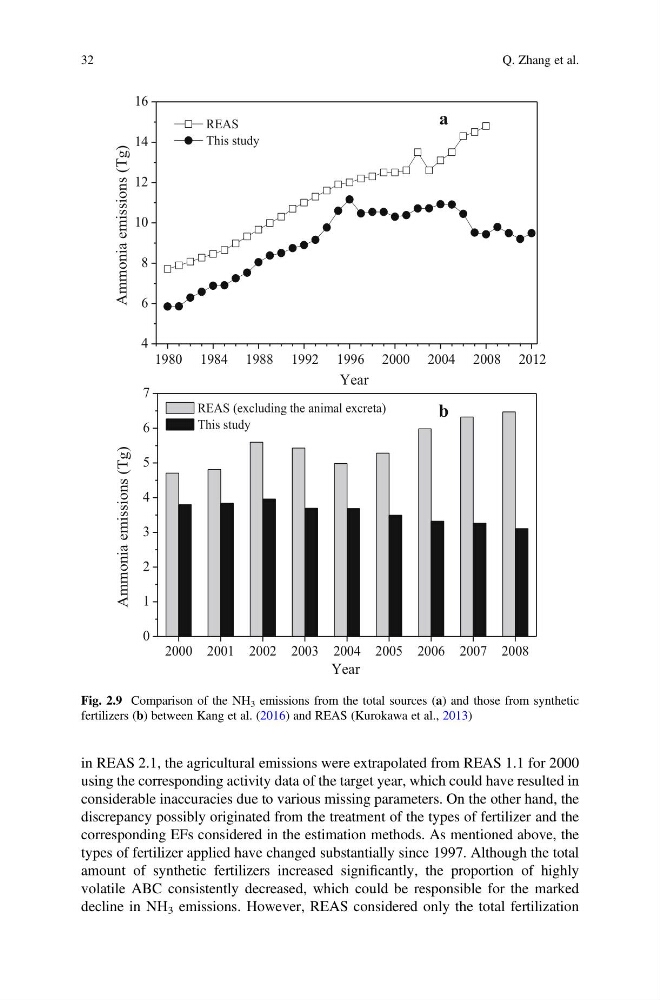
in REAS 2.1, the agricultural emissions were extrapolated from REAS 1.1 for 2000
using the corresponding activity data of the target year, which could have resulted in
considerable inaccuracies due to various missing parameters. On the other hand, the
discrepancy possibly originated from the treatment of the types of fertilizer and the
corresponding EFs considered in the estimation methods. As mentioned above, the
types of fertilizer applied have changed substantially since 1997. Although the total
amount of synthetic fertilizers increased significantly, the proportion of highly
volatile ABC consistently decreased, which could be responsible for the marked
decline in NH 3 emissions. However, REAS considered only the total fertilization
1980 1984 1988 1992 1996 2000 2004 2008 2012
4
6
8
10
12
14
16
)
g
T
(
s
n
o
i
s
s
i
m
e
a
i
n
o
m
m
A
Year
REAS
This study
a
b
2000 2001 2002 2003 2004 2005 2006 2007 2008
0
1
2
3
4
5
6
7
REAS (excluding the animal excreta)
This study
s
n
o
i
s
s
i
m
e
a
i
n
o
m
m
A
)
g
T
(
Year
Fig. 2.9 Comparison of the NH 3 emissions from the total sources (a) and those from synthetic
fertilizers (b) between Kang et al. (2016) and REAS (Kurokawa et al., 2013)
32
Q. Zhang et al.
using the corresponding activity data of the target year, which could have resulted in
considerable inaccuracies due to various missing parameters. On the other hand, the
discrepancy possibly originated from the treatment of the types of fertilizer and the
corresponding EFs considered in the estimation methods. As mentioned above, the
types of fertilizer applied have changed substantially since 1997. Although the total
amount of synthetic fertilizers increased significantly, the proportion of highly
volatile ABC consistently decreased, which could be responsible for the marked
decline in NH 3 emissions. However, REAS considered only the total fertilization
1980 1984 1988 1992 1996 2000 2004 2008 2012
4
6
8
10
12
14
16
)
g
T
(
s
n
o
i
s
s
i
m
e
a
i
n
o
m
m
A
Year
REAS
This study
a
b
2000 2001 2002 2003 2004 2005 2006 2007 2008
0
1
2
3
4
5
6
7
REAS (excluding the animal excreta)
This study
s
n
o
i
s
s
i
m
e
a
i
n
o
m
m
A
)
g
T
(
Year
Fig. 2.9 Comparison of the NH 3 emissions from the total sources (a) and those from synthetic
fertilizers (b) between Kang et al. (2016) and REAS (Kurokawa et al., 2013)
32
Q. Zhang et al.