

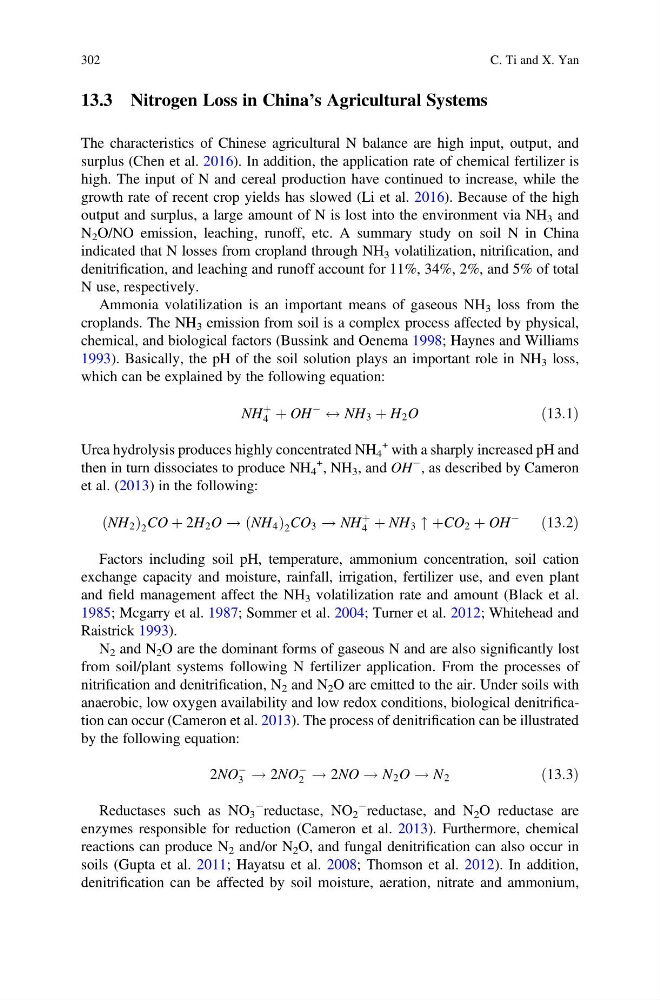
13.3 Nitrogen Loss in China’s Agricultural Systems
The characteristics of Chinese agricultural N balance are high input, output, and
surplus (Chen et al. 2016). In addition, the application rate of chemical fertilizer is
high. The input of N and cereal production have continued to increase, while the
growth rate of recent crop yields has slowed (Li et al. 2016). Because of the high
output and surplus, a large amount of N is lost into the environment via NH 3 and
N 2 O/NO emission, leaching, runoff, etc. A summary study on soil N in China
indicated that N losses from cropland through NH 3 volatilization, nitrification, and
denitrification, and leaching and runoff account for 11%, 34%, 2%, and 5% of total
N use, respectively.
Ammonia volatilization is an important means of gaseous NH 3 loss from the
croplands. The NH 3 emission from soil is a complex process affected by physical,
chemical, and biological factors (Bussink and Oenema 1998; Haynes and Williams
1993). Basically, the pH of the soil solution plays an important role in NH 3 loss,
which can be explained by the following equation:
NH
þ
4 þ OH
À
$ NH 3 þ H 2 O
ð13:1Þ
Urea hydrolysis produces highly concentrated NH 4
+ with a sharply increased pH and
then in turn dissociates to produce NH 4
+ , NH 3 , and OH
À , as described by Cameron
et al. (2013) in the following:
NH 2
ð
Þ 2 CO þ 2H 2 O ! NH 4
ð
Þ 2 CO 3 ! NH
þ
4 þ NH 3 " þCO 2 þ OH
À
ð13:2Þ
Factors including soil pH, temperature, ammonium concentration, soil cation
exchange capacity and moisture, rainfall, irrigation, fertilizer use, and even plant
and field management affect the NH 3 volatilization rate and amount (Black et al.
1985; Mcgarry et al. 1987; Sommer et al. 2004; Turner et al. 2012; Whitehead and
Raistrick 1993).
N 2 and N 2 O are the dominant forms of gaseous N and are also significantly lost
from soil/plant systems following N fertilizer application. From the processes of
nitrification and denitrification, N 2 and N 2 O are emitted to the air. Under soils with
anaerobic, low oxygen availability and low redox conditions, biological denitrification can occur (Cameron et al. 2013). The process of denitrification can be illustrated
by the following equation:
2NO
À
3 ! 2NO
À
2 ! 2NO ! N 2 O ! N 2
ð13:3Þ
Reductases such as NO 3
À reductase, NO 2
À reductase, and N 2 O reductase are
enzymes responsible for reduction (Cameron et al. 2013). Furthermore, chemical
reactions can produce N 2 and/or N 2 O, and fungal denitrification can also occur in
soils (Gupta et al. 2011; Hayatsu et al. 2008; Thomson et al. 2012). In addition,
denitrification can be affected by soil moisture, aeration, nitrate and ammonium,
302
C. Ti and X. Yan
The characteristics of Chinese agricultural N balance are high input, output, and
surplus (Chen et al. 2016). In addition, the application rate of chemical fertilizer is
high. The input of N and cereal production have continued to increase, while the
growth rate of recent crop yields has slowed (Li et al. 2016). Because of the high
output and surplus, a large amount of N is lost into the environment via NH 3 and
N 2 O/NO emission, leaching, runoff, etc. A summary study on soil N in China
indicated that N losses from cropland through NH 3 volatilization, nitrification, and
denitrification, and leaching and runoff account for 11%, 34%, 2%, and 5% of total
N use, respectively.
Ammonia volatilization is an important means of gaseous NH 3 loss from the
croplands. The NH 3 emission from soil is a complex process affected by physical,
chemical, and biological factors (Bussink and Oenema 1998; Haynes and Williams
1993). Basically, the pH of the soil solution plays an important role in NH 3 loss,
which can be explained by the following equation:
NH
þ
4 þ OH
À
$ NH 3 þ H 2 O
ð13:1Þ
Urea hydrolysis produces highly concentrated NH 4
+ with a sharply increased pH and
then in turn dissociates to produce NH 4
+ , NH 3 , and OH
À , as described by Cameron
et al. (2013) in the following:
NH 2
ð
Þ 2 CO þ 2H 2 O ! NH 4
ð
Þ 2 CO 3 ! NH
þ
4 þ NH 3 " þCO 2 þ OH
À
ð13:2Þ
Factors including soil pH, temperature, ammonium concentration, soil cation
exchange capacity and moisture, rainfall, irrigation, fertilizer use, and even plant
and field management affect the NH 3 volatilization rate and amount (Black et al.
1985; Mcgarry et al. 1987; Sommer et al. 2004; Turner et al. 2012; Whitehead and
Raistrick 1993).
N 2 and N 2 O are the dominant forms of gaseous N and are also significantly lost
from soil/plant systems following N fertilizer application. From the processes of
nitrification and denitrification, N 2 and N 2 O are emitted to the air. Under soils with
anaerobic, low oxygen availability and low redox conditions, biological denitrification can occur (Cameron et al. 2013). The process of denitrification can be illustrated
by the following equation:
2NO
À
3 ! 2NO
À
2 ! 2NO ! N 2 O ! N 2
ð13:3Þ
Reductases such as NO 3
À reductase, NO 2
À reductase, and N 2 O reductase are
enzymes responsible for reduction (Cameron et al. 2013). Furthermore, chemical
reactions can produce N 2 and/or N 2 O, and fungal denitrification can also occur in
soils (Gupta et al. 2011; Hayatsu et al. 2008; Thomson et al. 2012). In addition,
denitrification can be affected by soil moisture, aeration, nitrate and ammonium,
302
C. Ti and X. Yan