

Dianchi watershed has increased steadily from 1.8 million in 1992 to 4.1 million in
2015, which has led to significant increases in water consumptions and pollution
emissions as well as changes in hydrological budget and lake ecosystems (Wang
et al. 2012). Consequently, Lake Dianchi has suffered a dramatic deterioration in
water quality and severe eutrophication (e.g., TN of 2.20 mg/L and Chl-a of
67.00 μg/L), though approximately 7.7 billion USD was invested during
1996–2015 for lake restoration by the Chinese Central Government (Yang et al.
2010b).
Sampling of dry N deposition, including gaseous and particulate N, was
conducted from April 1, 2010 to March 31, 2011. Five deposition monitoring
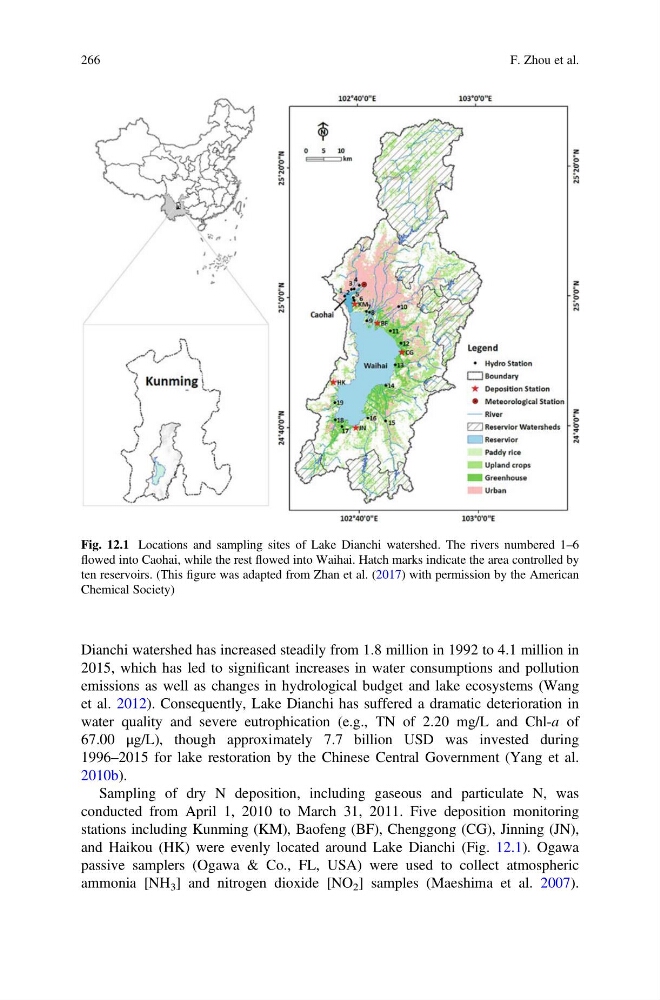
stations including Kunming (KM), Baofeng (BF), Chenggong (CG), Jinning (JN),
and Haikou (HK) were evenly located around Lake Dianchi (Fig. 12.1). Ogawa
passive samplers (Ogawa & Co., FL, USA) were used to collect atmospheric
ammonia [NH 3 ] and nitrogen dioxide [NO 2 ] samples (Maeshima et al. 2007).
Fig. 12.1 Locations and sampling sites of Lake Dianchi watershed. The rivers numbered 1–6
flowed into Caohai, while the rest flowed into Waihai. Hatch marks indicate the area controlled by
ten reservoirs. (This figure was adapted from Zhan et al. (2017) with permission by the American
Chemical Society)
266
F. Zhou et al.
2015, which has led to significant increases in water consumptions and pollution
emissions as well as changes in hydrological budget and lake ecosystems (Wang
et al. 2012). Consequently, Lake Dianchi has suffered a dramatic deterioration in
water quality and severe eutrophication (e.g., TN of 2.20 mg/L and Chl-a of
67.00 μg/L), though approximately 7.7 billion USD was invested during
1996–2015 for lake restoration by the Chinese Central Government (Yang et al.
2010b).
Sampling of dry N deposition, including gaseous and particulate N, was
conducted from April 1, 2010 to March 31, 2011. Five deposition monitoring
stations including Kunming (KM), Baofeng (BF), Chenggong (CG), Jinning (JN),
and Haikou (HK) were evenly located around Lake Dianchi (Fig. 12.1). Ogawa
passive samplers (Ogawa & Co., FL, USA) were used to collect atmospheric
ammonia [NH 3 ] and nitrogen dioxide [NO 2 ] samples (Maeshima et al. 2007).
Fig. 12.1 Locations and sampling sites of Lake Dianchi watershed. The rivers numbered 1–6
flowed into Caohai, while the rest flowed into Waihai. Hatch marks indicate the area controlled by
ten reservoirs. (This figure was adapted from Zhan et al. (2017) with permission by the American
Chemical Society)
266
F. Zhou et al.