

on desert steppe, and the effects were species-specific and varied among growth
forms, which might change the structure of the desert steppe ecosystem (Huang and
Yu 2016). The N can increase biomass, leaf number, and leaf area of annual and
perennial plants in desert ecosystem, while the responses of root weight and root
length of the two life-forms were different (Zhou et al. 2010, 2011c). The annual
ephemeral plants showed more sensitive to N and water compared to annual long
vegetative period plants (Zhou et al. 2011a). Nitrogen addition stimulated the
individual plant growth in terms of N gradients for annual ephemeral plants, while
the effects were not the same for annual long vegetative period plants in the
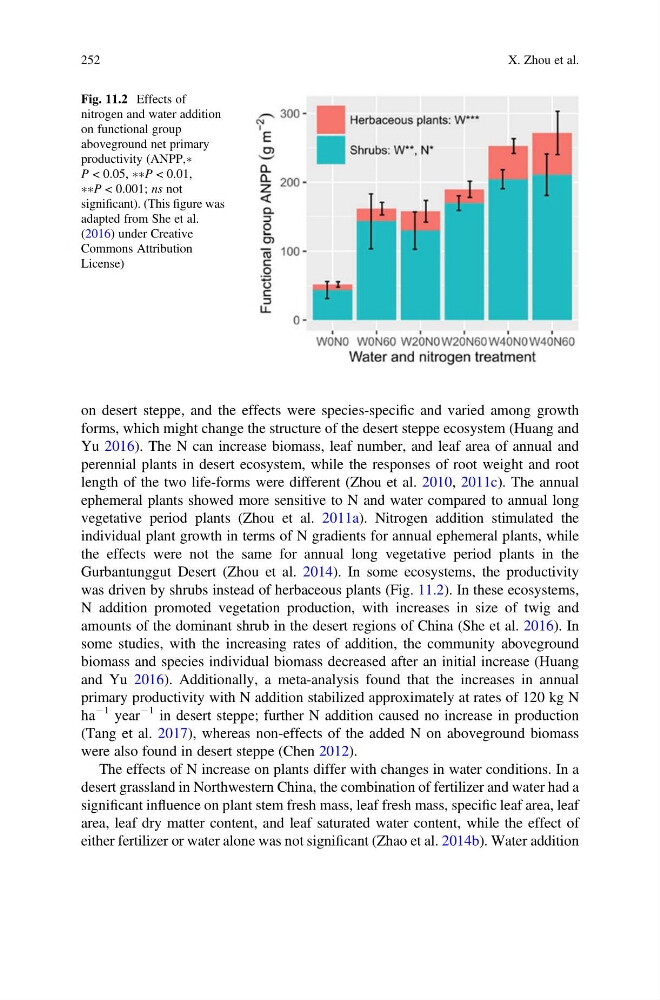
Gurbantunggut Desert (Zhou et al. 2014). In some ecosystems, the productivity
was driven by shrubs instead of herbaceous plants (Fig. 11.2). In these ecosystems,
N addition promoted vegetation production, with increases in size of twig and
amounts of the dominant shrub in the desert regions of China (She et al. 2016). In
some studies, with the increasing rates of addition, the community aboveground
biomass and species individual biomass decreased after an initial increase (Huang
and Yu 2016). Additionally, a meta-analysis found that the increases in annual
primary productivity with N addition stabilized approximately at rates of 120 kg N
ha
À1 year
À1 in desert steppe; further N addition caused no increase in production
(Tang et al. 2017), whereas non-effects of the added N on aboveground biomass
were also found in desert steppe (Chen 2012).
The effects of N increase on plants differ with changes in water conditions. In a
desert grassland in Northwestern China, the combination of fertilizer and water had a
significant influence on plant stem fresh mass, leaf fresh mass, specific leaf area, leaf
area, leaf dry matter content, and leaf saturated water content, while the effect of
either fertilizer or water alone was not significant (Zhao et al. 2014b). Water addition
Fig. 11.2 Effects of
nitrogen and water addition
on functional group
aboveground net primary
productivity (ANPP,Ã
P < 0.05, ÃÃP < 0.01,
ÃÃP < 0.001; ns not
significant). (This figure was
adapted from She et al.
(2016) under Creative
Commons Attribution
License)
252
X. Zhou et al.
forms, which might change the structure of the desert steppe ecosystem (Huang and
Yu 2016). The N can increase biomass, leaf number, and leaf area of annual and
perennial plants in desert ecosystem, while the responses of root weight and root
length of the two life-forms were different (Zhou et al. 2010, 2011c). The annual
ephemeral plants showed more sensitive to N and water compared to annual long
vegetative period plants (Zhou et al. 2011a). Nitrogen addition stimulated the
individual plant growth in terms of N gradients for annual ephemeral plants, while
the effects were not the same for annual long vegetative period plants in the
Gurbantunggut Desert (Zhou et al. 2014). In some ecosystems, the productivity
was driven by shrubs instead of herbaceous plants (Fig. 11.2). In these ecosystems,
N addition promoted vegetation production, with increases in size of twig and
amounts of the dominant shrub in the desert regions of China (She et al. 2016). In
some studies, with the increasing rates of addition, the community aboveground
biomass and species individual biomass decreased after an initial increase (Huang
and Yu 2016). Additionally, a meta-analysis found that the increases in annual
primary productivity with N addition stabilized approximately at rates of 120 kg N
ha
À1 year
À1 in desert steppe; further N addition caused no increase in production
(Tang et al. 2017), whereas non-effects of the added N on aboveground biomass
were also found in desert steppe (Chen 2012).
The effects of N increase on plants differ with changes in water conditions. In a
desert grassland in Northwestern China, the combination of fertilizer and water had a
significant influence on plant stem fresh mass, leaf fresh mass, specific leaf area, leaf
area, leaf dry matter content, and leaf saturated water content, while the effect of
either fertilizer or water alone was not significant (Zhao et al. 2014b). Water addition
Fig. 11.2 Effects of
nitrogen and water addition
on functional group
aboveground net primary
productivity (ANPP,Ã
P < 0.05, ÃÃP < 0.01,
ÃÃP < 0.001; ns not
significant). (This figure was
adapted from She et al.
(2016) under Creative
Commons Attribution
License)
252
X. Zhou et al.