

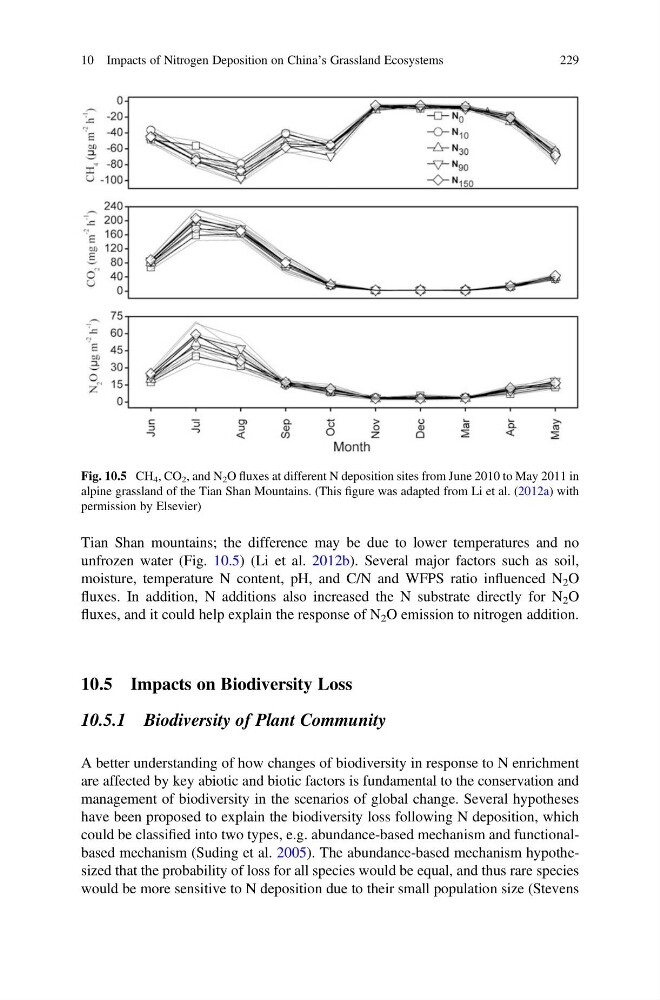
Tian Shan mountains; the difference may be due to lower temperatures and no
unfrozen water (Fig. 10.5) (Li et al. 2012b). Several major factors such as soil,
moisture, temperature N content, pH, and C/N and WFPS ratio influenced N 2 O
fluxes. In addition, N additions also increased the N substrate directly for N 2 O
fluxes, and it could help explain the response of N 2 O emission to nitrogen addition.
10.5 Impacts on Biodiversity Loss
10.5.1 Biodiversity of Plant Community
A better understanding of how changes of biodiversity in response to N enrichment
are affected by key abiotic and biotic factors is fundamental to the conservation and
management of biodiversity in the scenarios of global change. Several hypotheses
have been proposed to explain the biodiversity loss following N deposition, which
could be classified into two types, e.g. abundance-based mechanism and functionalbased mechanism (Suding et al. 2005). The abundance-based mechanism hypothesized that the probability of loss for all species would be equal, and thus rare species
would be more sensitive to N deposition due to their small population size (Stevens
Fig. 10.5 CH 4 , CO 2 , and N 2 O fluxes at different N deposition sites from June 2010 to May 2011 in
alpine grassland of the Tian Shan Mountains. (This figure was adapted from Li et al. (2012a) with
permission by Elsevier)
10 Impacts of Nitrogen Deposition on China’s Grassland Ecosystems
229
unfrozen water (Fig. 10.5) (Li et al. 2012b). Several major factors such as soil,
moisture, temperature N content, pH, and C/N and WFPS ratio influenced N 2 O
fluxes. In addition, N additions also increased the N substrate directly for N 2 O
fluxes, and it could help explain the response of N 2 O emission to nitrogen addition.
10.5 Impacts on Biodiversity Loss
10.5.1 Biodiversity of Plant Community
A better understanding of how changes of biodiversity in response to N enrichment
are affected by key abiotic and biotic factors is fundamental to the conservation and
management of biodiversity in the scenarios of global change. Several hypotheses
have been proposed to explain the biodiversity loss following N deposition, which
could be classified into two types, e.g. abundance-based mechanism and functionalbased mechanism (Suding et al. 2005). The abundance-based mechanism hypothesized that the probability of loss for all species would be equal, and thus rare species
would be more sensitive to N deposition due to their small population size (Stevens
Fig. 10.5 CH 4 , CO 2 , and N 2 O fluxes at different N deposition sites from June 2010 to May 2011 in
alpine grassland of the Tian Shan Mountains. (This figure was adapted from Li et al. (2012a) with
permission by Elsevier)
10 Impacts of Nitrogen Deposition on China’s Grassland Ecosystems
229