

non-linear effect has not been widely accounted when assessing N deposition effects
on soil respiration at regional and global scales. This might lead to an overestimate of
the soil C storage due to N deposition.
9.6.3 Impacts of Nitrogen Deposition on Net Ecosystem
Productivity
The overall effect of N deposition on net ecosystem productivity (NEP ¼NPP-Rh)
depends on the responses of NPP and heterotrophic respiration (R h ). Unfortunately,
experimental reports on effects of N deposition on NEP are extremely rare, compared with results on NPP and Rh. In boreal and temperate forests, N deposition
generally increased NEP by increasing NPP and soil C storage (Chen et al. 2015;
Yan et al. 2018). As evidenced by a 5-year N addition experiment in a boreal forest
in the Greater Khingan Mountains, low (25 kg N ha
À1 year
À1 ) and medium N
additions (50 kg N ha
À1 year
À1 ) increased NEP (66 and 19 kg C per kg N,
respectively) by exerting a stronger stimulation on NPP than Rh, while high-level
N addition (75 kg N ha
À1 year
À1 ) only led to a minor effect on C sequestration (9 kg
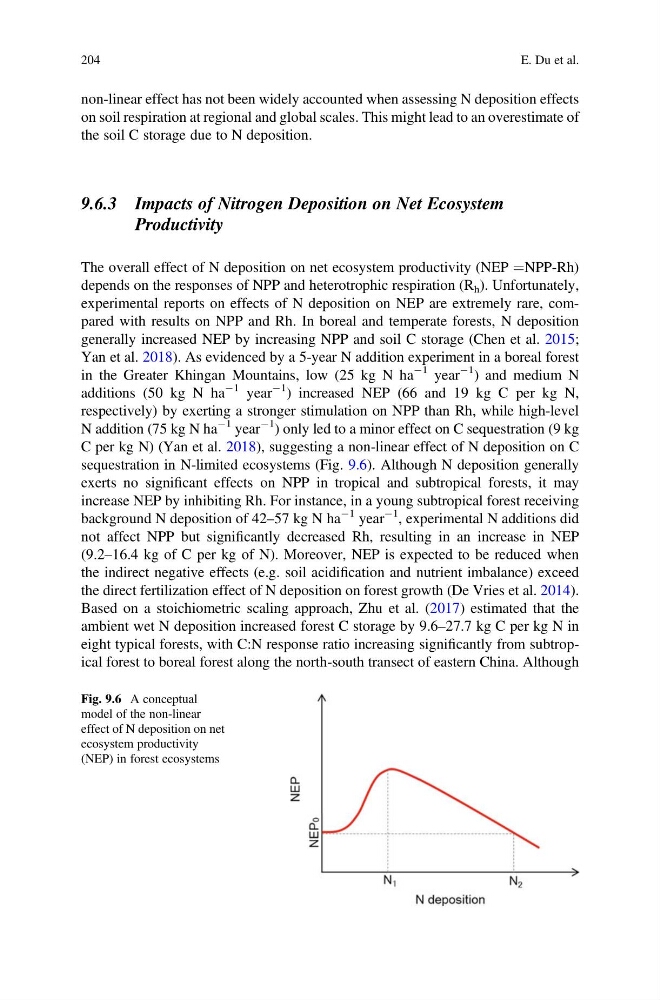
C per kg N) (Yan et al. 2018), suggesting a non-linear effect of N deposition on C
sequestration in N-limited ecosystems (Fig. 9.6). Although N deposition generally
exerts no significant effects on NPP in tropical and subtropical forests, it may
increase NEP by inhibiting Rh. For instance, in a young subtropical forest receiving
background N deposition of 42–57 kg N ha
À1 year
À1 , experimental N additions did
not affect NPP but significantly decreased Rh, resulting in an increase in NEP
(9.2–16.4 kg of C per kg of N). Moreover, NEP is expected to be reduced when
the indirect negative effects (e.g. soil acidification and nutrient imbalance) exceed
the direct fertilization effect of N deposition on forest growth (De Vries et al. 2014).
Based on a stoichiometric scaling approach, Zhu et al. (2017) estimated that the
ambient wet N deposition increased forest C storage by 9.6–27.7 kg C per kg N in
eight typical forests, with C:N response ratio increasing significantly from subtropical forest to boreal forest along the north-south transect of eastern China. Although
Fig. 9.6 A conceptual
model of the non-linear
effect of N deposition on net
ecosystem productivity
(NEP) in forest ecosystems
204
E. Du et al.
on soil respiration at regional and global scales. This might lead to an overestimate of
the soil C storage due to N deposition.
9.6.3 Impacts of Nitrogen Deposition on Net Ecosystem
Productivity
The overall effect of N deposition on net ecosystem productivity (NEP ¼NPP-Rh)
depends on the responses of NPP and heterotrophic respiration (R h ). Unfortunately,
experimental reports on effects of N deposition on NEP are extremely rare, compared with results on NPP and Rh. In boreal and temperate forests, N deposition
generally increased NEP by increasing NPP and soil C storage (Chen et al. 2015;
Yan et al. 2018). As evidenced by a 5-year N addition experiment in a boreal forest
in the Greater Khingan Mountains, low (25 kg N ha
À1 year
À1 ) and medium N
additions (50 kg N ha
À1 year
À1 ) increased NEP (66 and 19 kg C per kg N,
respectively) by exerting a stronger stimulation on NPP than Rh, while high-level
N addition (75 kg N ha
À1 year
À1 ) only led to a minor effect on C sequestration (9 kg
C per kg N) (Yan et al. 2018), suggesting a non-linear effect of N deposition on C
sequestration in N-limited ecosystems (Fig. 9.6). Although N deposition generally
exerts no significant effects on NPP in tropical and subtropical forests, it may
increase NEP by inhibiting Rh. For instance, in a young subtropical forest receiving
background N deposition of 42–57 kg N ha
À1 year
À1 , experimental N additions did
not affect NPP but significantly decreased Rh, resulting in an increase in NEP
(9.2–16.4 kg of C per kg of N). Moreover, NEP is expected to be reduced when
the indirect negative effects (e.g. soil acidification and nutrient imbalance) exceed
the direct fertilization effect of N deposition on forest growth (De Vries et al. 2014).
Based on a stoichiometric scaling approach, Zhu et al. (2017) estimated that the
ambient wet N deposition increased forest C storage by 9.6–27.7 kg C per kg N in
eight typical forests, with C:N response ratio increasing significantly from subtropical forest to boreal forest along the north-south transect of eastern China. Although
Fig. 9.6 A conceptual
model of the non-linear
effect of N deposition on net
ecosystem productivity
(NEP) in forest ecosystems
204
E. Du et al.