

amounts of plant N uptake (Matson et al. 1999). In theory, transforming 1 mol NH 4
+
to NO 3
À by nitrobacteria would release 2 mol H
+ (Ulrich 1986). Overall, N deposition decreases soil buffer capacity and induces soil acidification via direct H
+
inputs, NH 4
+ nitrification and NO 3
À leaching losses (Langan 1999). The greater
affinity of H
+ for soil exchange sites can displace base cations such as Ca
2+ and Mg
2
+
, along with which NO 3
À leaching occurs. Meanwhile, lowered soil pH mobilizes
Al
3+ and Mn
2+ /Fe
3+ . With further decrease in soil pH, nitrification and decomposition of organic matter will be inhibited. These changes may lead to a decline in base
cations and consequent nutrient imbalance (Lu et al. 2010; Huang et al. 2015; Tian
et al. 2017a; Mao et al. 2018).
Both temperate and subtropical forests in China are potentially subjected to soil
acidification due to high-level N deposition (Du et al. 2014a). In temperate forests, N
deposition has been evidenced to cause soil acidification and base cation depletion,
although strong plant demand for N slows down the rate of change (Matson et al.
1999). By synthesizing 106 studies globally, Tian and Niu (2015) revealed that
temperate forests showed a significant decrease in soil pH. Particularly, soil pH was
reduced more significantly in the forest ecosystems dominated by conifer species
than those dominated by broad-leaved species (Tian and Niu 2015). However, there
are only a few reports on N deposition-induced soil acidification in China’s temperate forests. This may be due to relatively high background soil pH and a strong effect
of the soil buffering system (Bowman et al. 2008). Tropical and subtropical forest
ecosystems are evidenced to be more acid-sensitive due to high background N
availability and poor soil buffering capacity. Across urban-rural transects in Pearl
River Delta of South China, soil pH decreased with increasing atmospheric N
deposition loads (Fang et al. 2011a). In subtropical forests in Dinghushan Reserve,
Lu et al. (2015) found that long-term N additions significantly decreased soil
buffering capacity and accelerated soil acidification in a primary forest, but not in
the degraded secondary and planted forests. The divergent responses are likely due
to different background N status, influenced by different land-use history. Moreover,
the shortage of Ca
2+ and Mg
2+ plays a part more important than soil exchangeable
Al
3+ in tropical and subtropical forests with elevated N deposition, considering that
most subtropical ecosystems are in the range of Al
3+ buffering (Lu et al. 2014).
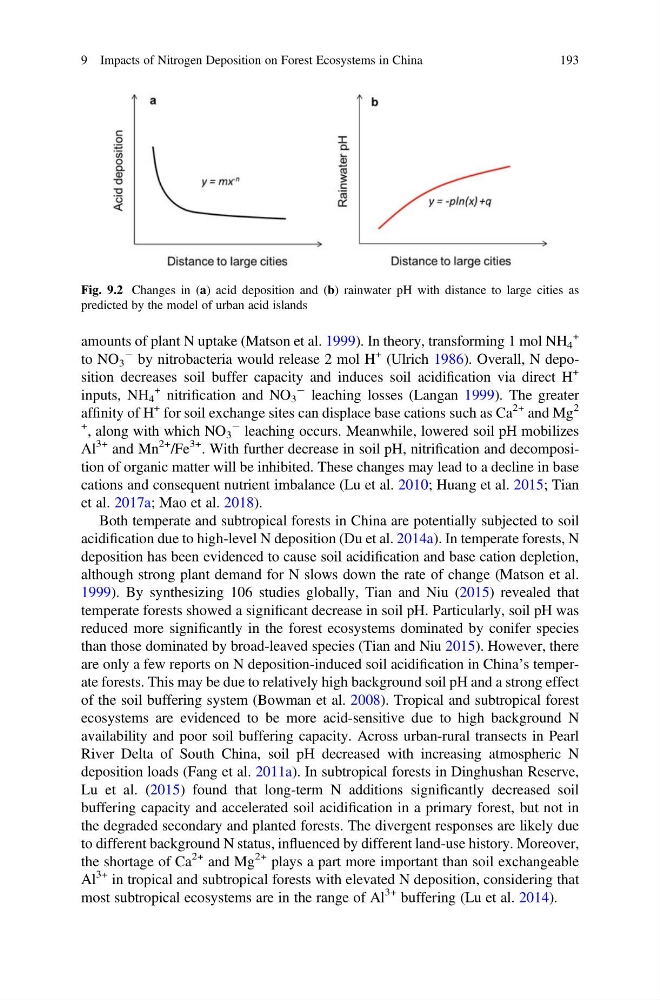
Fig. 9.2 Changes in (a) acid deposition and (b) rainwater pH with distance to large cities as
predicted by the model of urban acid islands
9 Impacts of Nitrogen Deposition on Forest Ecosystems in China
193
+
to NO 3
À by nitrobacteria would release 2 mol H
+ (Ulrich 1986). Overall, N deposition decreases soil buffer capacity and induces soil acidification via direct H
+
inputs, NH 4
+ nitrification and NO 3
À leaching losses (Langan 1999). The greater
affinity of H
+ for soil exchange sites can displace base cations such as Ca
2+ and Mg
2
+
, along with which NO 3
À leaching occurs. Meanwhile, lowered soil pH mobilizes
Al
3+ and Mn
2+ /Fe
3+ . With further decrease in soil pH, nitrification and decomposition of organic matter will be inhibited. These changes may lead to a decline in base
cations and consequent nutrient imbalance (Lu et al. 2010; Huang et al. 2015; Tian
et al. 2017a; Mao et al. 2018).
Both temperate and subtropical forests in China are potentially subjected to soil
acidification due to high-level N deposition (Du et al. 2014a). In temperate forests, N
deposition has been evidenced to cause soil acidification and base cation depletion,
although strong plant demand for N slows down the rate of change (Matson et al.
1999). By synthesizing 106 studies globally, Tian and Niu (2015) revealed that
temperate forests showed a significant decrease in soil pH. Particularly, soil pH was
reduced more significantly in the forest ecosystems dominated by conifer species
than those dominated by broad-leaved species (Tian and Niu 2015). However, there
are only a few reports on N deposition-induced soil acidification in China’s temperate forests. This may be due to relatively high background soil pH and a strong effect
of the soil buffering system (Bowman et al. 2008). Tropical and subtropical forest
ecosystems are evidenced to be more acid-sensitive due to high background N
availability and poor soil buffering capacity. Across urban-rural transects in Pearl
River Delta of South China, soil pH decreased with increasing atmospheric N
deposition loads (Fang et al. 2011a). In subtropical forests in Dinghushan Reserve,
Lu et al. (2015) found that long-term N additions significantly decreased soil
buffering capacity and accelerated soil acidification in a primary forest, but not in
the degraded secondary and planted forests. The divergent responses are likely due
to different background N status, influenced by different land-use history. Moreover,
the shortage of Ca
2+ and Mg
2+ plays a part more important than soil exchangeable
Al
3+ in tropical and subtropical forests with elevated N deposition, considering that
most subtropical ecosystems are in the range of Al
3+ buffering (Lu et al. 2014).
Fig. 9.2 Changes in (a) acid deposition and (b) rainwater pH with distance to large cities as
predicted by the model of urban acid islands
9 Impacts of Nitrogen Deposition on Forest Ecosystems in China
193