

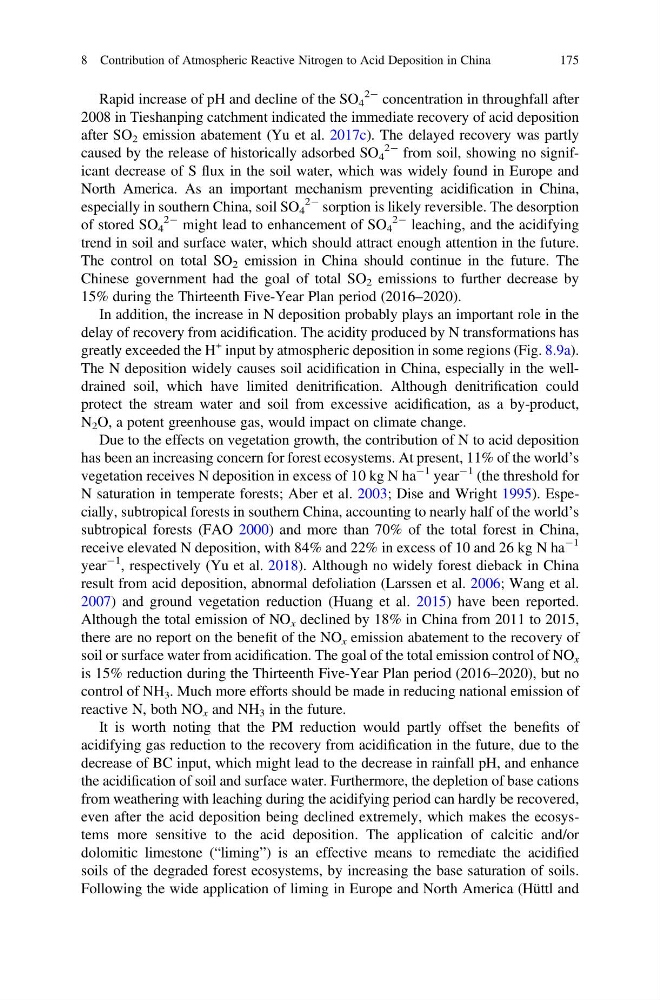
Rapid increase of pH and decline of the SO 4
2À concentration in throughfall after
2008 in Tieshanping catchment indicated the immediate recovery of acid deposition
after SO 2 emission abatement (Yu et al. 2017c). The delayed recovery was partly
caused by the release of historically adsorbed SO 4
2À from soil, showing no significant decrease of S flux in the soil water, which was widely found in Europe and
North America. As an important mechanism preventing acidification in China,
especially in southern China, soil SO 4
2À sorption is likely reversible. The desorption
of stored SO 4
2À might lead to enhancement of SO 4
2À leaching, and the acidifying
trend in soil and surface water, which should attract enough attention in the future.
The control on total SO 2 emission in China should continue in the future. The
Chinese government had the goal of total SO 2 emissions to further decrease by
15% during the Thirteenth Five-Year Plan period (2016–2020).
In addition, the increase in N deposition probably plays an important role in the
delay of recovery from acidification. The acidity produced by N transformations has
greatly exceeded the H
+ input by atmospheric deposition in some regions (Fig. 8.9a).
The N deposition widely causes soil acidification in China, especially in the welldrained soil, which have limited denitrification. Although denitrification could
protect the stream water and soil from excessive acidification, as a by-product,
N 2 O, a potent greenhouse gas, would impact on climate change.
Due to the effects on vegetation growth, the contribution of N to acid deposition
has been an increasing concern for forest ecosystems. At present, 11% of the world’s
vegetation receives N deposition in excess of 10 kg N ha
À1 year
À1 (the threshold for
N saturation in temperate forests; Aber et al. 2003; Dise and Wright 1995). Especially, subtropical forests in southern China, accounting to nearly half of the world’s
subtropical forests (FAO 2000) and more than 70% of the total forest in China,
receive elevated N deposition, with 84% and 22% in excess of 10 and 26 kg N ha
À1
year
À1 , respectively (Yu et al. 2018). Although no widely forest dieback in China
result from acid deposition, abnormal defoliation (Larssen et al. 2006; Wang et al.
2007) and ground vegetation reduction (Huang et al. 2015) have been reported.
Although the total emission of NO x declined by 18% in China from 2011 to 2015,
there are no report on the benefit of the NO x emission abatement to the recovery of
soil or surface water from acidification. The goal of the total emission control of NO x
is 15% reduction during the Thirteenth Five-Year Plan period (2016–2020), but no
control of NH 3 . Much more efforts should be made in reducing national emission of
reactive N, both NO x and NH 3 in the future.
It is worth noting that the PM reduction would partly offset the benefits of
acidifying gas reduction to the recovery from acidification in the future, due to the
decrease of BC input, which might lead to the decrease in rainfall pH, and enhance
the acidification of soil and surface water. Furthermore, the depletion of base cations
from weathering with leaching during the acidifying period can hardly be recovered,
even after the acid deposition being declined extremely, which makes the ecosystems more sensitive to the acid deposition. The application of calcitic and/or
dolomitic limestone (“liming”) is an effective means to remediate the acidified
soils of the degraded forest ecosystems, by increasing the base saturation of soils.
Following the wide application of liming in Europe and North America (Hüttl and
8 Contribution of Atmospheric Reactive Nitrogen to Acid Deposition in China
175
2À concentration in throughfall after
2008 in Tieshanping catchment indicated the immediate recovery of acid deposition
after SO 2 emission abatement (Yu et al. 2017c). The delayed recovery was partly
caused by the release of historically adsorbed SO 4
2À from soil, showing no significant decrease of S flux in the soil water, which was widely found in Europe and
North America. As an important mechanism preventing acidification in China,
especially in southern China, soil SO 4
2À sorption is likely reversible. The desorption
of stored SO 4
2À might lead to enhancement of SO 4
2À leaching, and the acidifying
trend in soil and surface water, which should attract enough attention in the future.
The control on total SO 2 emission in China should continue in the future. The
Chinese government had the goal of total SO 2 emissions to further decrease by
15% during the Thirteenth Five-Year Plan period (2016–2020).
In addition, the increase in N deposition probably plays an important role in the
delay of recovery from acidification. The acidity produced by N transformations has
greatly exceeded the H
+ input by atmospheric deposition in some regions (Fig. 8.9a).
The N deposition widely causes soil acidification in China, especially in the welldrained soil, which have limited denitrification. Although denitrification could
protect the stream water and soil from excessive acidification, as a by-product,
N 2 O, a potent greenhouse gas, would impact on climate change.
Due to the effects on vegetation growth, the contribution of N to acid deposition
has been an increasing concern for forest ecosystems. At present, 11% of the world’s
vegetation receives N deposition in excess of 10 kg N ha
À1 year
À1 (the threshold for
N saturation in temperate forests; Aber et al. 2003; Dise and Wright 1995). Especially, subtropical forests in southern China, accounting to nearly half of the world’s
subtropical forests (FAO 2000) and more than 70% of the total forest in China,
receive elevated N deposition, with 84% and 22% in excess of 10 and 26 kg N ha
À1
year
À1 , respectively (Yu et al. 2018). Although no widely forest dieback in China
result from acid deposition, abnormal defoliation (Larssen et al. 2006; Wang et al.
2007) and ground vegetation reduction (Huang et al. 2015) have been reported.
Although the total emission of NO x declined by 18% in China from 2011 to 2015,
there are no report on the benefit of the NO x emission abatement to the recovery of
soil or surface water from acidification. The goal of the total emission control of NO x
is 15% reduction during the Thirteenth Five-Year Plan period (2016–2020), but no
control of NH 3 . Much more efforts should be made in reducing national emission of
reactive N, both NO x and NH 3 in the future.
It is worth noting that the PM reduction would partly offset the benefits of
acidifying gas reduction to the recovery from acidification in the future, due to the
decrease of BC input, which might lead to the decrease in rainfall pH, and enhance
the acidification of soil and surface water. Furthermore, the depletion of base cations
from weathering with leaching during the acidifying period can hardly be recovered,
even after the acid deposition being declined extremely, which makes the ecosystems more sensitive to the acid deposition. The application of calcitic and/or
dolomitic limestone (“liming”) is an effective means to remediate the acidified
soils of the degraded forest ecosystems, by increasing the base saturation of soils.
Following the wide application of liming in Europe and North America (Hüttl and
8 Contribution of Atmospheric Reactive Nitrogen to Acid Deposition in China
175