

2000–2050 period in response to the changes in anthropogenic emissions under the
RCP2.6, RCP4.5, RCP6.0, and RCP8.5. Annual ground-level O 3 concentration
predicted from the year 2010 to 2050 for every decade relative to 2000 values
under the four RCPs are shown in Fig. 7.7. Under these four RCPs, predicted
changes in annual mean ground-level O 3 levels showed different trends. RCP8.5
predicted the worst scenario for 2020–2030, and RCP6.0 showed the worst situation
over 2040–2050.
Typically, O 3 levels are also significantly higher in the summer than in the winter
(Fig. 7.8). Formation rate of O 3 depends on solar radiation intensity, and thus shorter
light days and insufficient amount of sunlight inhibit O 3 formation in winter (Li et al.
2017a). During spring and summer, higher temperatures and stronger solar radiation
helps to generate many OH radicals, which react with VOC and further enhance rate
of O 3 formation. Furthermore, stratosphere-troposphere exchange processes in
springs and summers also lead to increased O 3 levels (Ou et al. 2015).
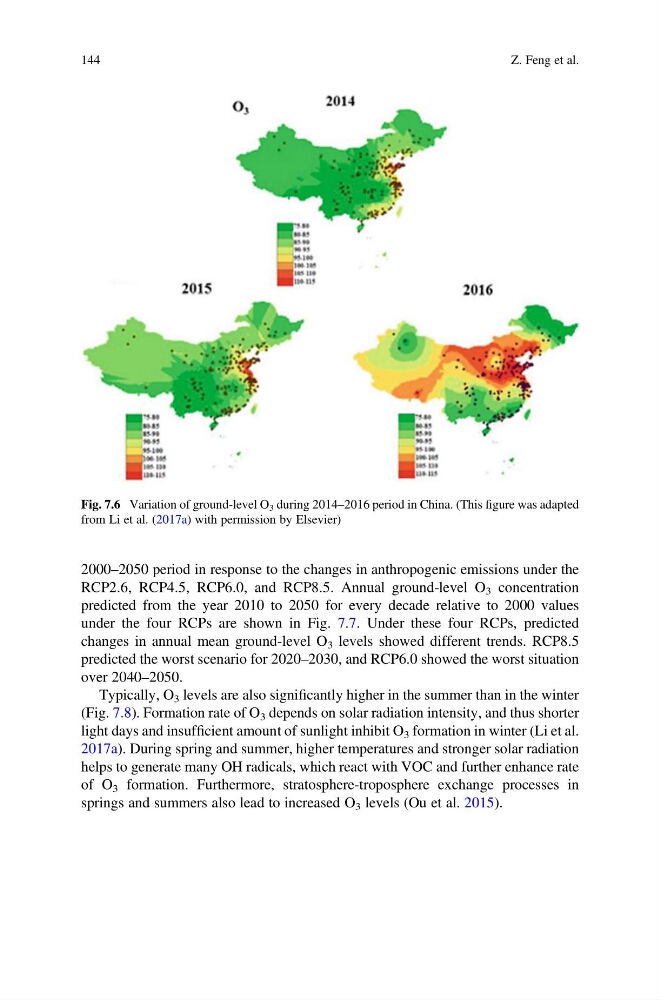
Fig. 7.6 Variation of ground-level O 3 during 2014–2016 period in China. (This figure was adapted
from Li et al. (2017a) with permission by Elsevier)
144
Z. Feng et al.
RCP2.6, RCP4.5, RCP6.0, and RCP8.5. Annual ground-level O 3 concentration
predicted from the year 2010 to 2050 for every decade relative to 2000 values
under the four RCPs are shown in Fig. 7.7. Under these four RCPs, predicted
changes in annual mean ground-level O 3 levels showed different trends. RCP8.5
predicted the worst scenario for 2020–2030, and RCP6.0 showed the worst situation
over 2040–2050.
Typically, O 3 levels are also significantly higher in the summer than in the winter
(Fig. 7.8). Formation rate of O 3 depends on solar radiation intensity, and thus shorter
light days and insufficient amount of sunlight inhibit O 3 formation in winter (Li et al.
2017a). During spring and summer, higher temperatures and stronger solar radiation
helps to generate many OH radicals, which react with VOC and further enhance rate
of O 3 formation. Furthermore, stratosphere-troposphere exchange processes in
springs and summers also lead to increased O 3 levels (Ou et al. 2015).
Fig. 7.6 Variation of ground-level O 3 during 2014–2016 period in China. (This figure was adapted
from Li et al. (2017a) with permission by Elsevier)
144
Z. Feng et al.