

interactions [5] or aromatic radical-pairing interactions [6], solvophobic effect often
in the form of hydrophobic forces [7] expressed in aqueous solutions, hydrogen
bonding [8], electrostatic forces [9], anion binding [10], as well as a variety of van
der Waals interactions [11]. On the other hand, host molecules often have preorganized conformations. As a consequence, host-guest recognition could occur
without too much entropy loss in the cases when the guests have complementary
sizes and geometries to fit within the host cavities. Host-guest recognition enables
many tasks to be accomplished, including labile guest stabilization [12], accelerating
reaction rates [13], as well as developing mechanically interlocked molecules [14].
Besides crown ethers, a few other macrocyclic molecules including cyclodextrins
[15], calixarenes [16], cucurbiturils [17], and pillararenes [18] have been playing
important roles in supramolecular chemistry. In the year of 1988, Sir Fraser Stoddart,
the chemistry Nobel Laureate [19] of 2016 for his contribution in the development of
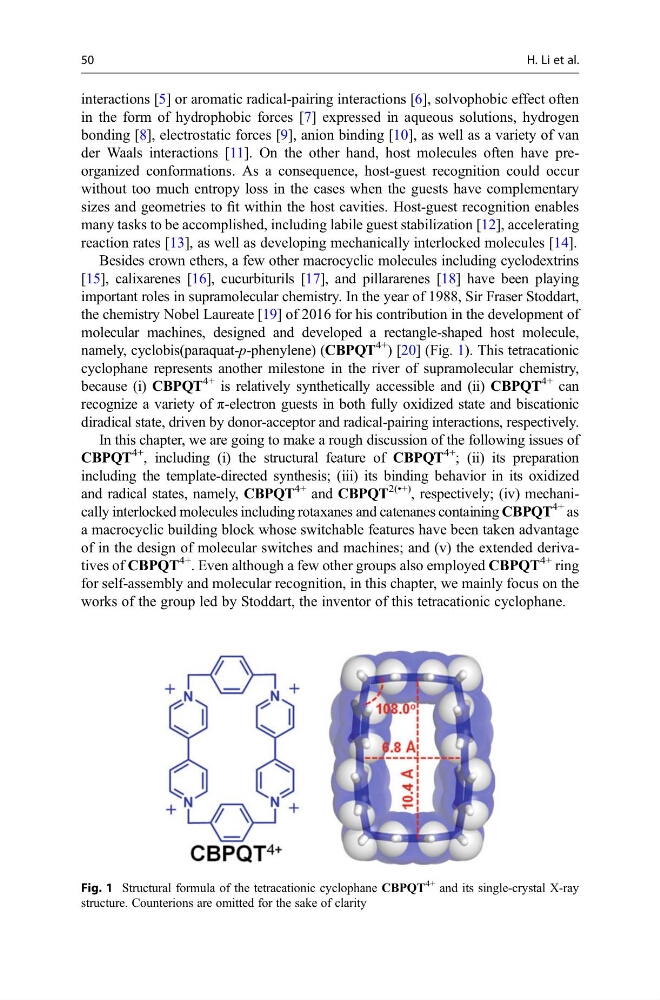
molecular machines, designed and developed a rectangle-shaped host molecule,
namely, cyclobis(paraquat-p-phenylene) (CBPQT
4+
) [20] (Fig. 1). This tetracationic
cyclophane represents another milestone in the river of supramolecular chemistry,
because (i) CBPQT
4+ is relatively synthetically accessible and (ii) CBPQT
4+ can
recognize a variety of π-electron guests in both fully oxidized state and biscationic
diradical state, driven by donor-acceptor and radical-pairing interactions, respectively.
In this chapter, we are going to make a rough discussion of the following issues of
CBPQT
4+
, including (i) the structural feature of CBPQT
4+
; (ii) its preparation
including the template-directed synthesis; (iii) its binding behavior in its oxidized
and radical states, namely, CBPQT
4+ and CBPQT
2(•+)
, respectively; (iv) mechanically interlocked molecules including rotaxanes and catenanes containing CBPQT
4+ as
a macrocyclic building block whose switchable features have been taken advantage
of in the design of molecular switches and machines; and (v) the extended derivatives of CBPQT
4+ . Even although a few other groups also employed CBPQT
4+ ring
for self-assembly and molecular recognition, in this chapter, we mainly focus on the
works of the group led by Stoddart, the inventor of this tetracationic cyclophane.
Fig. 1 Structural formula of the tetracationic cyclophane CBPQT
4+ and its single-crystal X-ray
structure. Counterions are omitted for the sake of clarity
50
H. Li et al.
in the form of hydrophobic forces [7] expressed in aqueous solutions, hydrogen
bonding [8], electrostatic forces [9], anion binding [10], as well as a variety of van
der Waals interactions [11]. On the other hand, host molecules often have preorganized conformations. As a consequence, host-guest recognition could occur
without too much entropy loss in the cases when the guests have complementary
sizes and geometries to fit within the host cavities. Host-guest recognition enables
many tasks to be accomplished, including labile guest stabilization [12], accelerating
reaction rates [13], as well as developing mechanically interlocked molecules [14].
Besides crown ethers, a few other macrocyclic molecules including cyclodextrins
[15], calixarenes [16], cucurbiturils [17], and pillararenes [18] have been playing
important roles in supramolecular chemistry. In the year of 1988, Sir Fraser Stoddart,
the chemistry Nobel Laureate [19] of 2016 for his contribution in the development of
molecular machines, designed and developed a rectangle-shaped host molecule,
namely, cyclobis(paraquat-p-phenylene) (CBPQT
4+
) [20] (Fig. 1). This tetracationic
cyclophane represents another milestone in the river of supramolecular chemistry,
because (i) CBPQT
4+ is relatively synthetically accessible and (ii) CBPQT
4+ can
recognize a variety of π-electron guests in both fully oxidized state and biscationic
diradical state, driven by donor-acceptor and radical-pairing interactions, respectively.
In this chapter, we are going to make a rough discussion of the following issues of
CBPQT
4+
, including (i) the structural feature of CBPQT
4+
; (ii) its preparation
including the template-directed synthesis; (iii) its binding behavior in its oxidized
and radical states, namely, CBPQT
4+ and CBPQT
2(•+)
, respectively; (iv) mechanically interlocked molecules including rotaxanes and catenanes containing CBPQT
4+ as
a macrocyclic building block whose switchable features have been taken advantage
of in the design of molecular switches and machines; and (v) the extended derivatives of CBPQT
4+ . Even although a few other groups also employed CBPQT
4+ ring
for self-assembly and molecular recognition, in this chapter, we mainly focus on the
works of the group led by Stoddart, the inventor of this tetracationic cyclophane.
Fig. 1 Structural formula of the tetracationic cyclophane CBPQT
4+ and its single-crystal X-ray
structure. Counterions are omitted for the sake of clarity
50
H. Li et al.