

drugs by noncovalent interaction or conjugate drug by prodrug strategy. Inorganic
nanoparticles could easily prepare with versatile sizes and shapes, which could
combine with organic or polymeric materials to form composite nanomaterials.
Hydrogel biomaterials are able to be implanted into target tissues and programed
to release encapsulated drugs in a sustained manner.
Macrocyclic hosts are generally used as building blocks in the construction of
DDSs. The use of host-guest chemistry could help design complex DDSs. Stimuliresponsive groups are incorporated into DDS to realize required drug delivery
efficacy. By taking advantage of dynamic nature of host-guest chemistry, we may
introduce complex stimuli responsiveness to DDS design.
23.4.1 Organic/Polymeric Nanoparticles
Organic or polymeric nanoparticles are self-assembled or cross-linked to maintain
nanoscale size. Several organic or polymeric materials are approved for medical use
by the Food and Drug Administration (FDA). Therefore, organic/polymeric nanoparticles are the most widely used type of nanoscale DDSs for clinical use. Some of
the best examples include liposome nanoformulation for doxorubicin and paclitaxel.
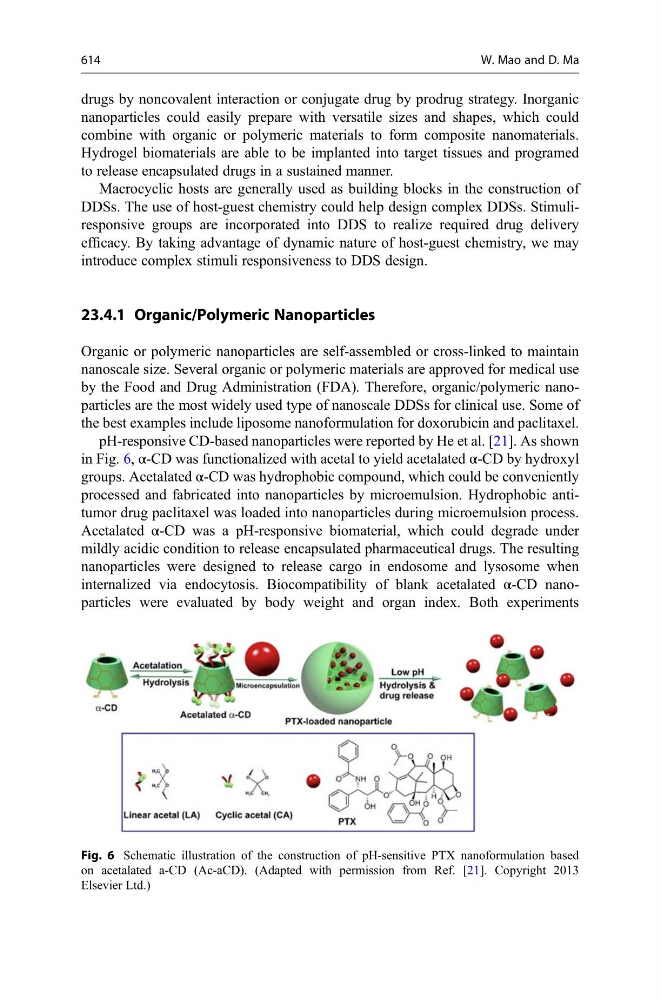
pH-responsive CD-based nanoparticles were reported by He et al. [21]. As shown
in Fig. 6, α-CD was functionalized with acetal to yield acetalated α-CD by hydroxyl
groups. Acetalated α-CD was hydrophobic compound, which could be conveniently
processed and fabricated into nanoparticles by microemulsion. Hydrophobic antitumor drug paclitaxel was loaded into nanoparticles during microemulsion process.
Acetalated α-CD was a pH-responsive biomaterial, which could degrade under
mildly acidic condition to release encapsulated pharmaceutical drugs. The resulting
nanoparticles were designed to release cargo in endosome and lysosome when
internalized via endocytosis. Biocompatibility of blank acetalated α-CD nanoparticles were evaluated by body weight and organ index. Both experiments
Fig. 6 Schematic illustration of the construction of pH-sensitive PTX nanoformulation based
on acetalated a-CD (Ac-aCD). (Adapted with permission from Ref. [21]. Copyright 2013
Elsevier Ltd.)
614
W. Mao and D. Ma