

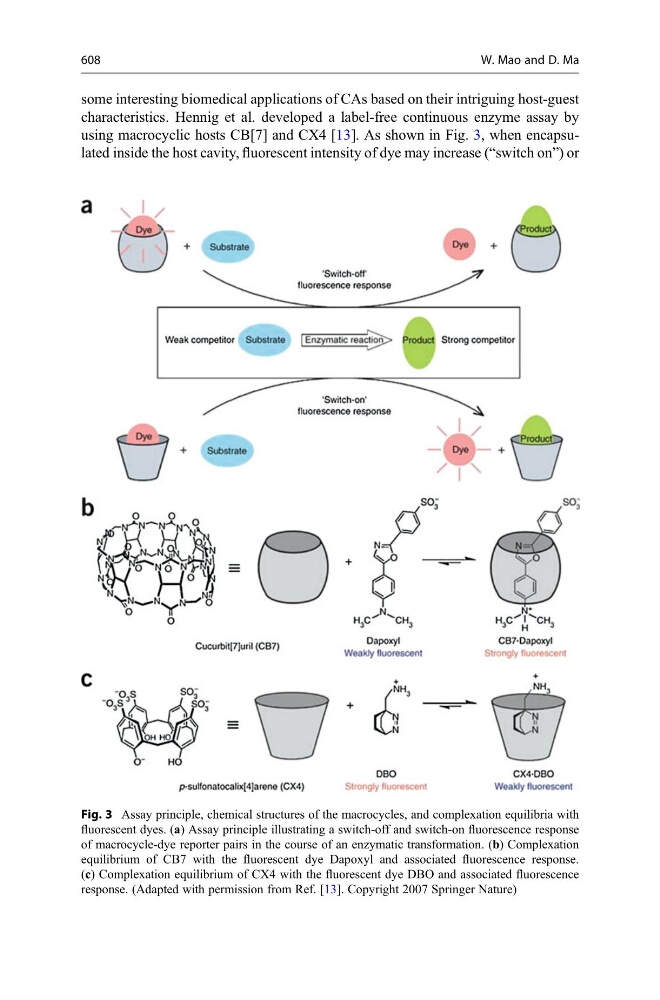
some interesting biomedical applications of CAs based on their intriguing host-guest
characteristics. Hennig et al. developed a label-free continuous enzyme assay by
using macrocyclic hosts CB[7] and CX4 [13]. As shown in Fig. 3, when encapsulated inside the host cavity, fluorescent intensity of dye may increase (“switch on”) or
Fig. 3 Assay principle, chemical structures of the macrocycles, and complexation equilibria with
fluorescent dyes. (a) Assay principle illustrating a switch-off and switch-on fluorescence response
of macrocycle-dye reporter pairs in the course of an enzymatic transformation. (b) Complexation
equilibrium of CB7 with the fluorescent dye Dapoxyl and associated fluorescence response.
(c) Complexation equilibrium of CX4 with the fluorescent dye DBO and associated fluorescence
response. (Adapted with permission from Ref. [13]. Copyright 2007 Springer Nature)
608
W. Mao and D. Ma