

the guest modified monomer (N-adamantane-1-acrylamide) formed hydrogels,
which showed immediate and autonomous self-healing with complete restoration
of the initial adhesion strength at ambient conditions [30]. When polymers are
composed of biodegradable matrices and biocompatible guest moieties, the resulting
supramolecular hydrogels showing biodegradable or biocompatible [32, 33]. For
instance, Yin et al. reported a kind of self-healing hydrogels based on self-assembly
between cholesterol (Chol)-modified triblock-poly(L-glutamic acid)-block-poly(ethylene glycol)-block-poly(L-glutamic acid) ((PLGA-PEG-PLGA)-Chol) and
β-CD-modified ply(L-glutamic acid) (PLGA-β-CD). The macroscopic self-healing
tests and rheological measurements demonstrated that the hydrogels have outstanding self-healing capability. Furthermore, these hydrogels can degrade in vitro. The
degradation time lied on the molecular weight of PLGA. These degradable and
biocompatible self-healing hydrogels provide a fascinating glimpse for the applications in tissue engineering, drug delivery, and other related biomedical fields.
Host-guest interactions between CDs and various guests are sensitive to external
stimulus. Therefore, we can not only control the self-healing behavior by stimulus
but also endow other functions through the association and dissociation of ICs with
CDs and guest molecules to CDs-based hydrogels. For example, Harada group
developed a kind of multifunctional stimuli-responsive supramolecular hydrogels
with coloring and self-healing properties [34]. As shown in Fig. 4, these hydrogels
are prepared using polyacrylamide (PAAm) as the main chain and β-CD and
phenolphthalein (PP) as the side chains. These β-CD-PP AAm hydrogels exhibited
a color change when heat, electric stimuli, or a competing molecular is applied at
a pH less than 8, which were cause by the dissociation of β-CD-PP. In addition, the
β-CD-PP AAm hydrogels showed self-healing properties due to the mobile and
reversible host-guest reformation.
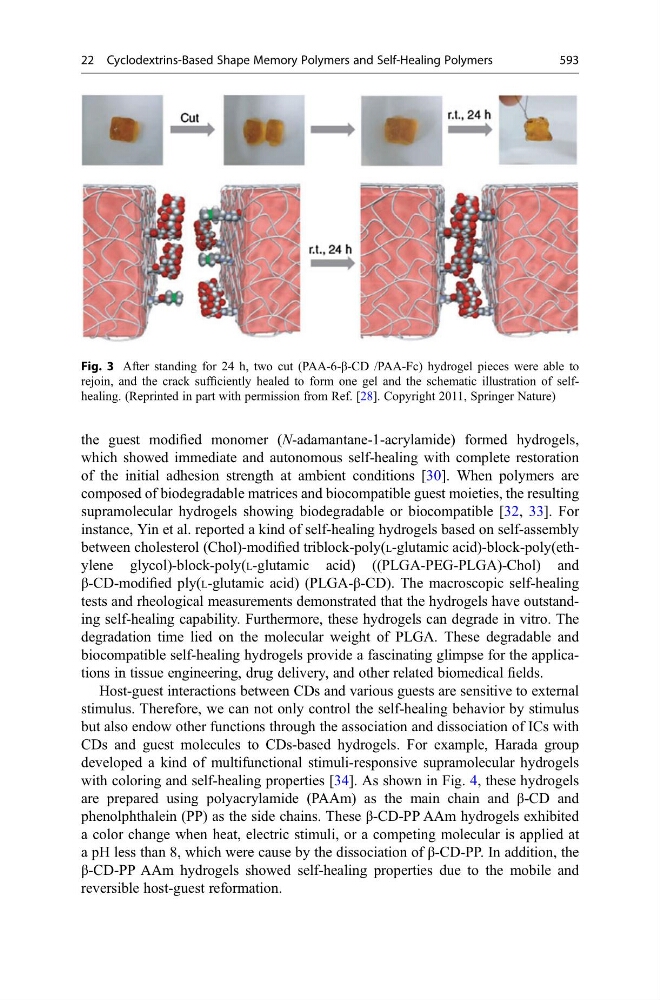
Fig. 3 After standing for 24 h, two cut (PAA-6-β-CD /PAA-Fc) hydrogel pieces were able to
rejoin, and the crack sufficiently healed to form one gel and the schematic illustration of selfhealing. (Reprinted in part with permission from Ref. [28]. Copyright 2011, Springer Nature)
22 Cyclodextrins-Based Shape Memory Polymers and Self-Healing Polymers
593