

developed by cross-linking β-CD-modified chitosan (β-CD-CS) and ferrocene
(Fc)-modified branched ethylene imine polymer (Fc-PEI) [23]. Because β-CDs are
able to include in Fc groups to form ICs, but dissociate with oxidized Fc, the
β-CD-CS/Fc-PEI material was able to recover to its original shape after immersion
in an oxidant solution. Intriguingly, if glucose oxidase (GOD) was immobilized
within the β-CD-CS/Fc-PEI network, the resultant material could show shape
memory behavior in response to glucose. This phenomenon was due to the fact
that GOD oxidized glucose to produce hydrogen peroxide and then oxidized
Fc. Multiresponsive SMPs are also easy to realize using this strategy. For instance,
a temperature-, light-, and chemical-sensitive SMP can be prepared by introducing
α-CD and azobenzene (Azo) into a poly(acrylate acid)/alginate (PAA/ Alg) network
[24]. The host-guest interactions between α-CD and Azo acted as molecular switches
in the material. Because the formation/dissociation of α-CDÀAzo ICs can be
modulated by temperature, light, or chemicals, this material can be processed into
a temporary shape as needed and recover its initial shape under tri-stimuli.
Ritter and co-workers [25] prepared another SMPs based on CD inclusion by
incorporating 2-(N-(adamantan-1-yl)ureido)ethyl-methacrylate (AdMA, as hydrophobic monomer) and N,N-diethylacrylamide (DAM, as thermosensitive monomer)
into the cross-linked polymer networks. The resulted hydrogel can be programmed
to form a temporary shape due to the thermosensitive DAM-based segments and
recover to its original shape after the addition of β-CD. This shape memory effect is
due to the fact that the hydrophobic Ad domains would switch to hydrophilic ICs by
the addition of a sufficient amount of free β-CD. Yan and co-workers reported a poly
Acid
Bending
A: pH 11.5
B: pH 7.0
C: pH 11.5
D: pH 7.0
Bending
Inclusion
Complexes
Base
Acid
Cyclodextrin
DETA
Fix Crosslinks
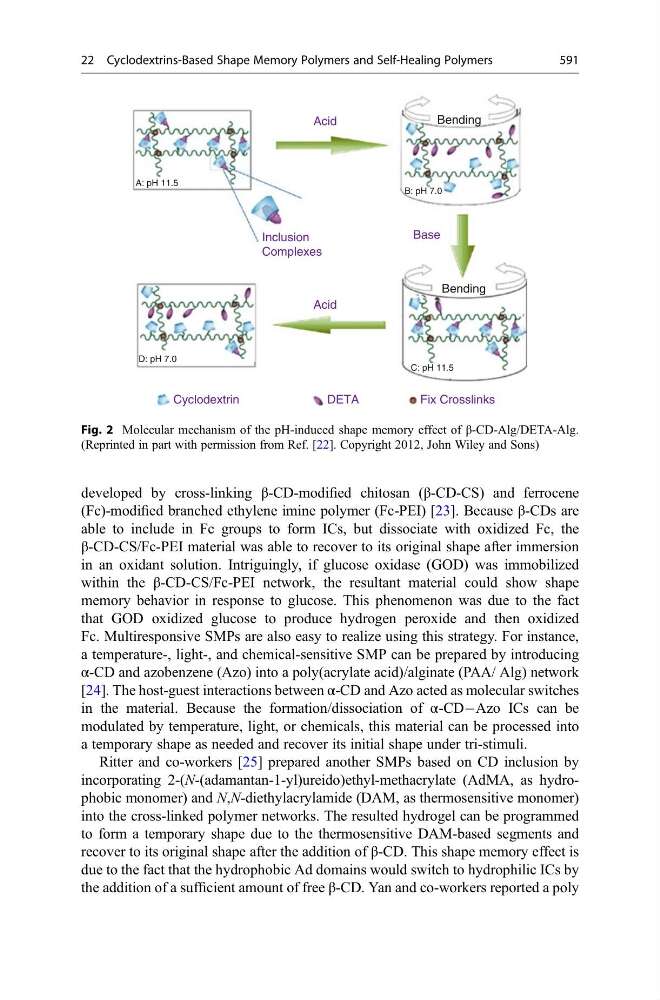
Fig. 2 Molecular mechanism of the pH-induced shape memory effect of β-CD-Alg/DETA-Alg.
(Reprinted in part with permission from Ref. [22]. Copyright 2012, John Wiley and Sons)
22 Cyclodextrins-Based Shape Memory Polymers and Self-Healing Polymers
591