

The shape memory capacity is always described by two parameters: R f and R r .
The shape fixity rate (R f ) describes the ability of the reversible segments to fix the
mechanical deformation, and the shape recovery rate (R r ) quantifies the ability of the
material to recover its original shape [12]. Cyclic mechanical investigation and
bending test are two typical way to quantify the shape memory effect.
22.2.2 SMPs Based on CDs-Polymer Interactions
A lot of polymers such as polyether, polyester, polyalkene, polyaniline, and polysiloxane have been found to be able to form ICs with different types of CDs
[13]. The CDs-polymer ICs have a crystalline structure due to the strong hydrogen
bonding formation between adjacent CDs. These crystalline ICs are thermally stable,
which have no melting behavior but only decompose above 300
[14]. Utilizing this
feature, our group developed a physical way to introduce netpoints into SMPs.
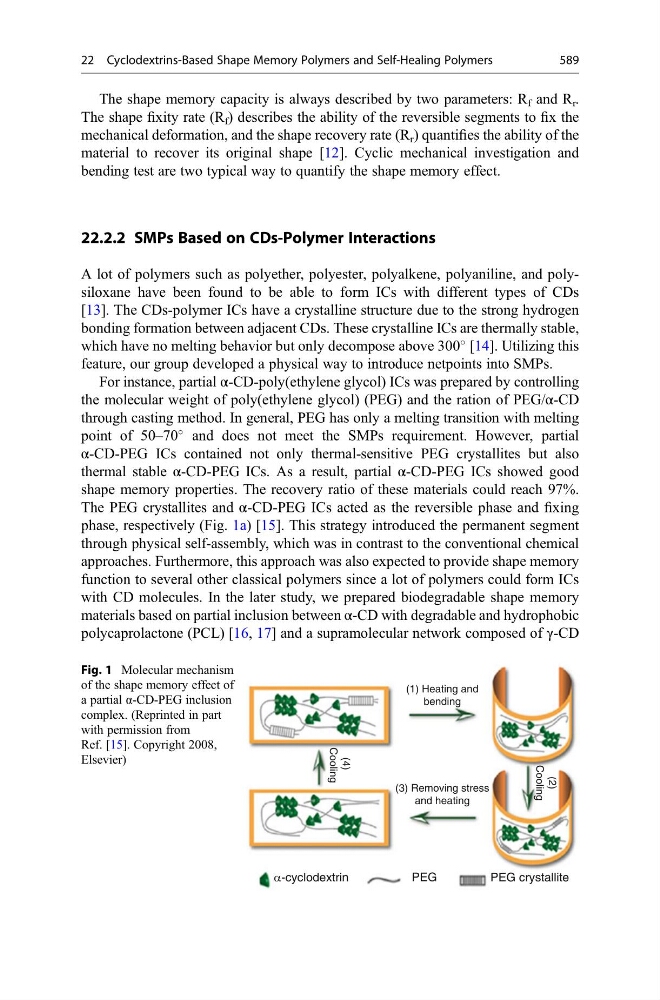
For instance, partial α-CD-poly(ethylene glycol) ICs was prepared by controlling
the molecular weight of poly(ethylene glycol) (PEG) and the ration of PEG/α-CD
through casting method. In general, PEG has only a melting transition with melting
point of 50–70
and does not meet the SMPs requirement. However, partial
α-CD-PEG ICs contained not only thermal-sensitive PEG crystallites but also
thermal stable α-CD-PEG ICs. As a result, partial α-CD-PEG ICs showed good
shape memory properties. The recovery ratio of these materials could reach 97%.
The PEG crystallites and α-CD-PEG ICs acted as the reversible phase and fixing
phase, respectively (Fig. 1a) [15]. This strategy introduced the permanent segment
through physical self-assembly, which was in contrast to the conventional chemical
approaches. Furthermore, this approach was also expected to provide shape memory
function to several other classical polymers since a lot of polymers could form ICs
with CD molecules. In the later study, we prepared biodegradable shape memory
materials based on partial inclusion between α-CD with degradable and hydrophobic
polycaprolactone (PCL) [16, 17] and a supramolecular network composed of γ-CD
(1) Heating and
bending
(3) Removing stress
and heating
(2)
Cooling
α-cyclodextrin
PEG
PEG crystallite
(4)
Cooling
Fig. 1 Molecular mechanism
of the shape memory effect of
a partial α-CD-PEG inclusion
complex. (Reprinted in part
with permission from
Ref. [15]. Copyright 2008,
Elsevier)
22 Cyclodextrins-Based Shape Memory Polymers and Self-Healing Polymers
589