

20.1 Introduction
Supramolecular chemistry, especially host-guest supramolecular chemistry, is
strongly prompted by the development of multi-stimuli and multifunctional supramolecular assemblies, which could dynamically respond to various physical/chemical/biological factors [1, 2]. Among these various assemblies, magnetic
supramolecular assemblies are emerging systems that are constructed by magnetic
building blocks and based on supramolecular interactions and could be sensitively
respond to external magnetic field [3, 4]. Owing to the noninvasive, wireless, and
high-flexible properties, magnetic fields may regulate formation and dynamic
change of magnetic supramolecular assemblies in a biocompatible way, endowing
the assemblies to have potential application in most living systems, especially for
drug delivery and imaging [5, 6, 7, 8].
20.2 Magnetic Building Blocks for Magnetic Supramolecular
Assemblies
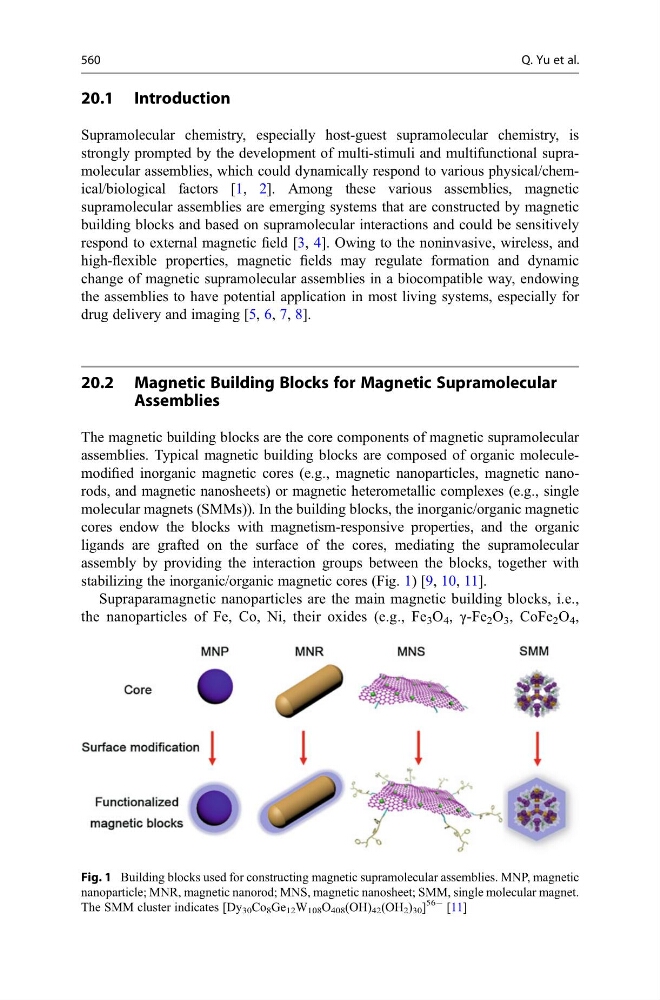
The magnetic building blocks are the core components of magnetic supramolecular
assemblies. Typical magnetic building blocks are composed of organic moleculemodified inorganic magnetic cores (e.g., magnetic nanoparticles, magnetic nanorods, and magnetic nanosheets) or magnetic heterometallic complexes (e.g., single
molecular magnets (SMMs)). In the building blocks, the inorganic/organic magnetic
cores endow the blocks with magnetism-responsive properties, and the organic
ligands are grafted on the surface of the cores, mediating the supramolecular
assembly by providing the interaction groups between the blocks, together with
stabilizing the inorganic/organic magnetic cores (Fig. 1) [9, 10, 11].
Supraparamagnetic nanoparticles are the main magnetic building blocks, i.e.,
the nanoparticles of Fe, Co, Ni, their oxides (e.g., Fe 3 O 4 , γ-Fe 2 O 3 , CoFe 2 O 4 ,
Fig. 1 Building blocks used for constructing magnetic supramolecular assemblies. MNP, magnetic
nanoparticle; MNR, magnetic nanorod; MNS, magnetic nanosheet; SMM, single molecular magnet.
The SMM cluster indicates [Dy 30 Co 8 Ge 12 W 108 O 408 (OH) 42 (OH 2 ) 30 ]
56À [11]
560
Q. Yu et al.