

A variety of polymer structures, such as cyclic, linear, grafted, and branched
polymers, have been reported so far. Compared with traditional polymers, supramolecular polymers show some advantages in the fabrication of responsive or
reversible materials. The development of supramolecular polymers also offers a
platform to construct complex and sophisticated materials via a bottom-up approach.
Supramolecular polymers can be prepared in solution, in gel, and in the solid state.
A dynamic polymer system without cleavage of the covalent bond that undergoes
a topological change is required to transform the polymer topology with sufficient
structural stability similar to that of a covalent compound.
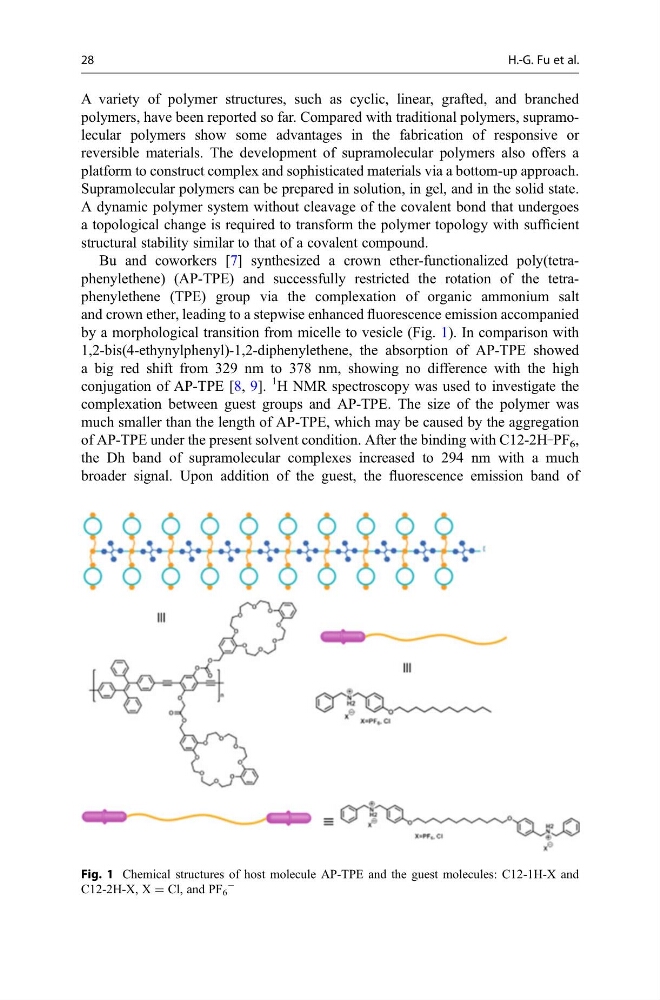
Bu and coworkers [7] synthesized a crown ether-functionalized poly(tetraphenylethene) (AP-TPE) and successfully restricted the rotation of the tetraphenylethene (TPE) group via the complexation of organic ammonium salt
and crown ether, leading to a stepwise enhanced fluorescence emission accompanied
by a morphological transition from micelle to vesicle (Fig. 1). In comparison with
1,2-bis(4-ethynylphenyl)-1,2-diphenylethene, the absorption of AP-TPE showed
a big red shift from 329 nm to 378 nm, showing no difference with the high
conjugation of AP-TPE [8, 9].
1 H NMR spectroscopy was used to investigate the
complexation between guest groups and AP-TPE. The size of the polymer was
much smaller than the length of AP-TPE, which may be caused by the aggregation
of AP-TPE under the present solvent condition. After the binding with C12-2H
_ PF 6 ,
the Dh band of supramolecular complexes increased to 294 nm with a much
broader signal. Upon addition of the guest, the fluorescence emission band of
Fig. 1 Chemical structures of host molecule AP-TPE and the guest molecules: C12-1H-X and
C12-2H-X, X = Cl, and PF 6
À
28
H.-G. Fu et al.
polymers, have been reported so far. Compared with traditional polymers, supramolecular polymers show some advantages in the fabrication of responsive or
reversible materials. The development of supramolecular polymers also offers a
platform to construct complex and sophisticated materials via a bottom-up approach.
Supramolecular polymers can be prepared in solution, in gel, and in the solid state.
A dynamic polymer system without cleavage of the covalent bond that undergoes
a topological change is required to transform the polymer topology with sufficient
structural stability similar to that of a covalent compound.
Bu and coworkers [7] synthesized a crown ether-functionalized poly(tetraphenylethene) (AP-TPE) and successfully restricted the rotation of the tetraphenylethene (TPE) group via the complexation of organic ammonium salt
and crown ether, leading to a stepwise enhanced fluorescence emission accompanied
by a morphological transition from micelle to vesicle (Fig. 1). In comparison with
1,2-bis(4-ethynylphenyl)-1,2-diphenylethene, the absorption of AP-TPE showed
a big red shift from 329 nm to 378 nm, showing no difference with the high
conjugation of AP-TPE [8, 9].
1 H NMR spectroscopy was used to investigate the
complexation between guest groups and AP-TPE. The size of the polymer was
much smaller than the length of AP-TPE, which may be caused by the aggregation
of AP-TPE under the present solvent condition. After the binding with C12-2H
_ PF 6 ,
the Dh band of supramolecular complexes increased to 294 nm with a much
broader signal. Upon addition of the guest, the fluorescence emission band of
Fig. 1 Chemical structures of host molecule AP-TPE and the guest molecules: C12-1H-X and
C12-2H-X, X = Cl, and PF 6
À
28
H.-G. Fu et al.