

reactions, but immediately and efficiently accessible via photochemical reactions.
Asymmetric photochemistry has thus attracted much attention as an alternative or
complementary synthetic route to such compounds [1]. However, electronically
excited organic molecules generated by photoirradiation are short-lived and highly
reactive compared with the corresponding ground-state molecules, and hence difficult to maintain long-lasting stable chiral intra- and intermolecular interactions,
rendering the stereochemical control in the excited state highly challenging. Indeed,
the early photochirogenic endeavors in isotopic media encountered rather disappointing results, affording only low-modest enantioselectivities that are obviously
insufficient for practical applications [1]. Later studies have however revealed that
the enantioselectivity of some chiral compounds, such as (E)-cyclooctene, can be
greatly improved by optimizing the structure of chiral sensitizer and the environmental factors [2].
A more versatile and promising approach is the use of chiral supramolecular host
as a tool for manipulating the stereochemical outcomes of asymmetric photoreactions [2–6]. Chiral host basically accommodates one, but sometimes more, guest
substrates in its cavity through noncovalent interactions, providing the perpetual
chiral environment for preorganizing the substrate(s) and also for transferring the
supramolecular chirality to the included substrate(s) in the excited state. Indeed, a
vast variety of chiral supramolecular systems have hitherto been exploited as the
environment for photochirogenesis, which include chirally modified zeolites [7],
cyclodextrins (CDs) [8], chiral hydrogen-bonding templates [9, 10], chiral liquid
crystals [11], and chiral supramolecular gels [12].
Possessing good water-solubilities and hydrophobic cavities suitable for accommodating small to medium-sized organic molecules [13], commercially available α-,
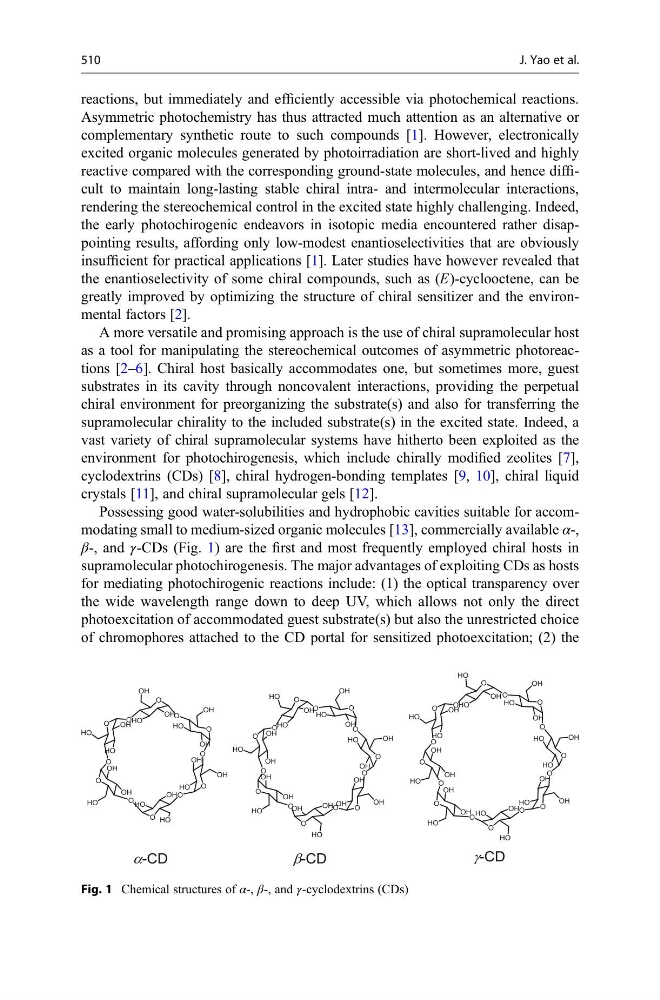
β-, and γ-CDs (Fig. 1) are the first and most frequently employed chiral hosts in
supramolecular photochirogenesis. The major advantages of exploiting CDs as hosts
for mediating photochirogenic reactions include: (1) the optical transparency over
the wide wavelength range down to deep UV, which allows not only the direct
photoexcitation of accommodated guest substrate(s) but also the unrestricted choice
of chromophores attached to the CD portal for sensitized photoexcitation; (2) the
Fig. 1 Chemical structures of α-, β-, and γ-cyclodextrins (CDs)
510
J. Yao et al.